Reducing the environmental footprint of Brazilian beef
Posted on Tuesday 16 May 2017
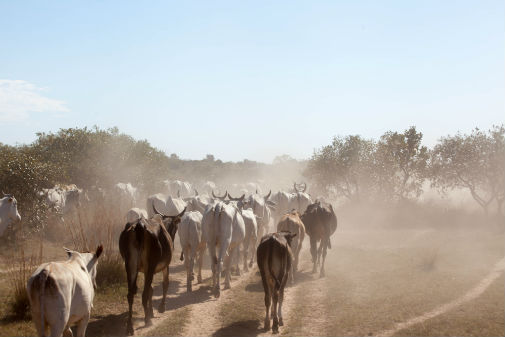
Cattle in Brazil
Researchers from the University of York, Scotland’s Rural College and the Brazilian Agricultural Research Corporation, have published a paper on how the country’s farmers can meet the rising demands for beef without increasing the amount of farming space used.
The paper, ‘Sustainable intensification of Brazilian livestock production through optimised pasture restoration’ has been published as part of the Agricultural Systems journal.
Global demand
The scientists have outlined plans to optimise Brazilian grazing pastures in order to increase beef productivity while reducing greenhouse gas emissions.
Researchers estimate that global demands for livestock products will double by 2050, a shift which is leading to calls for agricultural industries to adopt sustainable farming methods.
The team, which included Professor Dominic Moran of the N8 Research Partnership’s AgriFood programme, has now developed a method for restoring many of Brazil’s degraded grassland areas.
It is estimated that over half of Brazil’s pastures are currently degraded and, if restored, could transform the country’s beef production systems.
Sustainable intensification in Brazil is also believed to be necessary in order to maintain the current low deforestation levels in areas such as the Amazon and the Cerrado.
Sustainable
Prof Moran, N8 AgriFood’s chair in Resilient Food Supply Chains at the University of York, said: “Brazil has the potential to lead the way for global sustainable intensification in beef production.
“This paper focused on how we can apply the method to many of the country’s degraded farming fields, as well as outlining the benefits that this will bring to both the farming industry and environment.
“Through the optimisation of Brazilian grasslands, we can supply the growing demand for beef and also reduce greenhouse gas emission levels.”
Further information
- The other authors of the paper include Rafael de Oliveira Silva, University of Edinburgh; Luis Gustavo Barioni, Brazilian Agricultural Research Corporation; J.A. Julian Hall, University of Edinburgh; Professor Antonio Carlos Moretti, University of Campinas; Rui Fonseca Veloso, Brazilian Agricultural Research Corporation; Dr Peter Alexander, University of Edinburgh and Mariane Crespolini, University of Campinas.