York professors elected Fellows of the Royal Society
Posted on Tuesday 20 May 2025
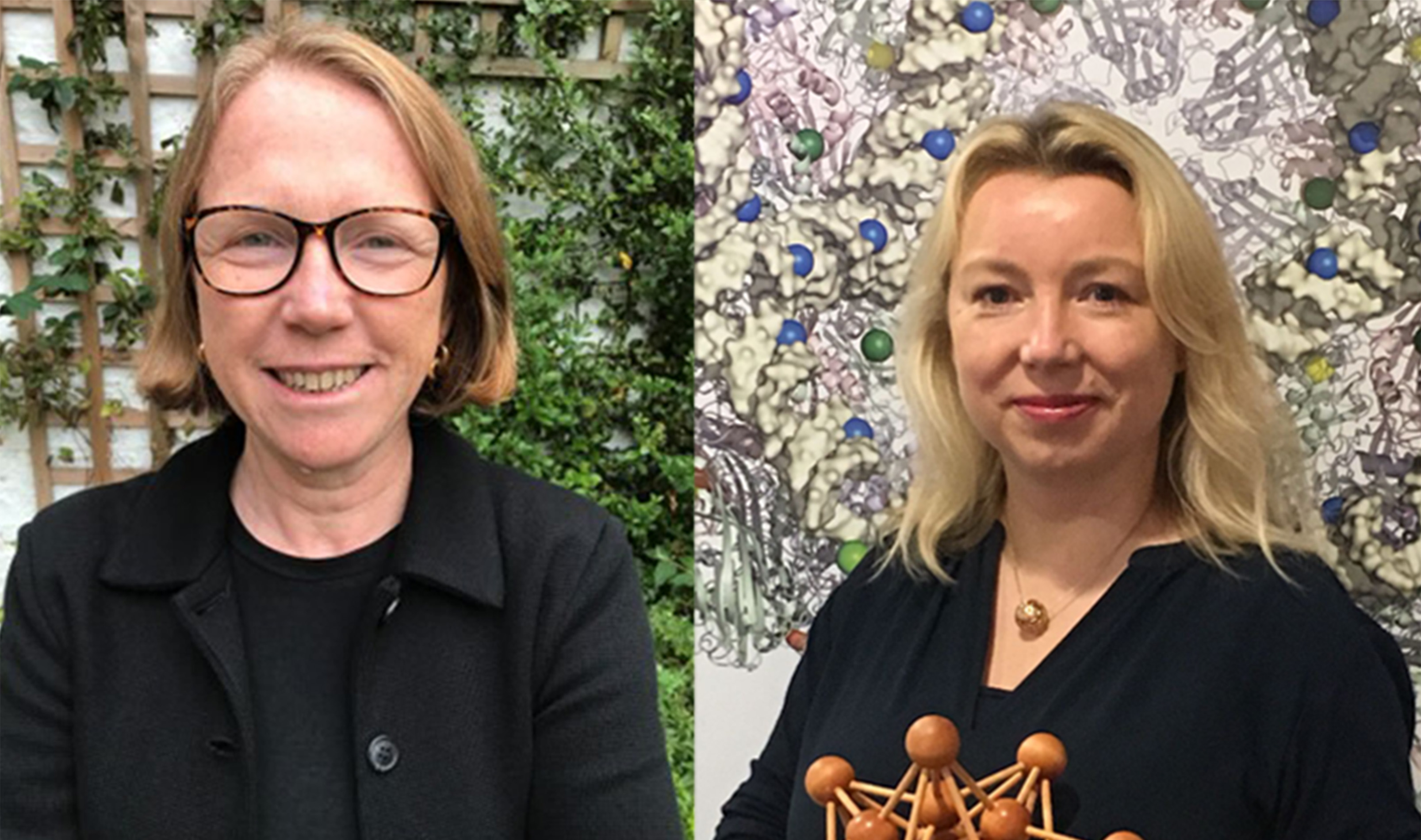
Professor Jane Hill and Professor Reidun Twarock are recognised for their scientific advancements that have made a real-world impact.
As the oldest continuously existing scientific academy in the world, The Royal Society elects Fellows that have made a substantial contribution to the improvement of natural knowledge, including mathematics, engineering science and medical science.
Mathematical virology
Professor Twarock pioneered mathematical virology, a unique combination of mathematics, biophysics and bioinformatics.
Her “mathematical microscope” has enabled discoveries in virology through the “lens of viral geometry”. Most importantly, her work was instrumental in deciphering the “assembly code” in collaboration with Professor Peter Stockley from Leeds that provides instructions for the formation of viral particles from their molecular components.
Professor Twarock, from the departments of Mathematics and Biology, said: "I am delighted and grateful to be elected to the Fellowship of the Royal Society.
“This comes at a very exciting time when discoveries enabled by my ‘mathematical microscope’ are taken up by industry, contributing to the mission of the University of York as a University for Public Good.
“This recognition is not only a reflection of my own work, but also that of the many talented PhD students, postdocs, and colleagues I had, and in many cases still have, the pleasure of sharing this journey with."
Improving biodiversity
Professor Jane Hill studies the impact of changes in habitat, climate and forest fragmentation on species, in both tropical and temperate ecosystems.
Her focus is on how current environmental challenges can be improved, and her research has shown that habitat connectivity can help boost local species richness, range expansion and diversity.
In addition, Professor Hill also runs studies testing the impact of sustainability certification schemes as well as investigating how palm oil can be produced more sustainably.
Professor Hill, from the Department of Biology, said: “I'm delighted to be elected as a Fellow of the Royal Society. As a member of the Department of Biology, and more recently as a member of the Leverhulme Centre for Anthropocene Biology at York, I have the privilege of collaborating with fabulous colleagues.
“I am an ecologist and my research examines the ecological processes that determine where species occur, trends in their abundances, and the consequences for biodiversity. I'm particularly interested in butterflies and moths and sometimes can't quite believe that my childhood fascination with these insects would develop into an exciting and hugely rewarding research career.”
Professor James Chong, Head of the Department of Biology, said: “It's fantastic to see the outstanding contributions of two Biology colleagues being recognised by the Royal Society.
“As well as being excellent role models, Jane and Reidun illustrate the breadth and depth of world-leading science supported at the University of York.”
Trailblazers
This year’s cohort of Royal Society Fellows includes trailblazers across a wide range of fields, from artificial intelligence and electron microscopy to global health and neuroscience.
Among them are a public health expert working to prevent HIV in young women, a Nobel Prize winner whose team created the transformative AI model, AlphaFold, an immunologist whose work has led to new insights into how the immune system can distinguish between ‘good’ and ‘bad’ microbes, and the first Sudanese scientist to be elected to the Fellowship.
Sir Adrian Smith, President of the Royal Society, said: “The achievements of the Fellows represent the very best of scientific endeavour, from basic discovery to research with real-world impact across health, technology and policy.”
The Fellows and Foreign Members of the Royal Society join the ranks of Stephen Hawking, Isaac Newton, Charles Darwin, Albert Einstein, Lise Meitner, Subrahmanyan Chandrasekhar and Dorothy Hodgkin.