From quantum leaps to improving patient care: Celebrating the achievements of our researchers in driving positive change
Posted on Tuesday 9 December 2025
This year, more than 200 University of York academics were recognised in the Stanford/Elsevier list of the world's top 2% most-cited scientists, highlighting the remarkable breadth and collaborative strength of our research community across all faculties at York.
Alongside this, York academics are winning prestigious national and international awards in vital fields – from the climate crisis and quantum technology to social care and children’s cancers – demonstrating how our experts are driving positive change where it matters most.
Vice-Chancellor Professor Charlie Jeffery said: “Our vision as a University for Public Good is built on the foundations of world-class academic quality. To see so many colleagues recognised this year – by citation metrics and the highest honours from learned societies – is a testament to the intellectual vibrancy of our community.
“Whether they are decoding viruses or shaping national policy, these awards demonstrate that York researchers are not just participating in the global conversation; they are leading it, finding tangible solutions to the profound challenges facing our world.”
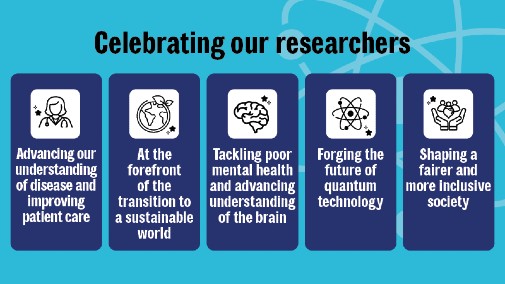
Here we celebrate our researchers for:
- Advancing understanding of disease and improving patient care
- Being at the forefront of the transition to a sustainable world
- Tackling poor mental health and advancing understanding of the brain
- Forging the future of quantum technology
- Shaping a fairer and more inclusive society
1. From viruses to cancer, York researchers are advancing our understanding of disease and improving patient care
Our researchers are decoding the “assembly code” of viruses to stop them at the source, developing new antiviral strategies, pioneering research into blood cancer and leading global-impact trials that change how surgeons operate and how doctors care for children with cancer.
- Professor Reidun Twarock (Fellow of the Royal Society): Recognised for her remarkable achievements in the field of mathematical virology. Her "mathematical microscope" has deciphered the assembly code of viruses – the instructions that dictate how a virus is constructed from its basic building blocks.
- Dr Chris Hill has been awarded the Lister Institute Research Prize, one of the most prestigious prizes for early-career biomedical scientists, receiving funding to lead innovative research into how RNA viruses (like SARS-CoV-2 and polio) hijack human cells, paving the way for novel antiviral strategies.
- Professor David Kent (Fellow of the Academy of Medical Sciences): Elected for his “remarkable contributions” as a leading stem cell biologist. His collaborative work, described as “revolutionary in his field,” includes advancing our knowledge of how blood cancer evolves and co-developing a new method to “barcode” stem cells.
- Professor Amar Rangan (Fellow of the Academy of Medical Sciences): Honoured as a leading figure in surgical research whose UK-wide multicentre trials have had “global impact, influencing clinical practice and policy” in orthopaedic surgery, ensuring better outcomes for patients.
- Professor Bob Phillips (RCPCH Member Award): Celebrated by the Royal College of Paediatrics for his "transformative" work in child health. His leadership in making complex evidence accessible has supported hundreds of clinicians, launched research careers and improved care for children with cancer.
- Dr. Nicola O'Donnell (William Inman Prize 2025): An honour presented only once every five years by The British Psychological Society (BPS), the award recognises her outstanding PhD research, funded by the Childhood Eye Cancer Trust, which explored the long-lasting psychological challenges, including survivor's guilt and treatment memories, faced by survivors of the rare childhood eye cancer, Retinoblastoma.
2. York researchers are at the forefront of the transition to a sustainable world
Our scientists are in the rainforests and at the policy-making table, driving crucial changes in environmental management, protecting biodiversity and championing climate justice on a global scale.
- Professor Jane Hill (Fellow of the Royal Society): Elected as a Fellow for her world-leading research as an ecologist. Her work on how climate and habitat changes affect biodiversity has provided the critical evidence needed to improve conservation strategies and inform sustainable practices for global industries.
- Professor Lindsay Stringer (MBE, King's Birthday Honours): Awarded a national honour for her pioneering research into the intricate links between people and the environment. Her work is explicitly recognised for having “directly driven crucial policy changes” in land management, climate change and livelihoods.
- Professor Rob Marchant (Fellow of The African Academy of Sciences): Recognised with a "rare honour" for an international academic, highlighting his vital work in coordinating and strengthening science across the African continent to tackle the global challenge of climate change.
3. York researchers are tackling poor mental health and advancing our understanding of the brain
Our academics are tackling the mental health crisis, exploring the links between sleep and trauma, defining the neural basis of memory and applying the science of perception to improve forensic security.
- Professor Beth Jefferies (Fellow of the British Academy): Elected to the UK's national academy for the humanities and social sciences for her outstanding contributions to cognitive neuroscience. She is recognised as a world leader in understanding the neural basis of memory and language.
- Professor Simon Gilbody (once again recognised in the global top 1% of most cited scientists): For demonstrating significant and broad influence in his field of research, developing scalable solutions to mental health challenges such as anxiety and depression.
- Dr Scott Cairney (BAP Senior Translational Research Award): Recognised by the British Association for Psychopharmacology for his important contributions to “translating fundamental scientific knowledge into societal benefits,” specifically his work on the neurocognitive links between sleep and mental health (such as anxiety and mood disorders).
- Professor Mike Burton (BPS Lifetime Achievement Award): Winner of the British Psychological Society's highest research award, celebrating his “impressive and impactful career” in psychological research. His work on face perception has crucial applied value in forensic science and security.
4. York researchers are forging the future of quantum technology
York is at the forefront of the UK's quantum revolution. Our researchers are providing the “landmark contributions” that will underpin the next generation of computing, setting the theoretical limits for quantum security and defining the foundations of quantum physics.
- Professor Stefano Pirandola (IET Achievement Medal): A top international award from the Institution of Engineering and Technology for his “exceptional contribution” to quantum technology. His groundbreaking research has set the theoretical limits for quantum communications, security and networks.
- Professor Chris Fewster (the Paul Ehrenfest Best Paper Award): A prestigious international prize for a paper deemed a "landmark contribution" to quantum physics. His work provides a new, solid framework for understanding quantum mechanics.
5. York researchers are breaking down barriers to opportunity and shaping a fairer and more inclusive society
Our research is providing the critical insights to build a fairer, stronger, and more inclusive society. We are shaping national policy on social care, challenging structural injustice, and ensuring our legal, business, and educational systems work for everyone.
- Three new Fellows of the Academy of Social Sciences were recognised for:
- Professor Yvonne Birks: A leading figure shaping national social care policy as Director of the NIHR School for Social Care Research.
- Professor Kiran Trehan: A leader in enterprise research who champions inclusive economic growth and women's enterprise.
- Professor Teresa da Silva Lopes: A groundbreaking researcher informing businesses and policymakers on how institutions can succeed in a global economy.
- Dr Alasia Nuti (Richard Rose Prize): Named a “rising star” in political studies, winning this prize for her “paradigm-shifting” scholarship on structural injustice, anti-liberalism and gender.
- Dr Kevin Tennent (Medal for Contribution to Communities): Awarded by the British Academy of Management (BAM) – The leading authority in the academic field of management – for “being an outstanding leader in the field”.
- Anthony V. Capildeo (Windham-Campbell Prize): The University of York Writer-in-Residence was awarded the prestigious Windham-Campbell Prize for poetry. One of the world's most significant global literary awards, it recognises exceptional literary achievement, contributing to a richer and more diverse cultural landscape.
- Professor Phillip Morgan (Deputy District Judge): A "rare and distinguished achievement for an academic," this judicial appointment highlights York's unique ability to bridge the gap between academic theory and high-level legal practice, enriching both teaching and research.
- Professor Ruth Penfold-Mounce (National Teaching Fellowship): Awarded in recognition of her pioneering teaching approaches, which use creative technology (like award-winning podcasts) to transform student learning.
- Dr Emma Casey (CHOICE Outstanding Academic Title 2025): Her book, The Return of the Housewife, was named a "best-of-the-best" academic title. It critically examines the world of social media "cleanfluencers" to ask why, despite decades of progress, the burden of domestic labour still falls disproportionately on women.
- Dr Lindsey Büster (UKRI Future Leaders Fellow): Awarded a fellowship from the UK's flagship fund for the most talented researchers and innovators to lead new, cutting-edge research on the archaeology of aging.
- Professor Jim Leary (2025 Openbook Best Book Award): Won 'Translation of the Year' for his book Footprints, which explores the archaeology of movement. Praised for its "humanistic spirit," the book examines how ancient paths of migration, resistance, and freedom connect us to our ancestors, offering vital philosophical reflections on community and human connection in our modern age.
- Professor Caroline Dessent, Professor Avtar Matharu, Dr Leonie Jones, Professor David Smith, Dr Kelechi Uleanya, Dr Samantha Furfari, Dr Ruhee Dawood, Dr Kgato Selwe, Amelia Milner (The Royal Society of Chemistry Horizon Education Award): This team from the Department of Chemistry have been recognised for their innovative work to decolonise the chemistry curriculum, ensuring a more inclusive environment for future scientists.