First prehistoric person with Turner syndrome identified from ancient DNA
Posted on Thursday 11 January 2024
The team from the University of York, the Francis Crick Institute, University of Oxford and Oxford Archaeology, developed a new technique to measure the number of chromosomes in ancient genomes more precisely.
This method not only helped them identify the first person with mosaic Turner syndrome, but also the earliest known person with Jacob’s syndrome - characterised by an extra Y chromosome - in the Early Medieval Period; three people with Klinefelter syndrome - characterised by an extra X chromosome - across a range of time periods; and an infant with Down Syndrome from the Iron Age.
Delayed development
Most cells in the human body have 23 pairs of DNA molecules called chromosomes, and the sex chromosomes are typically XX (female) or XY (male), although there are differences in sexual development.
‘Aneuploidy’ occurs when a person’s cells have an extra or missing chromosome. If this occurs in the sex chromosomes, a few differences like delayed development or changes in height can be seen around puberty.
Professor Ian Armit, from the University of York’s Department of Archaeology, said: “Ancient DNA samples decay over time and can often become contaminated, which makes it difficult to accurately capture differences in the number of sex chromosomes.
“A new technique was needed to help researchers overcome these challenges so that we could see just how far back we can trace these conditions, and we now know that they have been part of human history for a considerable period of time - more than 2,000 years in some cases.”
Large dataset
As part of their research published today in Communications Biology, researchers developed a computational method which aims to pick up more variation in sex chromosomes. For the sex chromosomes, it involves counting the number of copies of X and Y chromosomes, and comparing the outcome that you might expect to see.
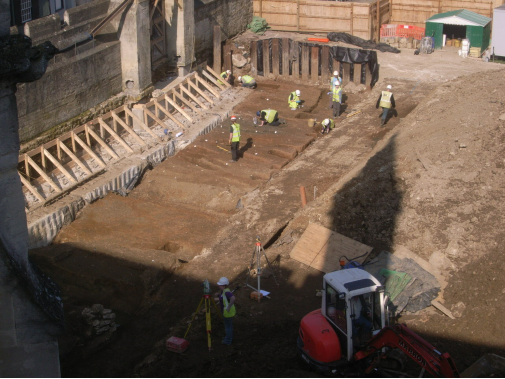
The team used the new method to analyse ancient DNA from a large dataset of individuals collected as part of the Thousand Ancient British Genomes project across British history, identifying six individuals with aneuploidies across five sites in Somerset, Yorkshire, Oxford and Lincoln.
The individuals lived across a range of time periods, from the Iron Age (2500 years ago) up to the Post-Medieval Period (about 250 years ago).
They identified five people who had sex chromosomes which fell outside of the XX or XY categories. All were buried according to their society’s customs although no possessions were found with them to shed more light on their lives.
Bone detail
The three individuals with Klinefelter syndrome lived across very different time periods, but they shared some similarities - all were slightly taller than average and showed signs of delayed development in puberty.
By investigating details on the bones, the research team could see that it was unlikely that the individual with Turner syndrome had gone through puberty and started menstruation, despite their estimated age of 18-22. Their syndrome was shown to be mosaic - some cells had one copy of chromosome X and some had two.
Ancient DNA
Pontus Skoglund, Group Leader of the Ancient Genomics Laboratory at the Crick, said: “Our method is able to classify DNA contamination in many cases, and can help to analyse incomplete ancient DNA, so it could be applied to archaeological remains which have been difficult to analyse.
“Combining this data with burial context and possessions can allow for a historical perspective of how sex, gender and diversity were perceived in past societies. I hope this type of approach will be applied as the common resource of ancient DNA data continues to grow.”
The team also worked with archaeologists from the University of Bradford, York Osteoarchaeology and Network Archaeology, acknowledging support from Lincolnshire County Council, Magdalen College and Balfour Beatty for National Highways.