Butterflies mimic each other’s flight behaviour to avoid predators
Posted on Monday 26 February 2024
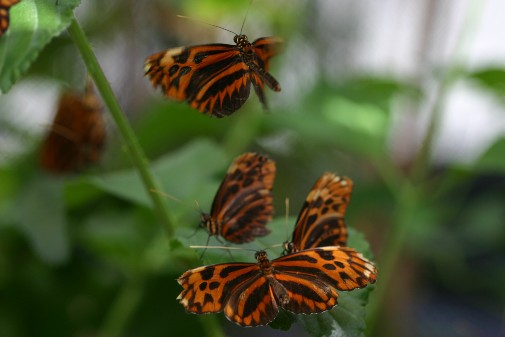
It is well known that many inedible species of butterfly have evolved near identical colour patterns, which act as warning signals to predators so the butterflies avoid being eaten.
Researchers from the University of York have now shown that these butterflies have not only evolved similar colour patterns, but that they have also evolved similar flight behaviours, which together make a more effective warning signal to predators.
Using high-speed video footage to record the flight of wild butterflies in South America, researchers measured the wing beat frequency and wing angles of 351 butterflies, representing 38 species each belonging to one of 10 distinct colour pattern mimicry groups.
Distant relatives
Using this dataset they investigated how the flight patterns of butterflies are related to factors such as habitat, wing shape, temperature and which colour pattern 'mimicry group' the butterfly belongs to see which elements most heavily affected flight behaviour.
Although the species habitat and wing shape were expected to have the greatest influence on flight behaviour, the researchers found that in fact the biggest determinant of flight behaviour was the colour pattern mimicry group a butterfly belonged to.
This means that distantly-related butterflies belonging to the same colour pattern mimicry group have more similar flight behaviour than closely-related species that display different warning coloration. To a predator, the butterflies would not only look the same through their colour patterns, but would also move in the same way.
Nasty taste
Edd Page, PhD student from the Department of Biology at the University of York and one of the lead authors of the study, said: “From an evolutionary perspective it makes sense to share the colour pattern between species, to reduce the individual cost of educating predators to the fact that they don’t taste nice!
“Once a predator has tasted one, the visual clues on others indicate that they too are also inedible, but flight patterns are more complex and are influenced by several other factors such as the air temperature and the habitat the species fly in.
“We wanted to see whether flight corresponded to colour - could predators be driving the mimicry of flight as well as colour patterns? We were surprised to find just how strong and widespread the behavioural mimicry is.”
70 millions years ago
The team looked specifically at a tribe of butterflies called the Heliconiini, which have around 100 species and subspecies distributed around the Neotropics, each belonging to one of several distinct colour pattern mimicry groups.
They also investigated a few species from the ithomiine butterfly tribe, which split from the Heliconiini about 70 million years ago, yet some of whom have very similar ‘Tiger’ colour patterns.
Edd said: “Sharing flight behaviour across multiple species seems to reinforce this ‘don’t eat me’ message. It is fascinating that this behaviour has evolved between distant relatives over a long period of time, but we can also see flight behaviour diverging between differently patterned populations within a species over a relatively short period of time too."
Subtle changes
Professor Kanchon Dasmahapatra, from the University of York’s Department of Biology, said: “The extent of flight mimicry in this group of butterflies is amazing. It is a great example of how evolution shapes behaviour, with selection from predators driving subtle changes which enhance the survival of individuals.
“The challenge and interest now is to identify the genes causing these changes, which will tell us how such behavioural mimicry evolves.”