Could AI and robotics reduce emergency room waiting time?
Posted on Tuesday 20 February 2024
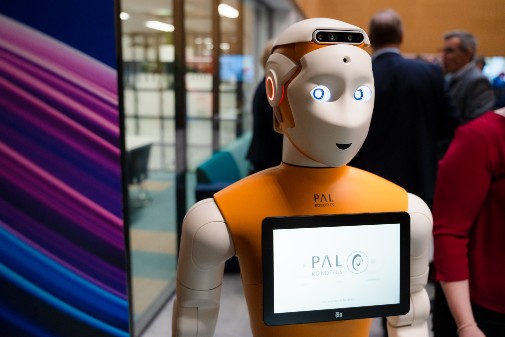
The project investigates the use of AI software to collect patient data including symptoms and vital signs such as body temperature and pulse rate, with a ‘social robot’ guiding patients who consent to use this service in the emergency room.
The social robot will provide instructions on how the patients can use the medical equipment to measure their own vital signs. It is hypothesised that the interaction with the robot at the triage stage could make communication more effective, reducing patient waiting time and easing the workload pressures on medics.
Patient safety
The project team - led by Professor Radu Calinescu from the University of York’s Department of Computer Science and Institute for Safe Autonomy, and Dr Tunde Ashaolu, Emergency Medicine Consultant at York and Scarborough Teaching Hospitals NHS Foundation Trust - will work to understand the social, legal, ethical, empathetic, and cultural norms, concerns and tensions associated with the use of AI and social robotics, working closely with clinicians and patients to understand the challenges involved.
Despite the potential of the technology, there are a number of areas that require further research, specifically relating to patient safety, such as the fact that AI cannot pick-up on some human behavioural clues that doctors often use during triage.
Anticipated benefits of the technology include being able to speak the same language as the patient if they are from outside of the UK, as well as the ability to make fast connections between patients that a medical professional on shift work would find challenging, such as an outbreak of an infection impacting on a particular area.
Perception
Professor Calinescu, the principal investigator of the project, said: “Robotics and AI are already part of many healthcare systems around the world, but mostly in areas related to deliveries and maintenance, or for the diagnosis of specific medical conditions.
“Looking to the future, we need a better understanding of how they might support medics in their work, including through interacting with patients. This requires the consideration of a range of factors from multiple perspectives - not just the technical capabilities of these technologies, but also how they are perceived by the end-user.
“We will explore the benefits and limitations of the technology, and how we might provide the stepping stones to solutions capable of making a positive difference to patient care and the working lives of medics.”
'Test-bed'
The team is developing a prototype Diagnostic AI System for Robot-Assisted A&E Triage (DAISY), with Dr Ashaolu providing the clinical knowledge that researchers need in order to understand emergency triage processes used in a hospital.
Researchers at York have created a ‘test-bed’ - a reproduction of an emergency room triage space in one of the labs of the Institute of Safe Autonomy to understand how DAISY might operate in such a space.
The team is also working with experts at the University’s Law School to understand what ethical and legal questions they may need to ask at the design stage in order for the technology to be trustworthy and accepted by patients and doctors.
Future of healthcare
Dr Chiara Picardi, lead researcher and co-investigator on the project, said: “The DAISY system will produce a report based on questions and measurements made of the patient’s health, which will be sent to a senior doctor for the next stages of triage.
“We ultimately aim to test the prototype in a real hospital setting, but the next stage in our project is working with patients to see whether it is something they could accept as part of their healthcare in emergency settings.
“Robotics and AI will be a significant part of the future of healthcare in one way or another, but our work at the moment is focused on the big question of making them safe, effective, and acceptable for the end-user and medics.”
Early diagnosis
The research, in collaboration with York and Scarborough Teaching Hospitals NHS Foundation Trust and the University of Southampton, is supported by the UKRI Trustworthy Autonomous Systems programme and the Assuring Autonomy International Programme.
Dr Ashaolu said: “Evidence shows that patients survive more and live a better life when their ailment is identified and treated at the earliest stage. Our ambition is that DAISY could create the opportunity for this to happen in a consistent manner, and perhaps make connections across patients to identify disease outbreaks before they become a significant problem.
“York and Scarborough hospitals serve a diverse population-base of around 800,000 and we continually aim to deploy safe technological innovations that will improve our population health.
“This is an incredibly exciting collaboration between clinicians, academics and patients that we hope will see real benefits for the NHS in the future.”