Earliest evidence of funeral practice sheds new light on human evolution
Posted on Monday 5 June 2023
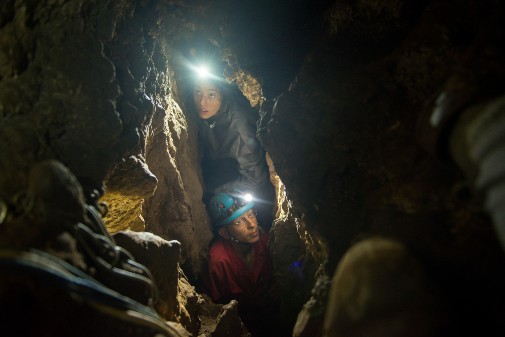
The recent findings, a result of excavations at the Rising Star cave system in South Africa, have been interpreted by an international team of scientists including the University of York, Princeton University and the University of Witwatersrand, and could alter experts’ understanding of human evolution, placing greater importance on the emotional lives of human relatives.
Until this latest discovery it was assumed that these extinct hominins, called Homo naledi, dragged their deceased into the caves and left them there.
An archaeological study of the caves, led by National Geographic Explorer in Residence, Lee Berger, has, however, shown that they buried their dead in sediments and covered them up, engraving images on the cave walls around them.
Emotional connections
They carried the dead deep into the cave chambers, placing them in a specific place, creating a meaningful funeral practice not too dissimilar to how humans create ceremonies for their dead today.
Professor Penny Spikins, from the University of York’s Department of Archaeology, said: “These individuals had brains not too dissimilar to the size of chimpanzees, and long arms with curved fingers and were much smaller than modern humans. It has always been assumed that complex, emotional responses between individuals, often seen in the care and attention given to funeral practices, was exclusively a feature of our large-brained ancestors.
“We were surprised to find that this is not the case. Homo naledi have developed social and emotional parts of their brains hundreds of thousands of years before homo sapiens.
“We assumed that big brains and technological advancement went hand-in-hand, but way before this, emotional connections were formed, and therefore could be a more significant building-block in our timeline than we ever thought possible.”
Geometric shapes
Engravings on the wall of the cave system could be between 241,000 and 335,000 years-old, and consist of geometric shapes on surfaces that appear to have been smoothed in preparation for a pointed or sharp object to make the markings.
Intentional designs of this kind that communicate a ‘message’ are considered to be a significant cognitive leap in human evolution, and it is seen here for the first time in small-brained human relatives.
Ahead of intellect
Professor Spikins said: “The evidence in these caves points to significant effort being made to care and attend to the dead, and given the size of the brains of Homo naledi, suggests that emotions developed ahead of intellect in our evolutionary history.
“Homo naledi could not be more different to humans, and yet they seem to have made emotional connections and collaborated with one another in a very human-like way. It is a hugely exciting discovery that now means we can look at other parts of our evolutionary journey in a different light, and start to question, if emotion came first, how may that help us today as we face a new world of technological advancement?”
Oldest example
The research is being presented at the Stony Brook University’s Richard Leakey Memorial Lecture, and published in the journal eLife.
Professor Agustin Fuentes, from Princeton University said: “This is simultaneously the oldest example of burials and one the earliest example of engravings on cave walls - evidence of complex culture and meaning-making by a hominin who is not us. This changes how we have to think about human evolution.”