‘Alien’ wasps thriving in tropical forests, study finds
Posted on Wednesday 8 November 2023
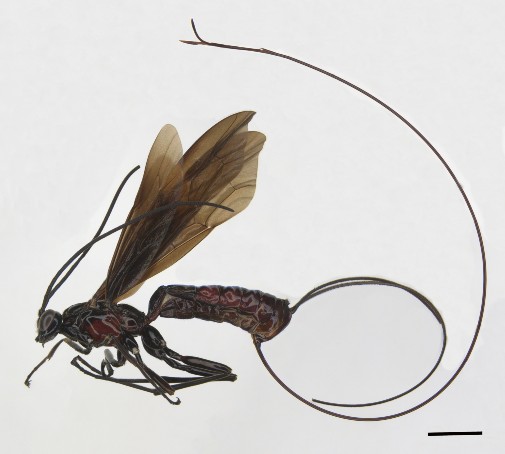
The wasps, which survive by living off host insects and spiders until adult-sized, were discovered on a mountain in the Brazilian Atlantic Rainforest. The number of types found were similar to that previously found in the whole of the UK.
The latest findings adds to a growing body of evidence that debunks the widely held belief that the Darwin wasp does not thrive in tropical environments and points to the possibility of many wasp species unknown to researchers in the past.
Researchers say it also provides further evidence of the biodiversity of the Brazilian Atlantic Rainforest and the significance of protecting and restoring the land from the effects of climate change and damage caused by human activities.
Hinder conservation
The level of diversity in a group of species changes depending on where they live, and yet for invertebrates, some of the most diverse species on Earth, little is known about how much diversity can change from one location to the next.
This can hinder conservation efforts, which is increasingly needed to maintain biodiversity in some of the most threatened areas of the world, such as rainforests.
Researchers at the University of York surveyed a group of Darwin wasps, a very diverse and important invertebrate group worldwide, on a mountain of the Brazilian Atlantic Rainforest to understand how common it was in a tropical environment and how it contributed to the biodiversity of the region.
Mid and low altitudes
Dr Peter Mayhew, from the University of York’s Department of Biology, said: “For a long time it was believed that Darwin wasps favoured more moderate climates, but recent reports of their diversity in tropical locations started to prompt questions about this assumption. They can be found in varying numbers on every continent of the world, apart from Antartica, so they are a particularly fascinating creature.
“We found high biodiversity of the species at mid and low altitudes of the mountain but not at high altitudes, which gives us some guidance on where to concentrate conservation efforts for this population, but it was a surprise to see the level of diversity over the six months of our survey.
“Of the type of wasp we looked at, there are 1,700 described species worldwide, and about 109 in the UK. We found, on just one mountain in the rainforest, 98 species of these wasps, three quarters of which could not be named. As our work continues we may well be able to name some of them, but there is a strong likelihood that many will be species we have not encountered before.”
Host bodies
The wasps reproduce by parasitizing other insects and spiders until they are adult sized, and as such they are most vulnerable to human threats, which will reduce the number of insects they can choose from as host bodies. They are important to biodiversity as they kill their host insect, keeping insect populations regulated and allowing lots of different species to coexist.
It is thought that wasps that parasitize other insects, such as the Darwin wasp, could be more diverse than beetles. Around 80,000 parasitic wasp species have been described, but they require more study to understand how their populations survive across a wide-range of environments around the globe.
Researchers hope that these latest findings will contribute towards campaigns to reduce deforestation in the rainforest region and put in place conservation programmes that include this highly diverse group of species.
Further information
Photo published as Figure 2a in the study, reproduced with changes here under licence