By royal appointment – Vice-Chancellor receives prestigious award on behalf of University at Buckingham Palace
Posted on Tuesday 18 February 2020
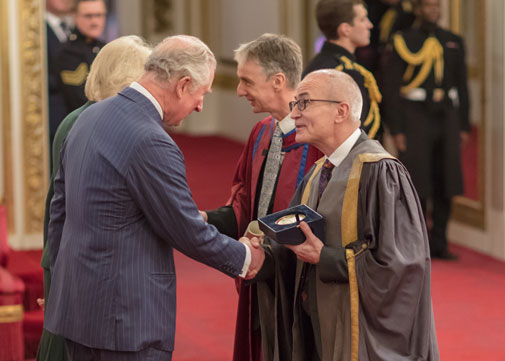
Vice-Chancellor Professor Charlie Jeffery formally received the Queen’s Anniversary Prize on behalf of the Laboratory at a ceremony in the Ballroom of Buckingham Palace on Thursday (20 February).
Professor Jeffery was presented with a medal, engraved with the Queen’s signature, while Professor Tony Wilkinson, current leader of York Structural Biology Laboratory (YSBL), collected a scroll on behalf of the University.
Unique honour
The prize, the highest national honour awarded in UK further and higher education, is for the work of the YSBL over the past 40 years in studying protein molecules.
The ceremony had the format of an investiture and was carried out by HRH The Prince of Wales and HRH The Duchess of Cornwall.
The prize is unique in the honours system in that the honour is conferred on an institution rather than an individual.
Protein molecules
The YSBL researchers study protein molecules: developing methods for looking at them, determining what the molecules look like and how they work, and how this knowledge can be exploited.
The methods developed at York are used by thousands of scientists around the world across many areas of science and industry.
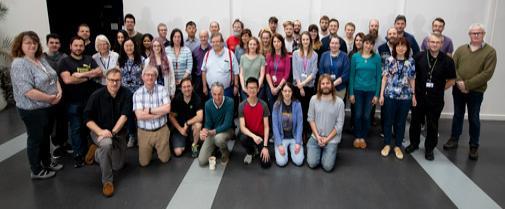
Studies of individual proteins in YSBL have revolutionised understanding of fundamental living processes. These insights can directly contribute in the development of new medicines, such as modified insulins for treating diabetes, and also be used in industrial processes to improve sustainability and food security.
Outstanding work
Recipients of the Queen’s Anniversary Prizes (2018 to 2020) were announced on 21 November at a ceremony at St James’s Palace in London.
The Prize recognises and encourages outstanding work - in any field - which is innovative and is delivering practical and substantive benefit both for the institution itself and in the wider world.
They are granted by the Queen every two years.
Richly deserved
Professor Jeffery said: “This award is a fantastic achievement and richly deserved. It recognises the excellence and dedication of the YSBL team over more than 40 years.
“The Laboratory's work has had far-reaching impact: the benefits it brings to the global research community include not only its world-renowned methods and discoveries but also the outstanding scientists it has trained.
“To wider society this research contributes to the development of new medicines and also the development of new approaches in the search for novel drugs and therapies in medicine.
“The prize adds to the five previous Queen’s Anniversary Prizes, providing further recognition of the quality and relevance of research carried out at York.”
Continuing evolution
Professor Wilkinson said: “YSBL works at the intersection of many different disciplines, harnessing the synergy of physics, computing and chemistry to answer questions about biological processes.
“This prize recognises the quality of the work of the many hundreds of scientists who have passed through the Laboratory over the past four decades and benefitted from the collaborative and flexible culture we have sustained.
“The Laboratory continues to evolve with new initiatives in advanced imaging methods and developing chemistry to study the role of the sugar molecules that are vital to living organisms.”