‘Dog-Speak’ important for social bonding between pet and owner
Posted on Tuesday 6 March 2018
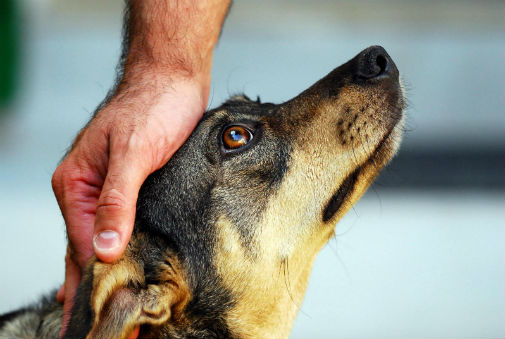
Dogs paid more attention to people that used 'dog-speak'
Speech interaction experiments between adult dogs and humans showed that this particular type of speech improves dog attention and may help humans to socially bond with their pets.
Previous studies on communicating with dogs had suggested that talking in a high-pitch voice with exaggerated emotion, just as adults do with babies, improved engagement with puppies but made little difference with adult dogs.
Researchers at York tested this theory with new experiments designed to understand more about why humans talk to dogs like this and if it is useful to the dogs in some way or whether humans do this simply because they like to treat dogs in the same way as babies.
Speech register
Dr Katie Slocombe from the University of York’s Department of Psychology, said: “A special speech register, known as infant-directed speech, is thought to aid language acquisition and improve the way a human baby bonds with an adult. This form of speech is known to share some similarities with the way in which humans talk to their pet dogs, known as dog-directed speech.
“This high-pitched rhythmic speech is common in human interactions with dogs in western cultures, but there isn’t a great deal known about whether it benefits a dog in the same way that it does a baby.
“We wanted to look at this question and see whether social bonding between animals and humans was influenced by the type and content of the communication.”
Unlike previous experiments, the research team positioned real humans in the same room as the dog, rather than broadcasting speech over a loud speaker without a human present. This made the set-up more naturalistic for the dogs and helped the team test whether dogs not only paid more attention to ‘dog speak’, but were motivated to spend more time with the person who had spoken to them in that way.
Dog-related content
Researchers did a series of speech tests with adult dogs, where they were given the chance to listen to one person using dog-directed speech containing phrases such as ‘you’re a good dog’, and ‘shall we go for a walk?’, and then another person using adult-directed speech with no dog-related content, such as ‘I went to the cinema last night.’.
Attention during the speech was measured, and following the speech, the dogs were allowed to choose which speaker they wanted to physically interact with.
The speakers then mixed dog-directed speech with non-dog-related words and adult-directed speech with dog-related words, to allow the researchers to understand whether it was the high-pitched emotional tone of the speech that dogs were attracted to or the words themselves.
Preferences
Alex Benjamin, PhD student from the University’s Department of Psychology, said: “We found that adult dogs were more likely to want to interact and spend time with the speaker that used dog-directed speech with dog-related content, than they did those that used adult-directed speech with no dog-related content.
“When we mixed-up the two types of speech and content, the dogs showed no preference for one speaker over the other. This suggests that adult dogs need to hear dog-relevant words spoken in a high-pitched emotional voice in order to find it relevant.
“We hope this research will be useful for pet owners interacting with their dogs, and also for veterinary professionals and rescue workers.”
The research paper, ‘’Who’s a good boy?!’ Dogs prefer naturalistic dog-directed speech, is published in the journal Animal Cognition.