The Tsetse fly genome: unlocking the secrets of a blood-sucking insect
Posted on Friday 25 April 2014
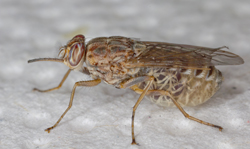
The tsetse fly (Glossina morsitans) is the sole vector for the parasite that causes African trypanosomiasis, which results in sleeping sickness in humans and nagana in livestock, causing many thousands of deaths and a huge burden on agriculture in sub-Saharan Africa.
The research, led by Yale University in the USA and the Sanger Institute in Cambridge in the UK, has provided insight into how tsetse acquires and digests this blood diet as its sole source of food. It is published in the latest issue of Science.
The tsetse is a true vampire as it lives only on blood, unlike other important disease-transmitting insects such as the mosquito which also feed on plant nectar. The tsetse is also unusual as it rears a single larva at a time, which grows inside its body using ‘milk’-like secretions from the mother. The study provided significant insight into its reproductive biology.
To live on blood alone, the insect has recruited a bacterial symbiont, Wigglesworthia glossinidia, which resides in a special organ and supplements the insect’s diet with nutrients missing from blood. Understanding the metabolic function of the bacterial symbionts that live in the tsetse is the subject of ongoing research by microbiologist Dr Gavin Thomas, in the Department of Biology at York. Dr Thomas is a co-author of the genome paper with Dr Sandy Macdonald, a former Biotechnology and Biological Sciences Research Council-funded postdoctoral fellow in his laboratory and now lead bioinformatician in the Wellcome Trust-funded C2D2 project in York.
Dr Thomas said: “Having an understanding of the genome of the insect as well as the bacteria that live within it allows us to understand more about how they talk to each other and suggest ways to break this line of communication and compromise the viability of the tsetse.”
Wellcome Trust funded CIDCATs PhD students Lindsey Flanagan and Michael Bottery, with Dr Jamie Wood of the Departments of Biology and Mathematics, are studying another symbiont of the tsetse, called Sodalis glossinidius, which is known to help the trypanosome parasites to infect the fly, and therefore increase overall infection rates. The research is revealing the metabolic interactions between the insect and the bacteria using microbiological and mathematical modelling methods.
Dr Thomas added: “Together, the new insight into the unique biology of the insect host from its genome, and improved understanding of the function of its bacterial symbionts, provides the foundation for research into the reduction or prevention of trypanosomiasis-mediated disease in coming years.”
Further information
- The paper ‘Genome Sequence of the Tsetse Fly (Glossina morsitans): Vector of African Trypanosomiasis’ is published in Science.
- For more information on the Department of Biology at the University of York, please visit: www.york.ac.uk/biology/