Exhibition of Star Carr’s Stone Age treasures to go on display at the Yorkshire Museum
Posted on Thursday 15 February 2024
The artefacts are going on display at the Yorkshire Museum, as part of an interactive exhibition exploring how they deepen our understanding of the way people lived 11,000 years ago, at the end of the last ice age.
Part funded by the University of York through the Department for Science, Innovation and Technology (DSIT) Regional Innovation funding, “Star Carr: Life after the ice” will showcase a range of finds made at the site in North Yorkshire which offer insights into how prehistoric communities settled, created, cooked, worshipped and adapted to the landscape they lived in.
Stonehenge of Mesolithic
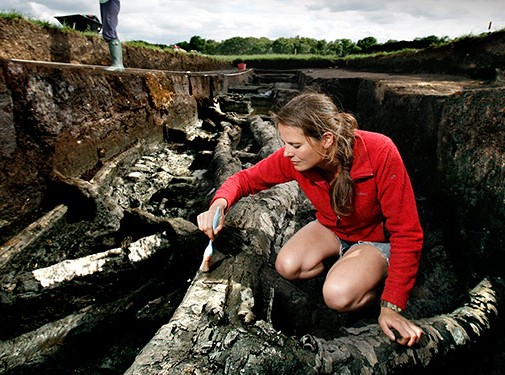
Star Carr, a site of international archaeological importance, is sometimes referred to as the ‘Stonehenge of the Mesolithic’. Buried beneath layers of peat, the site preserved evidence of the earliest houses, a place where hunter-gatherers settled and lived by what was once a large lake in a settlement which existed at a time when Britain was still connected to Europe.
Professor Nicky Milner from the Department of Archaeology at the University of York co-directed the excavation at Star Carr in an award-winning project which lasted for 15 years. Professor Milner said: “It is very exciting to have these internationally important artefacts go on display, some for the first time. They are incredibly rare and I’m sure people will be fascinated to see such old objects which give us a glimpse into what life was like 11,000 years ago.”
The display of artefacts will shed light on a world in which people were deeply connected to the natural environment in the face of extreme climate change after the first Ice Age. Through creative design and sensory space-making, visitors will be immersed in the Mesolithic world of Star Carr through an interactive mural and soundscape. Children will also be able to follow the story of Star Carr through the eyes of a friendly dog who lived with the people by the lake.
A wider programme of events including specialist lectures will run alongside the exhibition, with family-friendly events including weaving workshops, headdress-making and pendant-making scheduled for the Easter and summer school holidays.
Partnership
Adam Parker, Curator of Archaeology at the Yorkshire Museum said: “The Star Carr collection holds some of the most rare and special objects from Mesolithic Britain and this exhibition will form the finest and most diverse display of Mesolithic items in the country.
We are delighted to be working in partnership with the University of York on this project and to have the expertise of their researchers to help us to bring the settlement of Star Carr to life for visitors of all ages.
We are excited to be displaying many of the artefacts for the very first time and hope the exhibition will challenge our thinking about how the people of the Mesolithic era lived. They were sophisticated with complex sets of beliefs and living in an area which was very different to North Yorkshire’s landscape of today.”
Further information
'Star Carr: Life after the ice’ will open on 22 March 2024 in the central gallery at the Yorkshire Museum and entry is included in general admission.
To book tickets in advance visit: www.yorkshiremuseum.org.uk/ .