Award-winning film shows blurred lines of ‘real’ and ‘virtual’ life
Posted on Thursday 25 May 2023
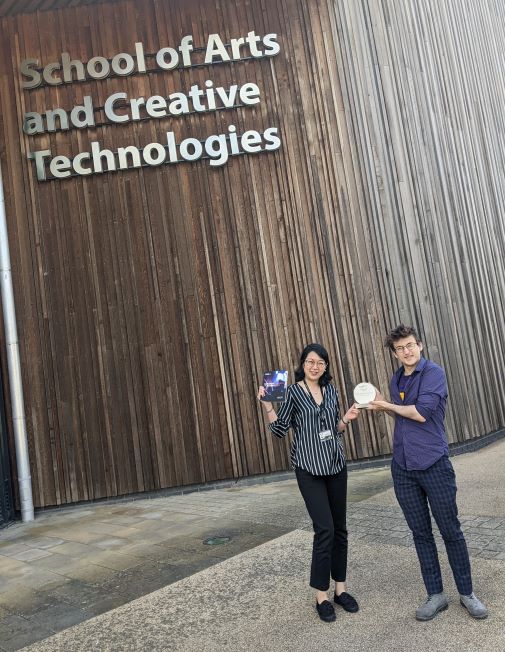
The New Virtuality: A Video Essay on the Disappearing Differences Between Real and Unreal, written by Dr Jenna Ng, a Senior Lecturer in Film and Interactive Media and directed by Oliver Tomkins, a research student in Interactive Media, explores how virtual reality and AI technologies can break down the boundaries between ‘truth’ and ‘fakery’, ‘real’ and ‘virtual’.
Celebrate
They were awarded the Special Jury Prize at the Learning on Screen Awards in a ceremony which took place at the British Film Institute (BFI) in London. The awards showcase and celebrate broadcast and professional productions as well as work by new filmmakers.
The film opens with an example of how a protest march in Madrid was staged using pseudo-holographic images of people marching in a virtual space, projected onto city buildings as if in real-time. This meant that the protest was seen on the streets as planned and the message was heard, despite police banning the march in ‘real-life’. The judges commented on the work as “an absolutely fascinating film, which was excellently cut and curated to tell the story of AI in an amazing and thoroughly engaging way.”
New technologies
Dr Jenna Ng, from the School of Arts and Creative Technologies (ACT) at the University of York, said: “We are living in a period of ‘media blur’ and grasping how these new technologies are understood and how they impact ideas of ‘truth’ and identity is important as virtual reality and AI methods advance into the future.
“We are so pleased to be able to tell this story with our film and utterly delighted with the reception it has received.”
Oliver Tomkins, director of the film, said: “Jenna came to me with a proposal too big to be confined to just the written word — this energetic, complicated audit of virtual unreality and its toll on us and our faculties and this video essay is just one slice of that brilliant boundary-defying idea.”
Transformation
Professor Marian Ursu, Professor of Interactive Media and Co-Director of XR Stories at the University, commented: “The New Virtuality responds to a society entering an era in which the boundary between the actual and the virtual is no longer absolute.
“This fundamental transformation makes it categorically necessary to re-evaluate our human condition itself, to re-discover and re-invent it. This essay does this brilliantly, by questioning and exposing the impacts of “the new virtuality” on our apprehensions and constructions of realities.”
Further information
The film was supported with funding from XR Stories and the Department of Theatre, Film, Television and Interactive Media (now School of Arts and Creative Technologies).
The film has since won the 2023 John Culkin Award for Outstanding Praxis in the Field of Media Ecology; and been shortlisted for a 2023 Media, Communication and Cultural Studies Association (MeCCSA) Practice Based Research of the Year award