Climate change and deforestation push tropical species towards extinction
Posted on Tuesday 9 July 2019
Researchers from the Universities of York and Sheffield have discovered how deforestation and climate change – two of the biggest drivers of species’ extinction – interact with each other to magnify their effects.
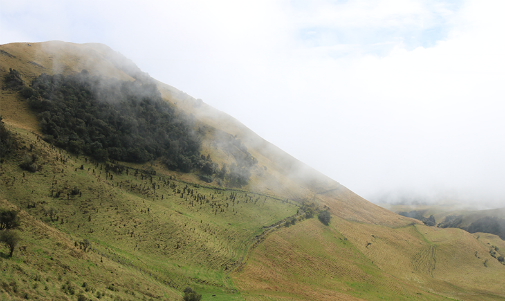
For millennia, wildlife around the world has moved up and down mountains and towards or away from the equator to cope with changes in the Earth’s temperature. The deforestation of tropical forests is creating a patchwork landscape where natural habitat is disconnected and confined to smaller spaces between a mass of farmland.
The research found that most tropical forest habitat is currently too disconnected to provide pathways to cooler climates, meaning wildlife will struggle to escape the impacts of climate change.
Improve connectivity
Professor Jane Hill, from the University of York's Department of Biology, said: “Tropical rainforests support vast numbers of species, and so preventing further forest loss and implementing reforestation programmes to improve connectivity for range-shifting species is vital for preventing extinctons of species.”
Tropical deforestation between 2000 – 2012 led to a vast amount of forest area, bigger than India, losing its ability to link tropical wildlife with a habitat that would protect them from rising temperatures. Today, only 38 per cent of tropical forest allows resident wildlife to avoid climate warming by moving uphill or towards the poles.
This loss of forest means that if species move as far as possible to the coldest places along connected temperature gradients, then under severe warming scenarios species would still, on average, suffer 2.6 degrees Celsius in warming.
Optimal climates
Professor David Edwards, from the University of Sheffield, said: “The speed and severity with which the ability of plants and wildlife to track their optimal climates has been severed is truly shocking.
“In considering what we can do to solve this problem, we urgently need to fund mechanisms to stop tropical forest loss whilst also investing in reforestation in places where deforestation has already been most severe.
“The time to act is now and failure to do so will have catastrophic effects for tropical biodiversity over the coming century.”