Soy source: Report maps global trade in Brazilian soy
Posted on Friday 29 June 2018
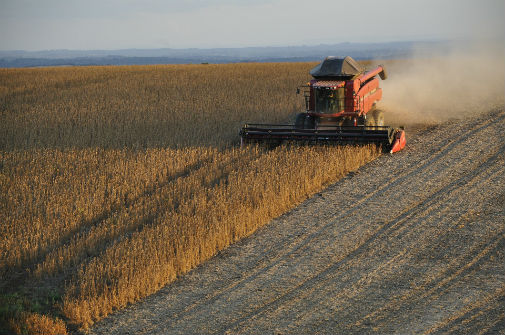
soy farms cover some 33m hectares in Brazil, an area half the size of France
The research looks at the big companies that dominate Brazil’s soy exports and the major consumer markets, including the EU and China, putting a spotlight on the role they play in the mass deforestation taking place in the country to make way for soy farms.
Global soy production has increased from 27m tonnes in 1961 to 335m tonnes in 2016, with most soy used as a protein source for animal feed around the world. In 2016 soy exports were worth over US$20 billion to the Brazilian economy, with soy covering some 33m hectares, an area half the size of France.
Habitat loss
A collaboration between the Stockholm Environment Institute (SEI) York and Stockholm Centres and NGO Global Canopy, the “Trase Yearbook 2018, Sustainability in forest-risk supply chains” aims to raise awareness of the issues associated with the production and trade of soy, which is one of the most widely-used agricultural commodities on the planet.
China is the biggest market for the bean, buying 60 per cent of Brazilian exports in 2016, with imports linked to around half the soy-related habitat loss in Brazil. But, the Trase Yearbook also shows that European countries are buying soy from areas where deforestation from soy is high, and where impacts per tonne of exports may be even higher than in China.
Using new data and interactive visualisations, the Trase Yearbook links the consumer countries buying Brazilian soy to the trading companies and to the areas where the soy was grown, showing the shifting patterns of soy production.
Transparency
Dr Chris West, Trase lead on Market Engagement and Senior Researcher at the SEI York Centre, said: “We hope the Yearbook will raise awareness of the issues and complexity inherent in the trade of agricultural commodities like Brazilian soy, as well as promoting greater transparency across the supply chain.
“Hopefully, that will mean it promotes positive action, both among policymakers and business decision makers, to respond to some of the challenges we’ve identified.
"The Yearbook builds on a powerful new supply chain mapping approach to assess the soy sourcing patterns of major countries and companies in Brazil. Our work identifies the sourcing patterns for the whole of Brazil's soy exports, providing key insights into exposure to deforestation risks - that’s crucial information for companies and governments wanting to meet deforestation commitments."
Change
The Trase Yearbook 2018 explores the impacts of the zero-deforestation commitments made by some companies and European countries. It has found that while these commitments offer great promise, as yet, there is little evidence of changes on the ground, with similar levels of deforestation risk for companies and countries with zero-deforestation commitments as for those without.
Arnaldo Carneiro Filho, Head of the Sustainable Supply Chain Programme and Trase lead at Global Canopy, added: “Soy is an important sector for the Brazilian economy, and an important source of animal feed, but the need for agricultural land must be balanced with the need to retain critical forest and savannah habitats.
“The commitments made by some companies and countries are encouraging and reflect their awareness of the problem. Opportunities for sustainable production are there to be taken, and the public and private sectors need to work together to take advantage of them.”