Research reveals sea-level changes over nearly three millennia
Posted on Monday 22 February 2016
The research, which involved a geologist from the University of York, found that without 20th-century global warming, global sea level would have risen by less than half the observed increase from 1900 to 2000 and might even have fallen. Instead, global sea level rose by about 14 centimetres.
The study, published in Proceedings of the National Academy of Sciences (PNAS), used a new statistical approach developed by lead author Robert Kopp, an associate professor in the Department of Earth and Planetary Sciences at Rutgers University, USA, his postdoctoral associates Carling Hay and Eric Morrow, and Jerry Mitrovica, a professor at Harvard University.
Professor Roland Gehrels of the Environment Department at York made a pivotal contribution to a new database of geological sea-level indicators which is key to the statistical calculation.
“The 20th century rise was extraordinary in the context of the last three millennia – and the rise over the last two decades has been even faster,” Professor Kopp said
“No local record measures global sea level. Each measures sea level at a particular location, where it is buffeted by a variety of processes that cause it to differ from the global mean. The statistical challenge is to pull out the global signal. That’s what our statistical approach allows us to do.”
The database covered 3000 years and included records from 24 locations around the world. Data on past sea levels were obtained from coral atolls, archaeological sites and many sediment cores from salt marshes obtained and analysed by Professor Gehrels. The analysis also tapped 66 tide-gauge records from the last 300 years.
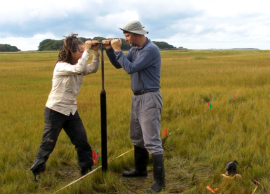
Professor Gehrels said: “Salt marshes in the inter-tidal zone are made of sediments which build up over time as the sea-level rises. Sediment cores from these locations provide a wealth of information that enables us to reconstruct the history of the rise of sea-levels at that particular spot.”
The study found that global sea level declined by about eight centimetres from 1000 to 1400, a period when the planet cooled by about 0.2 degrees Celsius.
“It is striking that we see this sea-level change associated with this slight global cooling,” Professor Kopp said. By comparison, global average temperature today is about 1 degrees Celsius higher than it was in the late 19th century.
Professor Gehrels was part of a team which included Andrew Kemp, an assistant professor of Earth & Ocean Sciences at Tufts University, and Benjamin Horton, a professor in Rutgers’ Department of Marine and Coastal Sciences and Jeffrey Donnelly of the Woods Hole Oceanographic Institution.
Klaus Bittermann and Stefan Rahmstorf, at the Potsdam Institute for Climate Impact Research in Germany, used the new global sea-level curve to calculate the relationship between temperature and sea-level change.
The researchers say it is likely that global sea level would rise by 0.52 to 1.31 m in the 21st century if the world continues to rely heavily upon fossil fuels. Phasing out fossil fuels would reduce the likely rise to between 0.24 and 0.61 m.
As well as Professor Gehrels, scientists at the following institutions contributed to the study: Rutgers, The State University of New Jersey; Tufts University; Potsdam Institute for Climate Impact Research in Germany; Woods Hole Oceanographic Institution;; and Harvard University.
The research was funded by the National Science Foundation, the National Oceanic and Atmospheric Administration, the New Jersey Sea Grant Consortium, the Strategic Environmental Research and Development Group, the U.K. National Environmental Research Council, the Royal Society, and Harvard University.
Further information
- The paper ‘Temperature-driven global sea level variability in the Common Era’ is published in Proceedings of the National Academy of Sciences.
- For more information about the Environment Department at the University of York, please visit http://www.york.ac.uk/environment/