
Working with the University

- Working with the University
- Ways to collaborate
- Collaborative research
- Knowledge Transfer Partnerships
- Information for organisations
Information for businesses
Recent times have clearly demonstrated that innovation is a key attribute harnessed by thriving businesses, or indeed those reinventing themselves to maintain their foothold in the face of massive challenges. Innovation tends to emerge when individuals with new ideas and different perspectives and experiences come together to consider a current challenge or problem. The KTP programme enables this intersection to happen in a structured yet organic way.
Why work with York?
- We offer a wide range of expertise in disciplines from over 30 academic departments and research centres.
- We have a strong track record of over 70 KTPs, which have formed valuable collaborations between organisations of varying sizes, from micro to multinationals.
- In the UK-wide assessment of the quality of research undertaken in universities - Research Excellence Framework (REF) - York ranked joint 10th in 2021, with all subject areas being ranked in the top 30 in the UK and 53% of research deemed as 'world leading'. Four departments were positioned in the top five: Language and Linguistic (1st), Philosophy (2nd), Sociology (4th) and Education (5th).
1. What are the benefits of KTP to a business?
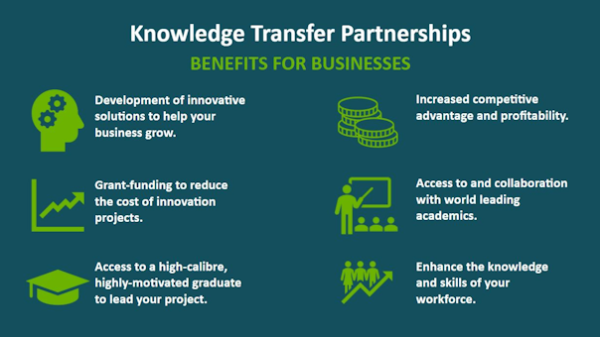
KTPs represent an extremely cost-effective means of introducing new skills into your workplace to resolve an ongoing challenge or issue. They can help you improve your business' competitiveness, productivity, performance and profitability through innovation and knowledge exchange.
2. What are the typical costs of a KTP?
A KTP is part-funded by a grant. Your business will need to contribute to the overall cost of the project. The amount you will need to contribute depends on the scale and length of the project. It will also depend on the size of your business. Typical annual costs for a KTP are detailed below.
| Description | Total annual KTP cost | Typical annual cost to an SME (33%) | Typical annual cost to a large business (50%) |
|---|---|---|---|
| Associate salary | £55,000 | £18,150 | £27,500 |
| Associate development, travel, subsistence and consumables | £5,250 | £1,732 | £2,625 |
| Access to and support of University's academic team and facilities | £20,000 | £6,600 | £10,000 |
| Additional associate support | £44,500 | £14,685 | £22,250 |
| Total | £124,750 | £41,167 | £62,375 |
The duration of a KTP is dictated by the project which is being delivered. They typically last around 24 months but can be anywhere between 12 and 36 months.
3. What support is provided to a business?
A KTP is a business-driven partnership, which means the partnership is in place to improve your business' competitiveness, productivity, performance and profitability. This in no way means that your business does all the work. You will have the support and expertise of the KTP Team available to you at any time, access to one of the national Knowledge Transfer Advisers from the Innovate UK Business Connect network and of course the academic(s) collaborating with you.
Your project has, by design, regular catch-ups between the three key parties: the company supervisor, the academic(s) involved and the Associate. There are also less frequent but no less important Local Management Committee meetings, which are attended by the KT Advisor, Associate, the academic and partner business' team and a member of the University's KTP Team. The structures and systems in place for KTP have been developed over decades and are there to ensure the best possible outcomes for the partnership and therefore your business.
4. Other eligibility criteria
Businesses who wish to apply should:
- be UK based and have absorptive capacity, i.e. be of sufficient size to supervise the KTP Associate and have the resources required to embed new knowledge. Businesses must have a minimum of two or more full time equivalent (FTE) employees.
- have the financial capacity to make the required contribution to the cost of running a KTP project.
- be able to show that your project demonstrates Impact, Innovation, Challenge and Cohesiveness.
As well as receiving up to 67% in grant funding for your project, you are also likely to be able to reduce your costs further through claiming Research and Development Tax Credit (you should seek advice on your eligibility).
KTP Team Contact details
Dr Rukmal Abeysekera
Knowledge Transfer Manager
Business Development team
The Stables, University of York, UK
Tel: +44 (0)1904 321124
rukmal.abeysekera@york.ac.uk