


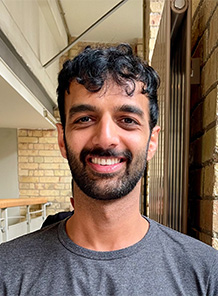
Professor Umar Toseeb
Visit Professor Umar Toseeb's profile on the York Research Database to:
- See a full list of publications
- Browse activities and projects
- Explore connections, collaborators, related work and more

Profile
Biography
I am a Professor of Psychology focusing on children and young people’s mental health and special educational needs. In my research group, we love fitting advanced statistical models to existing large and complex datasets (eg, longitudinal cohort studies or administrative data).
PhD applicants
I am interested in hearing from potential PhD students who are interested in secondary data analysis, are happy to undertake further training in advanced quantitative methods, and would like to develop projects on the following topics:
- children's social, emotional, and cognitive development
- special educational needs
- mental health and wellbeing
- bullying
- anti-social behaviour and youth offending
Podcast
I am a co-host of the Mind the Kids Podcast, focusing on children and young people's development. You can access the podcast on YouTube and all major streaming platforms.
Research
Overview
I lead the Child and Adolescent Neurodevelopmental Diversity (CANDY) Group; we focus on special educational needs and mental health during childhood and adolescence.
We love quantitative data-in fact we love big datasets! A key strength of our group is longitudinal modelling of large epidemiological and administrative datasets. We use big data to study:
- Social functioning (eg, anti-social behaviour, conduct problems, hyperactivity, inattention, bullying, youth offending),
- Emotional functioning (eg, depression, anxiety, self-harm, wellbeing, self-esteem, happiness, self-esteem),
- Cognitive and learning differences (eg, autism, developmental language disorder),
- Genetic and environmental influences on children’s development.
Analysis Keywords: Longitudinal Modelling, Latent Class Analysis, Growth Curve Modelling, Mixture Modelling, Structural Equation Modelling, Factor Analysis, Mediation Analysis, Latent Class Growth Modelling, Multilevel Modelling, Measurement Invariance, Twin Modelling, Polygenic Scoring, Genome-Wide Association Study, Network Analysis, Propensity Score Matching.
Datasets: Avon Longitudinal Study of Parents and Children, Millennium Cohort Study, Manchester Language Study, Twins Early Development Study, British Cohort Study, Neuroscience in Psychiatry Network, Born in Bradford Study, National Pupil Database, Police National Computer.
Research group members
- Dr Gill Francis (Assistant Professor): play and children’s development
- Dr Megan Frith (Research Associate): special educational needs and youth offending
- Dr Melisa Parlak (Research Associate): adventure learning for social and emotional functioning
Projects
Rethinking Special Educational Needs (2023-2027)
The current system for identifying and supporting children and young people with special educational needs and mental health difficulties is not fit for purpose. In this project, we are using existing data from four large population-based studies (ALSPAC, BCS, MCS, TEDS) to understand how to better identify and support children and young people with special educational needs and mental health difficulties in schools. We are trying to find alternatives to diagnostic labels (eg, depression, anxiety, ADHD, autism) which often don’t capture the needs of children and young people who struggle at school. We have received £332,000 from the Nuffield Foundation for this work.
Special Educational Needs and Youth Offending (2024-2026)
Young people with special educational needs and mental health difficulties are more likely to be cautioned or charged for a violent offence compared to those without such difficulties. In this project, we are using existing data from the National Pupil Database, National Police Computer, and the ALSPAC dataset to understand how to prevent young people with special educational needs and mental health difficulties from entering the criminal justice system. We are trying to identify levers for change during school (eg, EHCPs, early identification, school type etc.). We have received £160,000 from the Youth Endowment Fund for this work.
Adventure Learning Evaluation (2025-2028)
The evidence base for outdoor and adventure learning interventions (eg gorge walking, camping, hiking) is limited. It is unclear which elements of outdoor and adventure learning programmes impact upon children and young people’s social and emotional functioning, and educational outcomes. In this project, we are evaluating two adventure learning interventions: Inspire to Achieve and Adventure and Challenge. The programmes will be delivered and evaluated in two randomised controlled trials in around 100 schools. We have received £407,086 from the Education Endowment Foundation for this work.
Publications
Selected publications
- A full list of publications can be found on the York Research Database (PURE) or Google Scholar.
Contact details
https://linktr.ee/umartoseeb