
Our people
.jpg)
About us
11th in the UK for Psychology
Complete University Guide 2027.
2nd for research output quality
in the Times Higher Education’s ranking of the latest REF results (2021).
Our facilities
 (1) (1).jpg)
Our department is a purpose-built home for psychology, where labs, lecture theatres and seminar rooms sit side-by-side. By bringing everything under one roof, we’ve created a truly accessible and vibrant space for our whole community to connect and collaborate.
Equality, diversity and inclusion

The Department of Psychology has a deep and long-standing commitment to advancing equality, diversity and inclusion in every aspect of its work. We recognise that excellence in psychological research can only be achieved when people from all backgrounds are able to contribute their unique perspectives and experiences.
External engagement
The Department actively engages with external partners to extend the reach and impact of psychological research, strengthening our connection between practice and society.
Through our network of local school partnerships, we collaborate with teachers and practitioners to co-create research questions that drive the study of child development.
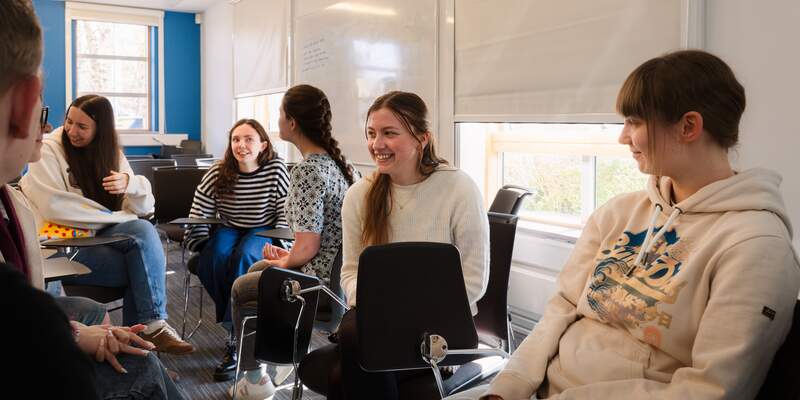
Providing school staff with free resources to support students - combining mental health awareness with practical tools for resilience and coping.

Bringing researchers together to address urgent needs in online safety and digital wellbeing. Initially focusing on social media and gaming, the project explores everything from mental health and media literacy to tackling discriminatory behaviour and disinformation online.
Our history
Since welcoming its first students in 1975, Psychology at York has built a reputation for combining rigorous scientific research with outstanding teaching. Founded by Peter Venables, the department was established on the belief that psychology advances through evidence, experimentation and the testing of ideas. This commitment shaped York's distinctive approach, bringing together experts across cognition, perception, social, developmental and personality psychology who shared a common scientific mindset. Over the decades, York has become internationally recognised for research that has transformed our understanding of memory, language, learning and developmental disorders.
Today, the department is home to world-leading research spanning neuroscience, cognition, communication, social interaction and forensic psychology. Landmark contributions from researchers including Maggie Snowling, Charles Hulme, Alan Baddeley and Graham Hitch have influenced education, clinical practice and cognitive science worldwide. The opening of the York Neuroimaging Centre in 2005 further strengthened York's position at the forefront of brain research, enabling scientists to study the neural basis of thought, perception and behaviour. While the department has expanded significantly in size, facilities and course offerings, it remains guided by the same principles of scientific excellence and innovation that defined its foundation.
 (1)-500x363.jpg)
Faculty of the Department in 1988. Front Row from left to right: Maureen Cox, Derek Roger, Charles Hulme, Peter Venables, Peter Bull, Peter Bailey. Back row from left to right: Nick Hammond, Geoff Hall, Peter Thompson, Euan Macphail, Andrew Monk.