Department of Education

- Education
- Research
- Psychology in Education Research Centre
- The role of mothers’ speech
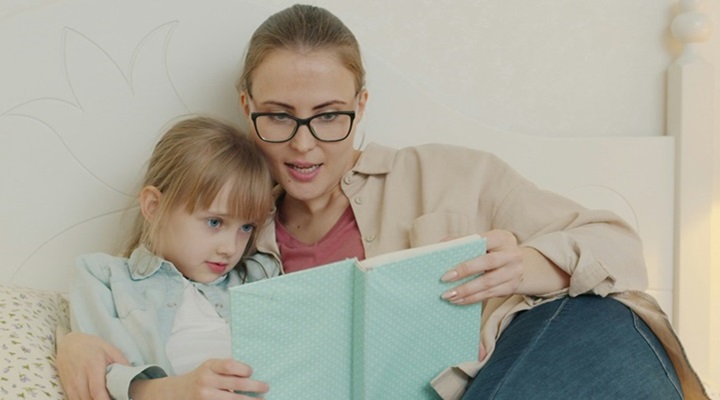
The role of mothers’ speech in the transmission of family background inequality
Children from well-resourced families achieve, on average, higher school grades and gain more educational qualifications than those from under-resourced family backgrounds. The association between family background and children’s education-related outcomes is likely driven by many factors.
Here, we studied the role of one specific factor: The speech that children hear from their mothers.
We found that mothers' speech explained only a small proportion of the educational inequalities that we can observe between families. Our findings matter for researchers, families, and policymakers. We draw three important conclusions. First, children’s educational success or failure cannot be reduced to the ways in which mothers speak. Second, interventions aimed at changing mothers’ speech are likely to deliver only modest benefits for children's educational achievement. And third, reducing educational inequality will require addressing wider socioeconomic disparities between families.
In the project, we analysed data from the Environmental Risk (E-Risk) Study, a longitudinal study of twins born in 1994 to 1996 in England and Wales. We thank the families for their participation in E-Risk, which is funded by grants from the Medical Research Council (MRC) [G1002190, MR/X010791/1].
Funding
Bluesky: @nuffieldfoundation.org
LinkedIn: Nuffield Foundation
Outputs
Some of our findings from this project have been written up as scientific articles:
- Brown, A., Caspi, A., Fisher, H. L., Moffitt, T. E., Wertz, J., & von Stumm, S. (2026). The role of mothers' speech for children's education beyond the early years. Child Development. Advance online publication. https://doi.org/10.1093/
chidev/aacag097 - von Stumm, S., Arseneault, L., Caspi, A., Ph.D., Fisher, H. L., Moffitt, T., Sugden, K., … Brown, A. (2025). The role of the ‘word gap’ in educational inequality: A genetically sensitive study. Under Review. Preprint: https://doi.org/10.31234/osf.
io/6ec5r_v1 - Wood, E., Brown, A., & von Stumm, S. (2026). Twins and their singleton siblings differ in language, cognition, and social-emotional development. Child Development, 97(3), 649–661. https://doi.org/10.1093/
chidev/aacaf029
Project reports
- One-page summary: Mothers’ speech plays a small role for educational inequality (PDF
 , 167kb)
 - Executive summary (6 pages): The role of mothers’ speech in the transmission of family background inequality (PDF , 615kb)
- Full research report: The role of mothers’ speech in the transmission of family background inequality (PDF , 2,424kb)