
Department of Education

Introducing ADLib
Posted on 16 July 2026
Author: Thomas Noret
Researchers at the University of York’s Department of Education have created a library of open-access, evidence-informed tools to enable researchers to include the voices of individuals with learning disabilities by developing accessible methods and data-collection tools that allow them to take part in research.
Researchers need a broad range of data from across society, and this new library helps make data collection more accessible. Created by Dr Kayleigh Doyle, Dr Laura Fox and Prof. Kathryn Asbury, the team explain that the primary purpose of the library is “to facilitate inclusive practices and therefore improve the representativeness of research data that society relies on to inform understanding and decision-making.” ADLib, which stands for Accessing Disability Library, has many resources for researchers to use which fulfil this aim and are all free to use.
All of ADLib’s current tools use picture communication symbols (PCS) to help individuals with a learning disability (especially those who are non-speaking or minimally speaking) to participate in research and convey messages, feelings and/or opinions to the researcher. For example, ADLib’s visual conversations include symbols or pictures and different opinion cards to support inclusion in discussion around likes and dislikes; if there is a photocard of a school, the individual can attach a “like,” “dislike” or “not sure” to the “school” PCS card to show their reaction and opinions on school in an accessible way.
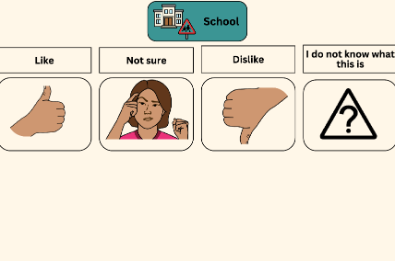
Example of a visual conversation
One of the main resources provided by ADLib is a “conversation board.” The library describes these as “an alternative medium in which a participant who may be non-verbal can communicate and answer the researchers’ questions”. They consist of a diverse collection of images which the individual can use, e.g. by pointing to them, to answer a researcher’s question. At the time of writing, there are 4 different languages that the conversation boards are available in, which are Hindi, Mandarin, Spanish and English. They are also currently available in 2 different themes, “School likes and dislikes”, and “future goals”.
The library also provides other accessible research tools, like the energy and regulation meters. The first of which can be used for the individual to convey how energetic/interested they would be in certain tasks, and the second focuses on the emotions that the individual would feel when doing these tasks.
Tools can also be paired with an “elicitation story.” These are used by a researcher to elicit a conversation on the researched topic, study focus, or the consent process. These different methods can help ensure that all participants are included in studies and reduce anxiety caused by misunderstandings throughout the research process.
ADLib is completely free to access, and all its tools are evidence-informed and supported by the researchers and learning disabled co-production team who developed them. ADLib and its community welcome researchers and specialists from around the world, for example, speech, language, and communication specialists, to use the resources available, and to contribute to the library by sending in their own tools.
Their tools and contact details are found in the ADLib website, along with more information.
The ADLib Team would like to thank Thomas for all of his hard work during his work experience and for writing this informative and helpful summary of our project.