New director for £15m robotics research centre at York
Posted on Monday 12 July 2021

Professor Miles Elsden will oversee the development of the new Institute for Safe Autonomy which is due to be offically opened in 2023 on the University’s Campus East.
The new institute will focus on research to ensure robots and autonomous systems such as driverless cars, operate safely. It will feature specialist laboratory and testing facilities including a quantum laser lab, a rooftop facility to test high altitude communications platforms and a pool for underwater robotic systems. It will host around 100 people from across the University and beyond.
Bringing extensive public sector and business experience, Professor Elsden completed a PhD in applied mathematics before working in industry and government. He worked in multiple government departments advising on issues across science and technology.
Technologies
His last role in government was as Chief Scientist at the Department for Transport where he worked on issues ranging from air quality to electric and autonomous cars. He left the Civil Service in 2015 to work for a US spinout Artificial Intelligence company and his own consultancy firm.
Professor Elsden said: “From the deployment of autonomous cars to Artificial Intelligence and robots in the home, new robotic and autonomous technologies have the power to bring about fundamental change to many aspects of our lives.
“The Institute for Safe Autonomy is an exciting new venture that will bring together a wide range of experts and users under a single roof. The Institute will design, develop, test and deploy a wide range of autonomous systems, ensuring they are safe, secure and used in a way that builds trust with the people who work with and around them.”
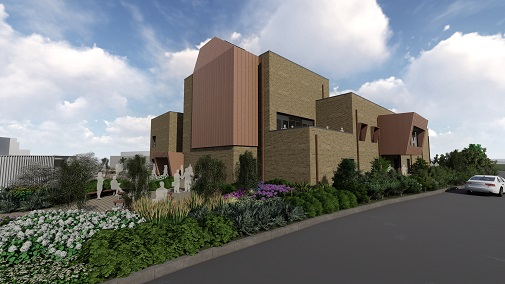
Architects image. Credit: Race Cottam Associates.
Robotics
He said the new building currently taking shape on Campus East is just one part of the University’s development as a centre of excellence in the safe operation of the latest robotics and autonomous systems.
“It is equally about creating a broad community from across the University, our industry and government partners and the public. The aim is to bring together a wide range of perspectives on the complex challenges involved in the successful, widespread deployment of connected and autonomous systems and make York an international leader in this field,” said Professor Elsden.
The new facility is jointly supported through the UK Government’s Research Partnership Investment Fund (RPIF) with a £10.5m grant and University funds, with additional investment from government, industry and philanthropic partners.