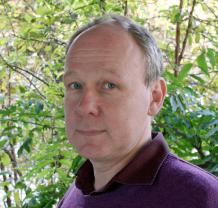
Stefan Weigert
Visit Stefan Weigert's profile on the York Research Database to:
- See a full list of publications
- Browse activities and projects
- Explore connections, collaborators, related work and more

Profile
Biography
In the early 1980s, I studied physics at RWTH Aachen University in Germany. After attending inspiring lectures by Nico van Kampen, I had the opportunity to work on my diploma thesis under his supervision at Utrecht University in the Netherlands. In 1986, I moved to Switzerland to pursue a PhD in Theoretical Physics with Harry Thomas at the University of Basel.
I stayed at the University of Basel for several more years as a postdoctoral researcher and spent a year at the Lawrence Berkeley Laboratory in California, visiting with Robert Littlejohn. In 1996, I completed my Habilitation and became a Privatdozent at the University of Basel. As a Fellow of the Swiss National Science Foundation, I subsequently joined Hans Beck's group at the University of Neuchâtel, collaborating closely with Anatole Amiet. In 2001, I was appointed as a Reader in Mathematical Physics in the Department of Mathematics at the University of Hull, and I joined the University of York in 2005.
Departmental roles
- Mathematics and Philosophy: Programme Leader (since 2021/22)
- Departmental International Officer (since 2024/25)
- Member of the Departmental Sustainability Committee (since 2022/23)
Research
Overview
Ever since my undergraduate days, I have been fascinated by quantum theory. My research focuses primarily on non-relativistic quantum mechanics, with an emphasis on quantum information and quantum foundations. Recent work includes research on foil theories of quantum mechanics, alternatives to the projection postulate, Gleason's theorem, uncertainty relations and mutually unbiased bases.
Current and Former PhD Students
Currently, Adam Beales is exploring the properties of mutually unbiased bases for continuous variables, while Ashley Brown, supervised jointly with Máté Farkas, aims to exploit quantum correlations to improve rates for the distribution of secret keys.
Laurens Walleghem (completed 2026), whom Matt Pusey and I supervised jointly, proposed a modern version of a paradox initially introduced by E. Wigner. Alistair Mansfield (2025) introduced "quantum miniatures", i.e. foil theories of quantum theory that possess only a limited set of observables, and examined their properties. Vincenzo Fiorentino (2025) defined foil theories with post-measurement states different from those in standard quantum theory, investigating them first as a PhD student and subsequently as a postdoc funded by the Leverhulme Trust.
Vicky Wright (2019) studied Gleason-type theorems and Hilbert space formulations of models with post-quantum correlations. Spiros Kechrimparis (2016) systematically derived new preparational uncertainty relations for quantum systems with one or more continuous variables. Dan McNulty (2013) and Steve Brierley (2010) shed light on the existence problem for complete sets of mutually unbiased bases, mostly in dimension six.
Literary Studies
My research interests extend to the history and epistemology of science, with a focus on the rhetorical strategies embedded in scientific arguments. Specifically, my work analyses the grammatical and stylistic choices of 18th-century German physicist Georg Christoph Lichtenberg who is widely known for his witty aphorisms.
Available PhD Research Projects
Interested in pursuing a PhD on the foundations of quantum theory? Feel free to reach out! Project areas include foil theories of quantum mechanics, uncertainty relations, and mutually unbiased bases as well as other emerging topics which help us to better understand the quantum world.
Current Research Students
- Adam Beales - adam.beales@york.ac.uk
- Ashley Brown - tkt526@york.ac.uk
Research group(s)
Mathematical Physics and Quantum Information Research Group
Available PhD research projects
If you would like to write a PhD thesis dealing with fundamental questions in quantum theory, you are welcome to contact me. Project areas include uncertainty relations, mutually unbiased bases, and generalised probabilistic theories with post-quantum correlations. I am also open to discussing the supervision of other topics in quantum information and foundations of quantum theory.
Supervision
Current Research Students
- Adam Beales - adam.beales@york.ac.uk
- Ashley Brown - tkt526@york.ac.uk