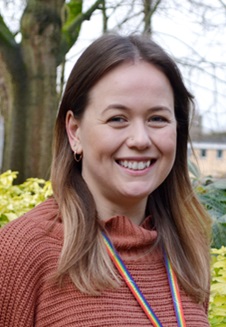
Kate Mooney
Research Fellow (Assistant Professor)
Profile
Biography
Dr. Kate Mooney is a Research Fellow in Epidemiology and Evaluation Methods within the Family Wellbeing team (Public Health and Society Research Group) at the University of York. She works in close partnership with the Family Inequalities Research (FAIR) team based at the Bradford Institute for Health Research and the Born in Bradford (BiB) cohort study.
Kate’s research focuses on evaluating the impacts of early life interventions with the Born in Bradford’s Better Start (BiBBS) interventional family cohort study. She leads quantitative evaluations testing the impacts of perinatal and parenting interventions on maternal mental health, child development, and healthcare outcomes. Her work also investigates the mechanisms driving social inequalities in children’s long-term health and educational outcomes, and the validity and implementation of child development and parenting measures.
Kate completed her PhD in the Department of Health Sciences in 2021, which investigated socioeconomic and ethnic inequalities in children’s working memory development in the Born in Bradford cohort study. Kate has a background in Psychology, with an MSc in Child Development and an MA in Social Research. Kate has also worked as a Research Assistant for the Born in Bradford study, and as a Trial Support Officer for the E-SEE trial.
Qualifications
- PhD – Department of Health Sciences, University of York
- MSc Development, Disorders and Clinical Practice, Psychology, University of York
- MA Social Research, University of York
- BSc (Industrial) Psychology, University of Leeds
Departmental roles
- October 2022 - October 2026: Member of the Contract Researchers Forum
- October 2021 - December 2022: Member of the Green Impact team
- July 2022: Co-organiser of the first Department of Health Sciences ‘Research Showcase’
Research
Overview
Kate’s research is dedicated to understanding and reducing social inequalities in children’s development, health, and educational outcomes. Her work includes early years intervention evaluation, lifecourse epidemiology, psychometrics, and scoping and systematic reviews.
Kate is a quantitative researcher and has experience in using analytic methods such as regression, structural equation modelling, item response theory, multilevel modelling, and exploratory/confirmatory factor analysis. Kate applies causal inference frameworks to her analysis and works with large datasets from longitudinal cohort studies.
Projects
- Supporting Parent-Infant Relationships Equitably (SPIRE): a mixed-methods evaluation of the Start for Life prompts for holding relationships in mind.
- BIBBS ACHIEVE: Addressing Childhood Inequalities through Evidence-Based Early Interventions using Born in Bradford’s Better Start (BiBBS) birth cohort.
- Bradford Better Start Innovation Hub (BSBIH). The BSBIH is a Partnership between Better Start Bradford, Born in Bradford and the University of York. The BSBIH conducts novel research and evaluation on early childhood interventions in one of the most multicultural populations in the UK.
- Early Life and Prevention (ELP) theme of the Applied Research Collaboration (YHARC). The ELP brings together policy makers, communities and charitable organisations to develop effective and sustainable interventions to improve health, catalysing systems change across the region and beyond.
Research group(s)
Publications
Full publications list
Policy briefings
- Policy implications for Best Start in Life: Addressing inequity in early years developmental screening using the Ages and Stages Questionnaire (ASQ-3) (PDF
 , 600kb)
- Evaluation of the Breastfeeding Support project delivered in Bradford (PDF , 475kb)
- Case study: The earlier we look, the more we can do. How linked data in Bradford shows the way to school readiness (PDF , 503kb)
- How do we promote healthy development in children? Lessons from the evaluation of the Better Start Bradford Programme (PDF , 3,832kb)
- ‘Baby Steps’ towards a Better Start? Evaluation of a perinatal parenting programme delivered in Bradford (available on request)
External activities
Invited talks and conferences
Invited presentations
- 2026: Society for Reproductive and Infant Psychology conference (Chester). Supporting the transition to parenthood in Bradford: An effectiveness, cost-effectiveness and qualitative evaluation of the ‘Baby Steps’ perinatal intervention.
- 2025: Annual International Society for Longitudinal and Lifecourse Studies (Fribourg, Switzerland). Universal provision, unequal outcomes: secondary analysis of health visiting and child development in the Born in Bradford’s Better Start (BiBBS) cohort’.
- 2024: Annual International Society for Longitudinal and Lifecourse Studies (Essex). Longitudinal Pathways Between Socioeconomic Status and Educational Attainment: Mediation by Executive Functions and Processing Speed.
- 2024: Emerging Longitudinal Scholars webinar organised by CLOSER. Longitudinal pathways between socioeconomic status and educational attainment: mediation by executive functions and processing speed.
- 2023: "Staged-and-Tailored" Informed Consent Symposium. Is it feasible to nest a Trial within a Cohort Study (TwiCS) to evaluate an early years parenting programme? A planned study with the Born in Bradford’s Better Start cohort.
- 2023: A Better Start Bradford learning event for nurses and practitioners. ‘How do we know what works in the early years, and who for?’
- 2022: British Psychological Society Developmental Conference. Socioeconomic position, the home learning environment & working memory across two ethnic groups.
- 2021: 3rd place at the University of York 3 Minute Thesis competition. Unequal memories: Is children's learning a matter of social circumstance?
- 2021: Society for Social Medicine & Population Health Virtual Annual Scientific Meeting. Socioeconomic disadvantage and ethnicity are associated with large differences in cognitive abilities that underlie children's educational outcomes: analysis of a prospective birth cohort study.
Awards
- October 2022: Department of Health Sciences ‘Making the Difference’ (MTD) award for organising the Health Sciences Research Showcase.
- September 2022: European Society for Prevention Research award (Best Early Career Researcher Conference poster, September 2022)
- August 2021: Third Place at the University of York 3 Minute Thesis competition for talk titled ‘Unequal memories: Is children's learning a matter of social circumstance?’. I wrote a blog post for the York Graduate Research School page, and my talk can be viewed here.
- September 2017: ‘Outstanding Dissertation’ Prize (Development, Disorders, and Clinical Practice MSc)