
Borthwick Institute for Archives

- Borthwick Institute for Archives
- News
- 2026
- Borthwick Newsletter - April 2026
Borthwick Newsletter - April 2026
Posted on 1 April 2026
April in the Archives - delve into our catalogues with this month’s featured description
List of birds seen in Palestine, 14 March 1929-2 April 1929 [Records of Michael Rowntree relating to Birdwatching, RFAM/MR/PD/1/14].
What’s New?
The sun is shining on campus as we head into April, just in time for a very exciting announcement. Today we added 16 million new records to Ancestry.com. As well as hundreds of registers of parish baptisms, marriages and burials for a large part of Yorkshire, you can now access colour scans of all of the wills from our probate registers for the very first time. The probate collection spans the period 1389 to 1858 and covers most of Northern England. You can read more about the collection in our Archive of the Month below and find out more about the Ancestry launch on the university’s news pages. If you don’t have a subscription to Ancestry, don’t forget you can access the site, as well as Find My Past, free of charge here at the Borthwick and at many local libraries.
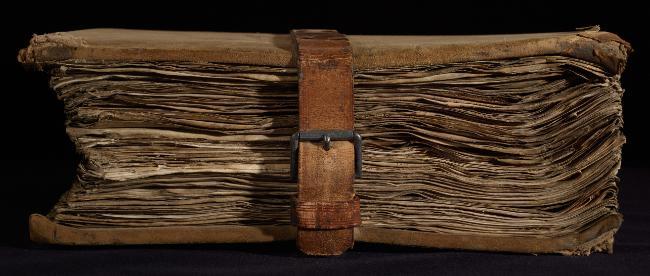
One of our Probate Registers,
New Accessions
We took in twelve accessions in March, seven of these being additions to the University of York Archive. We also added some new slides to the archive of the Yorkshire Wildlife Trust and the latest ‘Goon Show News’ newsletter to the archive of The Goon Show Preservation Society.
Our newest archive was something of an unexpected but very welcome addition. At the beginning of March we were alerted by The National Archives to an upcoming auction sale of a quantity of correspondence and papers relating to the Quaker Tuke family of York, in particular the establishment of the London office of their Tea, Coffee and Cocoa business in the 1840s. As we already hold the extensive Tuke Family Collection, as well as the related Rowntree archives, we were understandably very keen to acquire the archive if possible and thanks to the generous support of Friends of the Nations Libraries we were able to make that happen. It arrived last week and we’re happy to say that it has not disappointed! As well as hundreds of letters between the Tukes and their business partner John Casson capturing the concerns, large and small, of running a business between 19th century York and London, the archive also includes a wealth of printed circulars, posters, wrappers and price lists dating back as far as 1792.
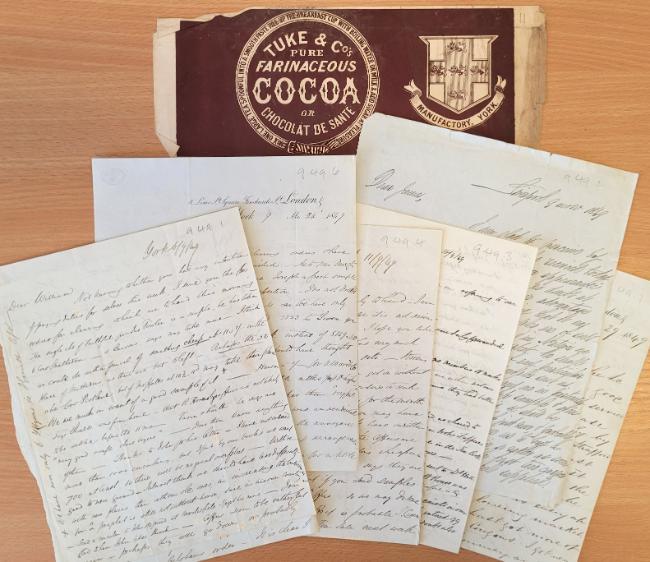
A selection of documents from the newest Tuke accession.
The success of the Tuke family business would leave an indelible mark on the city of York, from the establishment of the pioneering psychiatric hospital The Retreat to the foundation of the world famous Rowntree confectionery company, which started life in the Tukes’ own cocoa and chicory workshop. The Tuke Family Collection already provided a wealth of information about the family and its contributions to causes such as the abolition of the slave trade, education, politics, medicine and psychiatry. Now, we are able to fill in the gaps, broadening our understanding of the family business and of the tea, coffee and cocoa trade more generally. Although the archive has yet to be catalogued, it is fully open to researchers. Please get in touch if you’d like to view it.
New Catalogues
Number of archival descriptions on Borthcat on 1st April 2026: 153,165
In March we added the catalogue for the parish archive of New Malton, St Leonard’s to Borthcat. St Leonard’s became a parish in 1855 but its roots can be traced back to the 12th century when it was a chapel of ease in the parish of ‘Old Malton’. The castle and village of Old Malton were burned by Archbishop Thurstan of York in 1138 after Malton’s lord defected to the cause of the Empress Matilda in the ongoing Civil War between Matilda and King Stephen. As a result a new settlement sprang up nearby which became known as ‘New Malton’, leading to the (sometimes confusing) designations of Old Malton and New Malton.
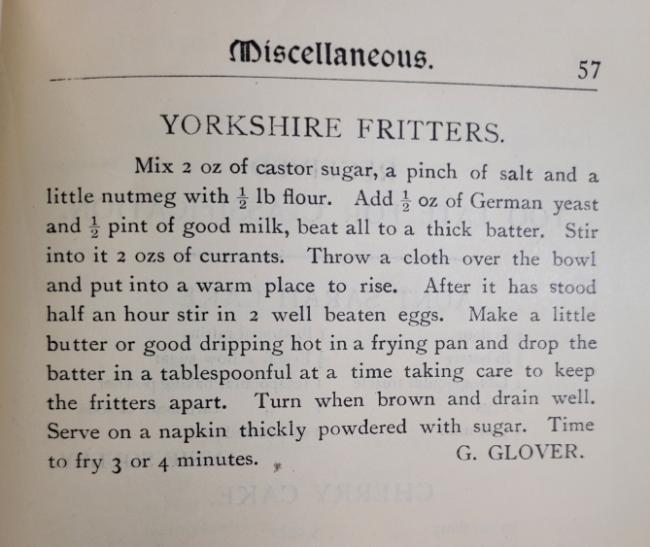
A recipe for Yorkshire Fritters from the parish archive of New Malton, St Leonard's.
Fortunately the parish archive is rather more straightforward, with the usual run of parish registers of baptisms, marriages and burials dating back to 1600, as well as more recent administrative records relating to the church building and the wider parish. One particular highlight is a small souvenir recipe book printed for a bazaar held in 1907 in aid of the church’s restoration fund. The recipes were contributed by parishioners and includes the delicious sounding ‘Yorkshire Fritters’, various sweet and savoury dishes, and an ode to the value of the humble onion - ‘No medicine,’ it’s claimed, ‘is so useful in cases of nervous prostration, and there is nothing else that will so quickly relieve and tone up a worn out system.’
News from Conservation
In Conservation we have been handling a host of loans and exhibition material over the last few months. When loans and/or displays occur we are usually involved in the assessment and documentation of the selected material, any treatment required, mounting and supporting the material for display and packaging for transport if necessary.
If you are out and about at the Bronte Parsonage Museum in Haworth you might see one of our Rare Books, a copy of the 1802 edition of The Arabian Nights’ Entertainments, which the Bronte siblings were known to have read during their childhood. This was given minor treatment before going on its travels, and we made a custom book support for it and supervised its installation at the Parsonage Museum for their new exhibition for 2026, The Colonial Brontes.
We have also helped to facilitate displays for our Post-Offer visit days; a temporary withdrawal for a display of Merchant Adventurers material; the All Shall Be Afforded Dignity exhibition at Thin Ice Press; and a rainbow display of KitKat wrappers for the revealing of a new Blue Plaque at the Cocoa Works on Haxby Road.
Excitingly, our new exhibition area also launched its first exhibition on 25th March. This was to celebrate Dante Day, with an exhibition of facsimiles of manuscripts of the Divine Comedy followed by a poetry reading with Kimberley Campanello. The facsimile exhibition is accompanied by some examples of Monika Beisner’s published work. Beisner is an internationally acclaimed artist, who undertook to illustrate all 100 cantos of the Divine Comedy. Please do come and admire all 12 cases within the next month - we will be able to keep the Dante facsimiles on display for longer, but the 4 cases of Beisner’s work will be deinstalled in the first week of May to welcome a new exhibition.
Borthwick Out and About
At the beginning of March we were thrilled to welcome members of the Universities of York and York, St John’s Doctor Who Societies to view our extensive Terrance Dicks Archive, with bonus material from the archive of Who story editor and writer David Whitaker. The students enjoyed an introductory talk from Keeper of Archives and noted Whovian Gary Brannan, before being let loose on some of the highlights from the collection. Judging from the feedback, a good time was had by all!
To mark International Women’s Day on 8th March Yorkshire Museum featured several of our records in a new display celebrating North Yorkshire botanist Catherine Muriel ‘Kit’ Rob. You can watch a video about the display on the Museum’s facebook or read more about her life and work on the university website, as described by Research Services Archivist, Lydia Dean, who catalogued the archive.
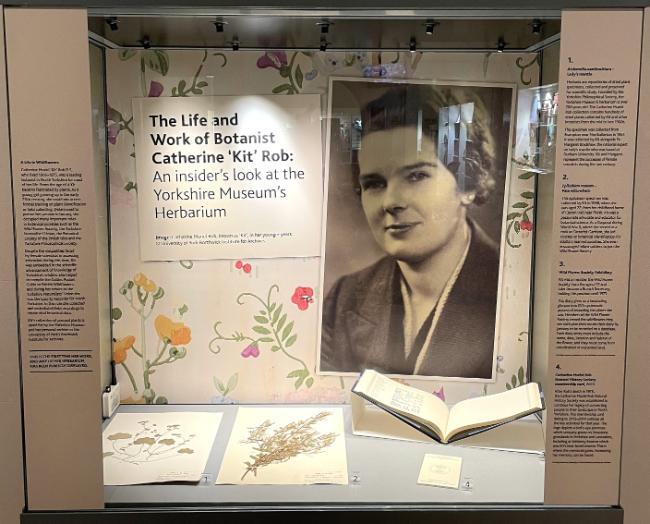
The foyer display on Kit Rob at Yorkshire Museum.
We have also contributed to two new exhibitions. The first, mentioned above in ‘News from Conservation’ was launched for Dante Day and will run in our new exhibition space until the start of June. Away from campus, we were delighted to launch a new collaborative archival display to accompany the current exhibition of Norman Kaplan artworks ‘All Shall Be Afforded Dignity!’, now showing at the Thin Ice Press in St Anthony’s Hall. The archive display is co-curated by our University Archivist, Charles Fonge, and Olivia Reed, a York MA in Museum Studies student who is on placement with the Anti-Apartheid Legacy Centre, and draws on our extensive Southern African and University Archive collections to ground Norman Kaplan’s international activism within a local context. While Kaplan’s powerful linocuts and prints speak to a global struggle and life under apartheid, our featured archives help to highlight York’s own history of advocacy and resistance. Visitors can explore a selection of student newspapers, circulars, photographs and leaflets that served as the tools and expression of solidarity on campus.
The records offer a localised lens on the fight for democracy and justice, illustrating how university communities responded to apartheid through print culture and collective action. Set within the historic home of Thin Ice Press (and, until 2004, home of the archives themselves), the display invites us to reflect on how art and everyday activism combined to champion the universal rights to freedom and dignity. The exhibition is free to visit and runs until 30 April 2026.
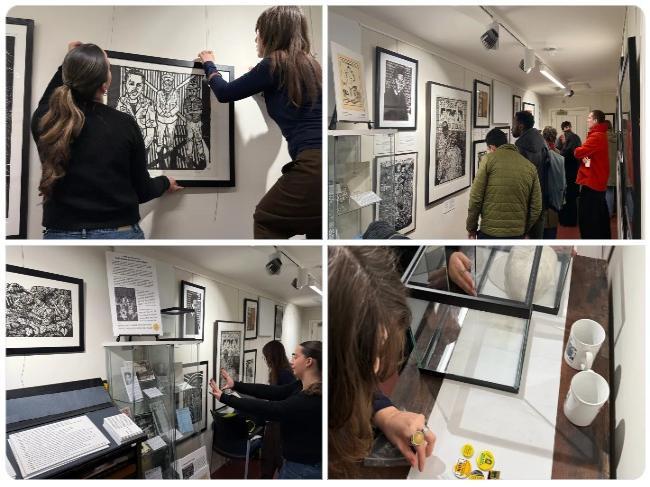
Photographs from the exhibition shared by the Anti Apartheid Legacy Centre
On the 25th of March, Charles also had the rare privilege of witnessing history in the making, as he represented the Canterbury and York Society at the installation of Sarah Mullally as the 106th Archbishop of Canterbury. As Honorary Secretary of the Society, whose Presidents are the archbishops of Canterbury and York, he was delighted to be part of this landmark occasion. The Society is renowned for publishing editions of medieval bishops’ and archbishops’ registers and other ecclesiastical records and has long-standing ties with the Borthwick and its records. Its forthcoming volume will feature further sections of the York register of William Melton, archbishop from 1317 to 1340. Entries relate to the archbishop’s Mint, the war with Scotland and reflect the resultant transfer of government departments to York. They also cover an attempt to raise forces against Queen Isabella and Roger Mortimer’s invasion in 1326, and to Melton’s funding of the great West window of York Minster.
Looking ahead to April, we will be hosting visits by members of the York Family History Society and the Fishergate, Fulford and Heslington Local History Society, as well as manning our usual Borthwick Institute stall at three upcoming Post Offer Visit Days on campus (if you’re coming along to these, please come and say hi!). We’ll also be taking a selection of historic KitKat wrappers along to the unveiling of a blue plaque commemorating the former Rowntree’s Cocoa Works on Haxby Road on 10th April. The event is organised by York Civic Trust in recognition of one of York’s most significant industrial and social heritage sites.
Archive of the Month: York Diocesan Archive Probate Collection
What is it? The wills proved at the Prerogative, Exchequer and Peculiar Courts of Probate in York between 1389 and 1858, covering most of Northern England.
Where can I find it? All of the probate registers and surviving original wills are housed here at the Borthwick. The probate registers have been indexed by name and can be searched here and on Ancestry and Find My Past. As of the 31st March you can also view original scans of all of the wills in the probate registers on Ancestry. Please contact us if you need help or advice on how to find a will.
Why is it Archive of the Month? With the launch of the probate registers on Ancestry.com this seems an excellent time to celebrate the Borthwick’s vast probate collection. You may already be familiar with it, certainly enquiries about wills and orders for scanned copies of wills make up a substantial part of the hundreds of emails, letters and phone calls our searchroom team receive each month.
For those who are less familiar, until 1858 there were two main jurisdictions for probate in England - Canterbury in the south and York in the north. If a person made a last will and testament, then following their death that will would need to be ‘proved’ by a Court of Probate, in other words the court would need to see the original will and rule that it has been made and witnessed correctly and was therefore a legally binding document. Once it had been proved by the court, the text of the will was copied into one of a series of probate registers and the original will was rolled up and filed away in the diocesan probate registry. In theory, this should mean that for every will proved at York, there should be an original will and a copy of the text of the will in the relevant probate register for that year. In reality (and as many researchers have discovered) sometimes the original will has not survived and all that remains is the probate register copy. You can read a more detailed guide to the probate courts, and the exceptions to coverage, on our website.
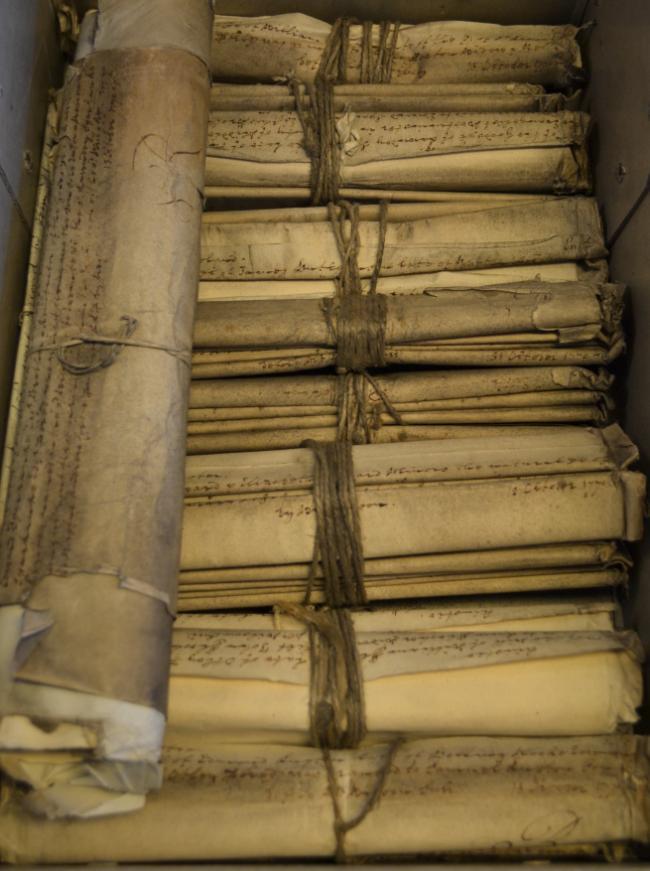
A box of original wills, still rolled and tied.
The resulting collection is an immensely rich record of the lives of hundreds of thousands of men and women over the course of nearly five centuries as they put pen to paper to make their final beliefs and wishes known. From the deeply held religious faith that guided decisions on how and where they wished to be buried, to what they owned and who they left it to, and the names of friends, relations and business partners; loved ones are remembered with gratitude, debts (and grievances) are settled, and codicils are added and amended as testators change their minds - sometimes multiple times. Some original wills also include detailed inventories of the household belongings of the deceased, providing a tantalising glimpse of their day to day lives and material comforts.
Whilst some wills are only a few lines long, others fill many pages and their format can be as unique as the person who wrote them. Among the collection of original wills, we have ones that have been written on the back of family letters and musical notations, wills that have been doodled on, and even a will written in the form of a poem. The probate registers are more formal, but even that hasn’t stopped the diocesan clerks showing off their impressive calligraphy and adding in ornate capital letters and the occasional illustration - like this impressive dragon at the start of Probate Register 9.
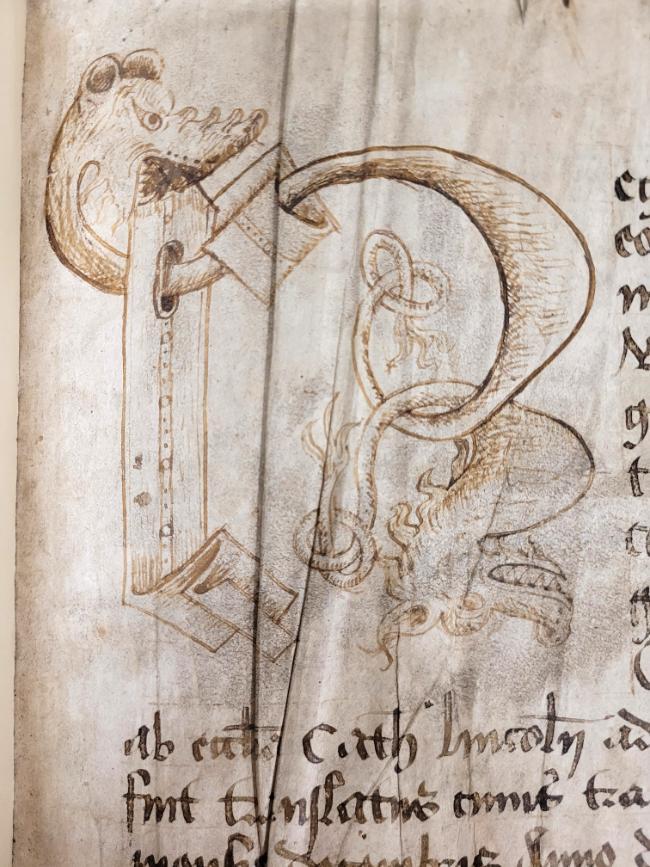
The probate collection is fully open to the public, so whether you’re researching your family history or want to know more about how people lived and worked in the past, it’s ready to be explored onsite and now online as well. Happy hunting!
We’ll be back in May with more news and events from the archives.
Borthwick Institute for Archives
University of York,
Heslington,
York,
YO10 5DD,
UK
Tel:
01904 321166
|
borthwick-institute@york.ac.uk

Legal statements | Privacy | Cookies | Accessibility
© University of York | Modify | Direct Edit