

Professional Registration
What is Professional Registration?
Awarded by professional bodies like the Institute of Science & Technology and the Science Council, professional registration validates your practical skills, industry knowledge, and commitment to excellence.
While academic degrees show what you studied, registration proves what you can actually do. It bridges the gap between formal education and real-world experience, giving you immediate credibility as a skilled technician.
Benefits for you:
- Boosts promotion potential
- Sharpens your interview edge
- Formally accredits your career development
Benefits for employers:
- Enhances company reputation
- Guarantees high standards of practice
- Builds client trust
Why become Professionally Registered?
Why get professionally registered? (Science Council short video)
- Gain formal credibility: Turn years of on-the-job learning into an immediate, internationally recognised qualification.
- Benchmark your expertise: Validate your technical skills against global industry standards.
- Accelerate career progression: Stand out to employers, boost your promotion prospects, & increase your earning potential.
- Ensure skill transferability: Take credentials with you that are easily recognised across different roles, companies, and sectors.
- Drive personal development: Elevate your confidence, deepen job satisfaction, & demonstrate a commitment to lifelong growth.
- Give back to the community: Share your expertise, mentor emerging technicians, & raise standards across the field.
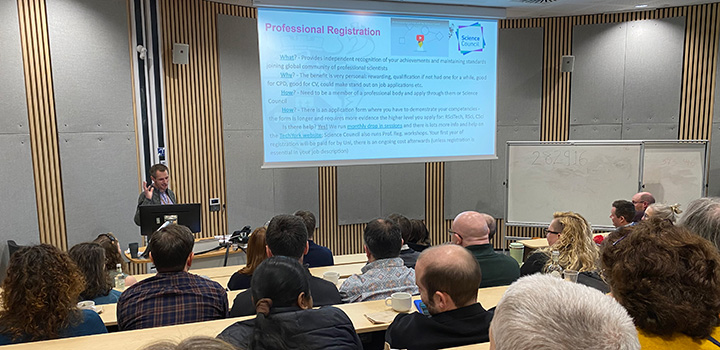
Watch University of York Head of Technical Operations, James Fox, describe his personal experience of professional registration during a webinar entitled "Why gain professional registration in engineering, the environment, and science".
Applying for Registration
We recommend that you apply for registration through either the Institute of Science & Technology (IST) or Science Council (SC) websites.
There are many other professional bodies which can award professional registration, some of which focus on specific disciplines, industry sectors, or type of employee. You can decide which is most appropriate for you.
Resources and Support
Take advantage of national workshops, videos, and local support to guide your registration journey:
- Science Council Workshops: Attend free online workshops to learn about the process and begin your application. View upcoming dates and register on the Science Council website.
- Application Video Guide: Watch the Science Council's Completing Your Application Video for a step-by-step walkthrough.
- UoY Drop-In Sessions: Join our local drop-in sessions to get one-on-one advice from University of York Mentors, receive feedback on drafts, or simply dedicate quiet time to writing your submission. Check the TechYork Events Page for upcoming session dates.
Top tip - get a registration buddy to support you through the process!
Heads of Technical Operations Graeme McAllister and James Fox serve as University of York’s Professional Registration Champions. As active Science Council assessors, they know exactly what makes a successful application. Reach out to Graeme and James for tailored advice and support through the registration process.
Funding and fee reimbursement
The University will reimburse the cost of your individual professional registration, provided the following conditions are met:
- HMRC Approval: The professional body must be included on the HMRC Approved List. Includes IEEE, IST, IoP, RSB, RSC and SC.
- Job Description Requirement: Professional registration must be listed as essential or desirable in your job description. Professional registration is standard in all current generic JDs, grade 5 and above. If your job description is over 6 years old, speak with your line manager about transitioning to a generic JD to ensure policy eligibility.
Important Fee Distinction:
The University covers your professional registration fee but does not cover general membership fees. Here is an example:
IST
- Member fee £57 - The individual pays
- Registered scientist (Rsci) £45 - The university will pay
Case studies
Read our staff experience stories:
- My registration story - read about one colleague's experience of registration; how it has benefited their career & why it pays to prepare.
- Upgrading to CSci - read how two colleagues made the move from RSci to CSci, & their advice on how best to approach registration.
Opportunities after registration
Once registered, you can give back to the technical community by volunteering with the Science Council and TechYork.
Key volunteer roles include:
- Professional Registration Champion: Inspire your colleagues by sharing your experience and advocating for the benefits of registration.
- Science Council Registration Assessor: Review applications, maintain industry standards, and mentor the next generation of technicians through their journey.