
Health Sciences

- Health Sciences
- Research
- Centre for Health Research Inclusion
- Projects
- Socially disadvantaged groups
Socially disadvantaged groups
This section showcases projects that focus on the inclusion of a wide range of socially disadvantaged groups. This includes, for example, women leaving prison and people experiencing food poverty. We are adding new studies to this section every few months, so please keep checking in to keep up-to-date.
The ARROW study
Project title
Assessing the potential of a women only, gender- and trauma-informed residential rehabilitation pathway for drug dependent women leaving prison.
What we’re doing
The Review of Health and Social Care for Women in Prison (NHS England, 2023) highlighted the lack of quality treatment for drug dependent criminalised women (DDCW) and the importance of continuity of care on release.
ARROW is a 2-year NIHR-funded project examining whether moving women directly from prison to women-only residential rehabilitation (WORR) services can support their long-term recovery from drug use, helping both them and their children live better lives. As well as long-term recovery from drug dependency, we will explore all the other ways in which the women’s lives might have improved, such as employment, housing, relationships with children, and better mental and physical health.
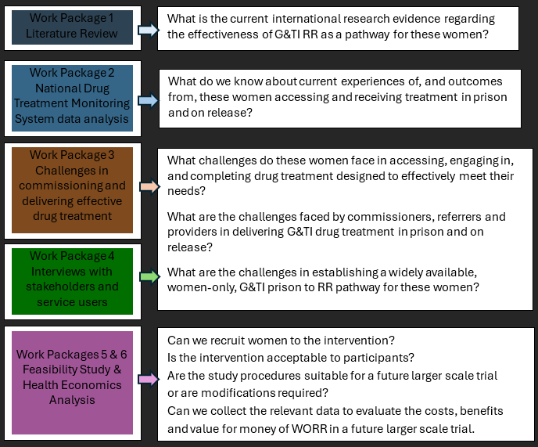
The project comprises six work packages including a survey of commissioners, participatory research with services users and providers in both the drug treatment and criminal justice sectors, and analysis of National Drug Treatment Monitoring System data to track the drug treatment journeys of a cohort of women on release from prison. A feasibility study aims to assess the feasibility of evaluating a resettlement pathway DDCW leaving prison, comprising of immediate transfer to a women-only, gender-and trauma- informed residential rehabilitation (G&TI RR) facility, in achieving long term recovery from dependent drug use compared to treatment as usual. Health economic analysis will explore the scope of costs, benefits and value for money of WORR.
How we’re doing it
Research inclusion: Including an underserved group in a trial
Female prisoners are more likely than male prisoners to use Class A drugs. They often commit crimes to support their drug use and, when they are sent to prison, they frequently ask for help with that drug use.
Many women leave prison without a support plan to stay off drugs and most do not even have a safe place to live. Women can find drug treatment services that accept both men and women difficult because of their experiences of trauma and violence. So, it is possible that WORR might work better in supporting their recovery.
WORR services can provide specialist women-centred support, safe accommodation, and help with other issues such as trauma, mental health and finding a job.
Team
The ARROW team is led by Professor Sharon Grace (University of York) with co-investigators Professor Charlie Lloyd, Dr Jude Watson, Dr Geoff Page, Alex Mitchell, Steve Parrott, Jinshuo Li (all University of York), Professor Tim Millar and Dr Andrew Jones (both University of Manchester) and Associate Professor Sarah Page (Staffordshire University). Dr Claire Warrington (University of York) is the project’s Research Associate and the feasibility study team, based at York Trials Unit, comprises of Rachel Ellison, Camila Piccolo-Lawrance and Shannon Halmkan.
Find out more about the study, contact: arrow-study@york.ac.uk
Funder information
This study is funded by the National Institute for Health and Care Research (NIHR) Public Health Research (NIHR166825).
BiBBS ACHIEVE
Project title
BiBBS ACHIEVE: Addressing Childhood Inequalities through Evidence-Based Early Interventions using Born in Bradford’s Better Start (BiBBS) birth cohort

What we’re doing
Socially disadvantaged children in high income countries experience poorer health, wellbeing, and developmental delays. These children have also experienced multiple systemic shocks (e.g. austerity/pandemic/cost-of-living crisis), the long-term impacts of which are unknown. The UK spends billions on a system of preventative support for families, but entrenched inequalities suggest that this system is failing disadvantaged children.
The BiBBS ACHIEVE project will utilise Born in Bradford’s Better Start (BiBBS), an innovative interventional birth cohort designed to evaluate the effectiveness of multiple preventative interventions. BiBBS includes >5,500 ethnically diverse and deprived children and families, recruited throughout recent systemic shocks (2016-2024).
How we’re doing it
BiBBS ACHIEVE will enhance the BiBBS cohort with additional data collection in middle-childhood (aged 7-8) and the use of creative, innovative methodologies to:
- Generate significant advances in understanding of the mechanisms by which these contemporary experiences impact the health, wellbeing, and educational development of socially disadvantaged children.
- Push the boundaries of understanding of how existing interventions can be adapted and combined to effectively mitigate the impact of these exposures and reduce inequalities in child outcomes.
Research inclusion: Ethnically diverse and socially disadvantaged families
The BiBBS cohort consists of ethnically diverse and socially disadvantaged families who are disproportionately under-represented in research. BiBBS has successfully recruited a representative sample of >5,500 babies and their families consisting of 88% ethnic minorities, 55% migrants, with many facing adversity, including maternal obesity (56%), poor maternal mental health (46%) and child language delay (25%).
BiBBS ACHIEVE will apply the social determinants of health framework to allow in-depth understanding of the multiple, complex mechanisms by which inequalities have been exacerbated by recent systemic shocks (e.g. COVID), and how combinations of interventions can work to mitigate these effects and for whom they will work.
BiBBS ACHIEVE will apply previously successful approaches for improving recruitment and inclusion of underserved families used by BiBBS, such as recruitment by bilingual community researchers at community events (e.g. school parent evening, religious settings), and surveys being undertaken by bilingual researchers (32% mothers have limited English), face-to-face or by phone. Data collection will be deliberately concise to enhance response rates and ensure a representative/inclusive sample. Throughout BiBBS recruitment, a Community Research Advisory Group (CRAG), consisting of parents and local community members, have supported study processes and development of evaluation plans. The CRAG has been central to the development of BiBBS ACHIEVE, requesting an equal focus on knowledge generation on the early-years and in middle-childhood.
Team
The study is led by Professor Josie Dickerson at the Bradford Institute for Health Research.
University of York Staff include Professor Kate Pickett, Dr Sarah Blower, Dr Kate Mooney, Dr Sebastian Hinde, and Dr Rachael Cheung.
External partners include Professor Josie Dickerson (Bradford Institute for Health Research), Dr Sunil Bhopal (Bradford Institute for Health Research), Dr Sufyan Dogra (Bradford Institute for Health Research), Professor John Wright (Bradford Institute for Health Research), Professor Sharon Goldfeld (Murdoch Children's Research Institute).
For more information, see our website at: https://www.york.ac.uk/healthsciences/research/public-health/projects/bibbs-achieve/
https://borninbradford.nhs.uk/what-we-do/studies/bibbs-achieve/
BiBBS ACHIEVE is funded via a Wellcome Discovery Award.
The Fair Food Futures
Project title
The Fair Food Futures (FFF) UK project
What we are doing
The FFF UK project aims to understand the role of community food organisations in the UK to support families who experience food insecurity. We are interested in the ways organisations (like food banks, pantries and community cafes) offering help with food also provide other types of support beyond food, for instance with benefits and bills. We want to understand how this wider support can help families to be in a better place, where food from food banks and similar organisations is no longer needed. This project is funded by the National Institute for Health and Care Research.
Research inclusion: Families experiencing food insecurity
Fair Food Futures UK represents a project of true partnerships and inclusive practice by its co-creating nature and by centering the voices of people with food insecurity via a photo exhibition, transforming them from research subjects into content creators, ensuring dignity and agency.
FFFUK researchers spent 12 months volunteering in 9 community food organisations, where they observed how organisations worked in practice. We also recruited 40 families with diverse backgrounds who experienced food insecurity (many who used the food organisations). Over the course of a year, we listened to their stories, learnt about their challenges and explored what support they value most. They also shared photos with us that were meaningful to them (related to food) in order to generate a discussion about the lived experiences of many people in the UK. Photography workshops empowered them and offered new skills, as well as providing a way to express themselves and advocate for change.
FFFUK were also very lucky to work in partnership with a community advisory group consisting of people who have experienced food insecurity from a variety of backgrounds, including minoritised ethnic backgrounds, asylum seekers and other people who are under-represented in research.
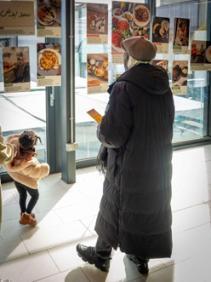
Participants and some of the advisory group members played key roles in launching two photo exhibitions to members of the public and policy makers. They are now on display in public areas (The Bromley By Bow community centre (Tower Hamlets, London) and Darley Street Market (Bradford)). One of the exhibition visitors said that “the photos are like a gift to the public” and another wrote that “the photos and the quotations are powerful voices of the voiceless. It is important that the exhibition travels!”
Team
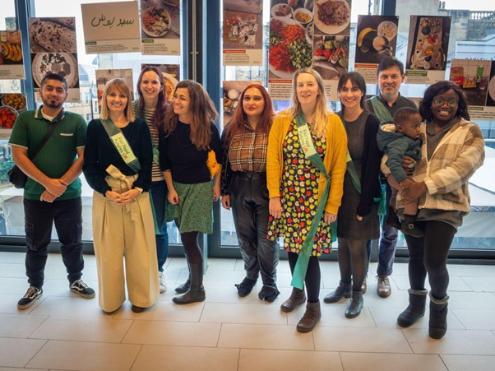
The FFF UK project exemplifies authentic partnership that spans boundaries by integrating the voices of academics, local and national policy makers, community food organisations, and most importantly of those with lived experience of food insecurity. It is led by Professor Maria Bryant (University of York) and Dr Laura Sheard (now at Manchester University). Other UoY researchers include Dr Giorgia Previdoli, Dr Wendy Burton, Dr Ariadne Kapetanaki, Dr Philip Hadley, Professor Kate Pickett, Professor Bob Doherty. In University College London, the team are: Professor Claire Cameron and Dr Rachel Benchekroun. The research team also includes Dr Maddy Power, at the London School of Medicine and Tropical Hygiene, Shahid Islam, at Bradford Institute of Health Research and partners with Bradford council and the London Borough of Tower Hamlets. Importantly, we have worked closely with members of the public, including Sairah Mirza, who joins our research team meetings and our wonderful public advisory group.
Find out more on the study website: https://www.fairfoodfuturesuk.org/
Funding
This study is funded by the NIHR Public Health Research Programme (NIHR151034). https://www.nihr.ac.uk/explore-nihr/funding-programmes/public-health-research.htm The views expressed are those of the authors and not necessarily those of the NIHR or the Department of Health and Social Care. The funder did not play any role in the study design, data collection, decision to publish or preparation of the manuscript.
SPIRE Study
Project title
Supporting parent-infant relationships equitably (SPIRE)
What we’re doing
During the first two years of life, responsive relationships with parents or caregivers help babies feel secure, understood, and supported, laying the foundation for healthy development. However, caring for a new baby can be a complex time, and many parents and caregivers may find it difficult to build a strong connection with their baby. It is important to be able to identify families experiencing parent–infant relationship difficulties and signpost them to appropriate support.
The Department of Health and Social Care has published guidance for staff working with families with young children, to help open sensitive, meaningful discussions about parent-infant relationships. We are conducting an independent evaluation of the new guidance. Our research aims to explore whether the guidance is acceptable and useful in practice, whether it helps identify families to refer for additional support, and what training and support might help support staff to use the guidance effectively and sensitively.
How we’re doing it
We have identified four geographic areas of England where the guidance has been adopted to varying extents. In each area, we are inviting parents/caregivers and staff members to share their perspectives of the new guidance. We are also exploring the impact of the guidance on referrals to relevant services. We will hold a national stakeholder workshop to discuss the findings and identify recommendations for policy.
Research inclusion: Parents and caregivers from marginalised groups
We are using the Health Equity Implementation Framework to ensure a clear focus on equitable implementation throughout the research. We used the framework to inform the design of the topic guides for staff and parent/caregiver interviews, and will use it when interpreting the findings. We have prioritised inclusion of marginalised groups of parents/caregivers in the research, including kinship carers, adoptive and foster parents, grandparents, parents not with their children for any reason, fathers, other non-birthing parents or caregivers, parents with experience of perinatal mental health difficulties, parents and caregivers from marginalised ethnic backgrounds, families with experience of perinatal mental health difficulties, families whose first language is not English, LGBTQI+ families, parents/caregivers under the age of 25 years, and parents/caregivers with disabilities and/or neurodivergence.
We have proactively designed the research to be inclusive, for example, identifying local community groups in each area to support with inviting families to take part, co-designing a video to invite people to take part in the research with our lived experience group, translating our recruitment materials, including costs for interpreters for interviews, and using purposive sampling to invite people to take part in interviews and focus groups.
Team
The PI is Dr Sarah Blower, in the Department of Health Sciences, University of York. Our SPIRE team members include Katy Baynes, a public co-investigator, and researchers Tracey Bywater, Zoe Darwin, Kelly Hollingsworth, Simona Manni, Claire Marshall, Kate Mooney, and Kate Morton. We are also supported by an Expert Advisory Board made up of specialists in parent–infant relationships and family support, as well as a Lived Experience Group of parents and caregivers who have personally experienced concerns about bonding with their baby.
For more information, see our website at: https://www.york.ac.uk/healthsciences/research/public-health/projects/spire/
This independent research is funded by the National Institute for Health and Care Research Policy Research Programme (NIHR207680).