
Borthwick Institute for Archives

- Borthwick Institute for Archives
- News
- 2025
- Borthwick Newsletter - July 2025
Borthwick Newsletter - July 2025
Posted on 30 June 2025
July in the Archives - delve into our catalogues with this month’s featured description
Letter from Sarah Grubb (née Tuke) to Henry Tuke: recollections of travels as Quaker minister in Scotland and the duties associated with Quaker Ministry. 4-8 July 1783 [TUKE/1/4/1/2/3]
What’s New?
June has been a rather warm month here in York, which might explain all the people flocking to our climate controlled searchroom. Over the past four weeks we’ve welcomed 92 researchers, hosted 6 onsite visits, and shared our ‘Best of the Borthwick’ archive display with more than 500 prospective students and their families across 2 university open days. We’ve even received a visit from comedy legends Eric Morecambe, Bob Monkhouse and Tommy Cooper - or rather, the talented actors playing them in a new stage production ‘The Last Laugh’ at York’s Grand Opera House. Read on to find out more!
New Accessions
We took in twelve accessions in June, all but of which was an addition to an existing collection. We made six additions to the University of York Archive, including the websites of the university’s Cyber Security Society, Web and App Development Society, and the Computer Science Society. We also added a selection of DVDs, programmes, flyers and photographs to the Joseph Rowntree Theatre Trust Archive and a workshop pack for the 1996 production ‘White Clouds’ to the archive of composer Trevor Wishart.
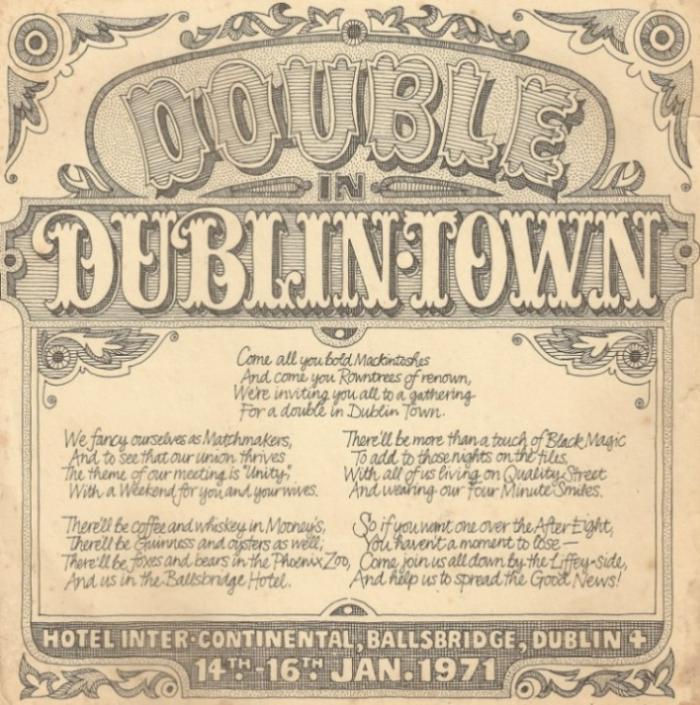
Sticking with the musical theme, we were excited to be gifted three flexi discs of promotional music recorded for Rowntree Mackintosh - not something we come across very often. Two of these contained jingles used for the ‘Good News’ chocolates and ‘Chew-Chew Toffee Crisp’ television advertisements, but the third contains an original song by The Peelers specially recorded for guests at the 1971 Rowntree-Mackintosh company conference in Dublin (and packed choc-full of confectionery puns). The conference was held soon after the merger between Rowntree and Mackintosh, a change which clearly influenced the song lyrics: ‘We fancy ourselves as Matchmakers/ And to see that our union thrives/ The theme of our meeting is “Unity”/ With a weekend for you and your wives.’ We can vouch for it being pretty catchy!
Thanks to the support of Friends of the Nations Libraries; the V&A/ACE Purchase Grant Fund, and Friends of the Library and Archives (York), we were able to purchase a further eleven items for our Eric Morecambe Papers in June, including a notebook with ideas for sketches and jokes and his appointment diaries and address books. And not forgetting our newest archive, gifted by Professor Christopher Norton, which includes survey and research data relating to the historic King’s Manor in York, in particular the restoration work of 1988-1991.
New Catalogues
Number of archival descriptions on Borthcat on 1st July 2025: 142,851
In June we added the parish archive of Birkin with Haddlesey and the company archive of Terry’s of York to Borthcat. The Church of St Mary, Birkin, dates from the twelfth century although, as with many parishes, the surviving records don’t begin until many centuries later. The earliest parish register starts in 1649 and the archive contains the expected mix of registers of baptisms, marriages and burials, churchwardens’ and parochial church council records, and records relating to the fabric of the church and churchyard - but there are one or two surprises hidden among the routine administration.
The first is a 1747/8 note of ‘parochial rewards’ for prosecutors of thieves, which was prompted by a spate of burglaries in the township whereby corn, poultry and other items were stolen away, ‘peoples houses beset & the Inhabitants disturbed in their beds & put in fear by disorderly persons in the night time’. A public meeting was held to discuss the matter and the town agreed to pay a reward of up to 20 shillings (£1) to anyone who could discover the culprit or culprits, so long as they were successfully prosecuted for the offence, with all additional costs being covered by the town. In the 18th century policing was minimal and individuals were required to bring prosecutions themselves, a time consuming and often expensive process. As a result, rewards were often used as an incentive and given that 20 shillings was 10 days wages for a skilled tradesman at the time, it’s quite likely that this particular reward inspired some would-be detectives!
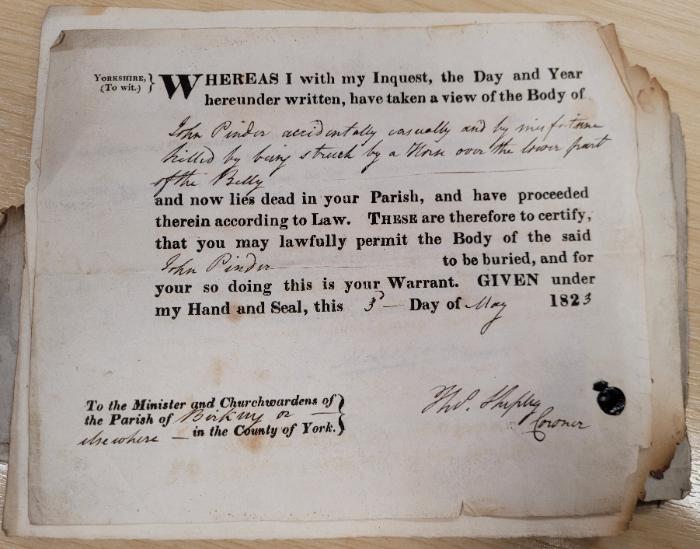
The second unusual addition is a bundle of coroner warrants for burials, dated from 1786 to 1833. These were issued following a coroner’s inquest, once the cause of death had been established and the coroner was satisfied the body could now be removed for burial. As a result they often list the cause of death, something not always present in burial registers of the same period. Causes of death at Birkin include Jane Wilbourn, who died ‘by the Visitation of God in a violent Fit of the Colic’, John Pinder who was struck by a horse, and Sarah Baxter who was accidentally and ‘by misfortune’ killed by a stone thrown by Thomas Pollard which struck her on the side of the head. These warrants are, so far, the only ones we know of in our collections, which makes their survival in a relatively small parish archive all the more interesting.
You can read more about the archive of Terry’s of York in June’s Archive of the Month below.
News from Conservation
We've had a hotch potch of a month in Conservation. Business as usual has been rumbling along, with an exhibition deinstallation, environmental monitoring, cleaning and flattening customer reprographics orders, digitisation project support, prepping and mounting material for an offsite display and various packaging requests fulfilled. But we've also participated in some less regular activities.
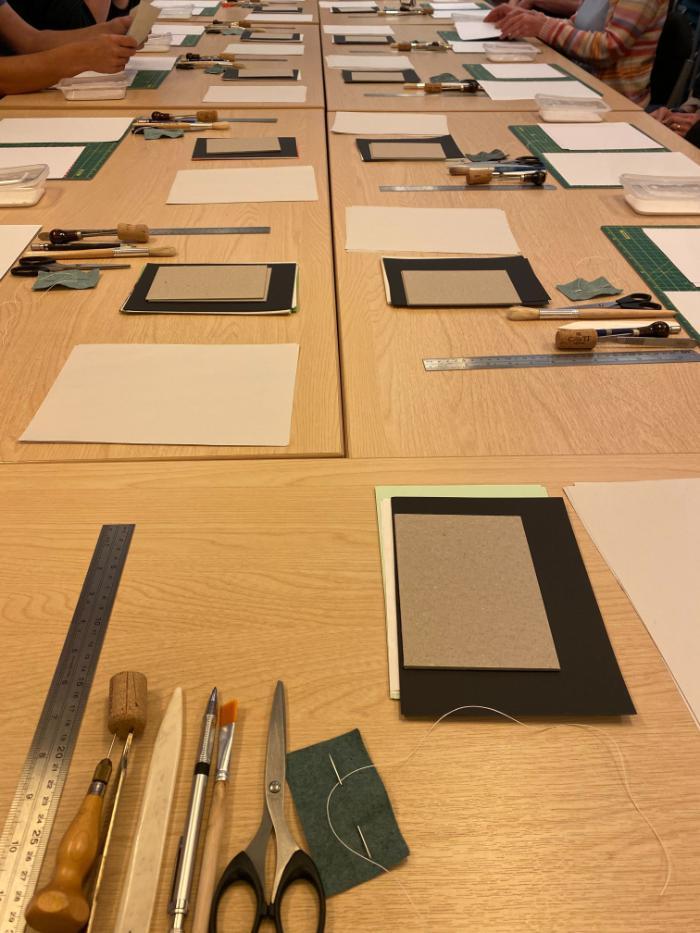
Catherine ran a bookbinding workshop with fellow York conservator Emma Lloyd-Jones for the Festival of Ideas; we had a fantastic visit from a sculpture conservator to look at the condition of some of our campus sculptures; and conservation ran several sessions for our Archives Insight Week placement students, to share how conservation fits into the archive world. As well as surface cleaning architectural plans, the students managed to create an exhibition in just one day, which will be on display from the beginning of September in our Burton display cases on the ground floor.
Borthwick Out and About
June was a pretty hectic month here at the Borthwick. We began with the York Festival of Ideas which included a sold-out talk on ‘The World of Hancock and Steptoe’ by our Keeper of Archives, Gary Brannan, exploring the recently acquired archive of comedy writers Galton and Simpson. You can watch the complete talk on YouTube or listen to Gary talk further about the archive on the comedy podcast Goon Pod, in particular the discovery of several early sketches, written by Galton and Simpson and featuring characters from The Goon Show.
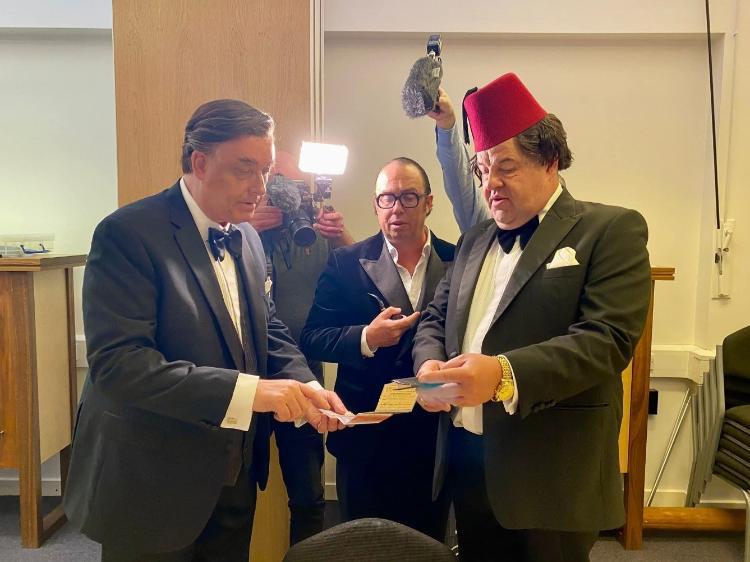
When he wasn’t promoting our campaign to save the final part of the Galton and Simpson Archive, you might have spotted Gary on BBC Breakfast, as well as BBC York and BBC Look North, in connection with another comedy legend, Eric Morecambe. On the 11th June, actors Bob Golding, Simon Cartwright and Damian Williams visited the Borthwick to see Morecambe’s handwritten joke books, acquired earlier this year. The three were appearing as Morecambe, Bob Monkhouse and Tommy Cooper in a play ‘The Last Laugh’, which had recently arrived in York from the West End. The visit was covered on local radio and television and you can also read about it in the York Mix and The Northern Arts Review.
Away from the world of showbiz, we hosted nine undergraduate students for our first annual Archives Insight Week. Over the course of five days the students were introduced to different aspects of archival work by various members of staff and had the opportunity to try their hand at box listing, packaging, and putting together a small exhibition. The results of the latter can be viewed in the exhibition cases on the top floor of the Raymond Burton wing.
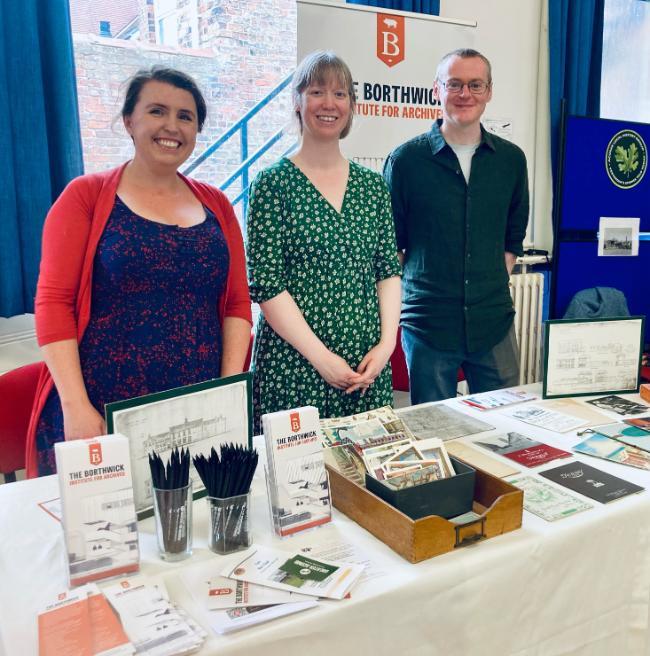
We were also pleased to host a number of visits to the archives, including representatives from the National Museum of Tanzania, The Rowntree Society, the York Civic Trust, and the Company of Merchant Adventurers of the City of York, and to take part in the university’s most recent Open Days for prospective students. Away from campus, we took a selection of new leaflets, pencils (and ourselves) to the York Family History Society Fair at Acomb on the 28th, meeting present and hopefully future researchers and answering questions about what we hold and how they can access it.
Finally we were grateful to receive a copy of a new book, ‘Drowned: The Stillingfleet Tragedy’ by David Lewis, which was inspired by a Borthwick Blog on the same event, written by Archives Assistant Neil Adams. Mr Lewis’ book delves deeper into the tragedy which saw 11 church singers lose their lives when a boat foundered on the River Ouse on Boxing Day, 1833. Our own copy will be available for consultation in the searchroom reception and we will keep you updated when copies are made available for purchase elsewhere.
Looking briefly ahead to July, we’ll be opening up the Borthwick searchroom on the 3rd for the university’s ‘Celebrating Spaces: Connecting Researchers’ event and we’ll be taking a stall to History Day North at Durham on the 29th. You can also expect more Borthwick related podcasts for your listening pleasure. Gary will be appearing in an episode of the StepPod and Son podcast next week and in two new episodes of our Curator and Keeper podcast with University Art Curator Helena Cox. Additionally we are putting the finishing touches to our first Borthwick Paper Podcast, in which Stan Young discusses the life and legacy of Noel Terry. We’ll have links to all of those (and more) in the August newsletter!
Archive of the Month: Terry’s of York
What is it? The surviving records of the York based confectionery company that gave the world the Chocolate Orange.
Where can I find it? The archive has now been fully catalogued and is available to search on Borthcat.
Why is it Archive of the Month?
Today the name ‘Terry’ is largely synonymous with one thing, the Chocolate Orange, but there was a time when Terry’s of York was as much of a York institution as Rowntree’s, employing thousands of local people across its factories, shop and restaurant and even influencing the creation of a beloved stage and film musical.
It was a business founded not with the chocolate you might expect, but with the medicinal lozenges, candied peel and sweets sold by William Bayldon and Robert Berry in York in the late 18th century. The first Terry - Joseph Terry of Pocklington - did not join the business until 1823, after which the business briefly traded under the memorable name of Terry and Berry. In 1830 Terry became the sole owner, beginning the slow but steady rise of the family and business from a single small shop to one of the ‘big six’ confectionery firms in the UK alongside Fuller’s, Cadbury, Fry, Nestle and Rowntree.
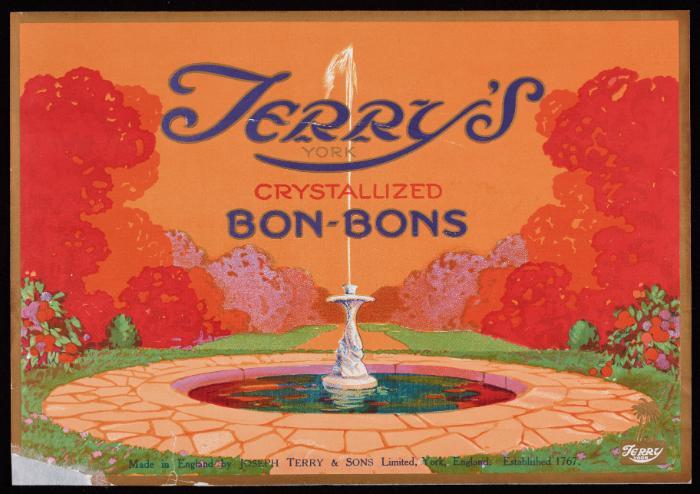
The surviving archive is particularly rich for this early period, with sales ledgers dating back to the 1820s and purchase ledgers dating back to the 1840s. An especially fascinating survival is a recipe book for food, drink and medicinal products that begins in 1834 and includes such products as Raspberry Vinegar, Treacle Parkin and ‘Port Wine Lozenges’. These early products were made in the small factory at Brearey Yard (also known as Brearey Court) in Stonegate and sold in the nearby shop in St Helen’s Square. If you visit the square today you can still see the Terry name etched on the front of the building that once housed the ‘Front Shop’ and popular Terry’s restaurant where, thanks to the many menus in the archive, we know visitors could stop for lunch, maybe have a drink at the ‘American Soda Fountain’, and then buy a bag of sugared almonds or a beribboned box of chocolates on their way out.
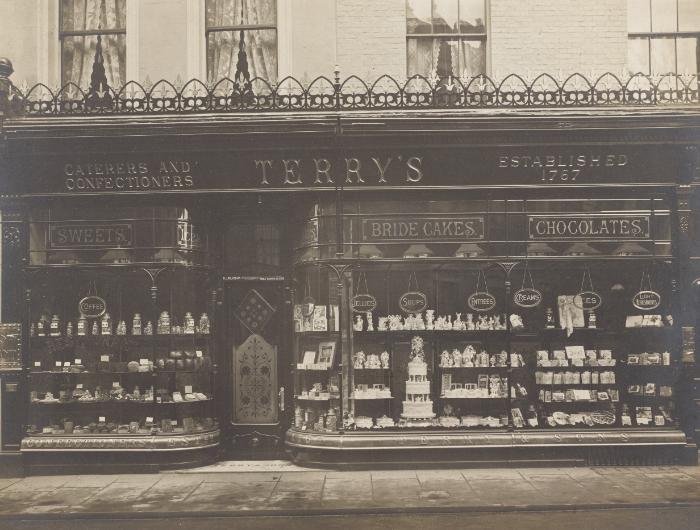
It is of course the chocolates that have become the company’s lasting legacy, but did you know the Chocolate Apple was launched seven years before the Chocolate Orange? Or that composer Lionel Bart would one day attribute the idea for the musical Oliver to his childhood enjoyment of the Terry’s Oliver Twist chocolate bar? The archive reveals all this and more, thanks to the survival of original packaging, illustrated product catalogues and price lists, as well as publicity materials for the company’s many and varied promotional schemes - from a replica Terry’s shop at York Castle Museum to a Terry’s All Gold hot air balloon flying over Yorkshire.
There are, inevitably, gaps in the archive, particularly among the records of the Board of Directors and company employees, but we are fortunate that what remains touches on every part of the business and on almost every decade of its existence, charting the rise (and fall) of a Yorkshire confectionery giant.
We’ll be back in August with more news and events from the archive!
Borthwick Institute for Archives
University of York,
Heslington,
York,
YO10 5DD,
UK
Tel:
01904 321166
|
borthwick-institute@york.ac.uk

Legal statements | Privacy | Cookies | Accessibility
© University of York | Modify | Direct Edit