
Humanities Research Centre

- Humanities Research Centre
- How we support our postgraduate students
- Opportunities
- HRC PhD poster competition
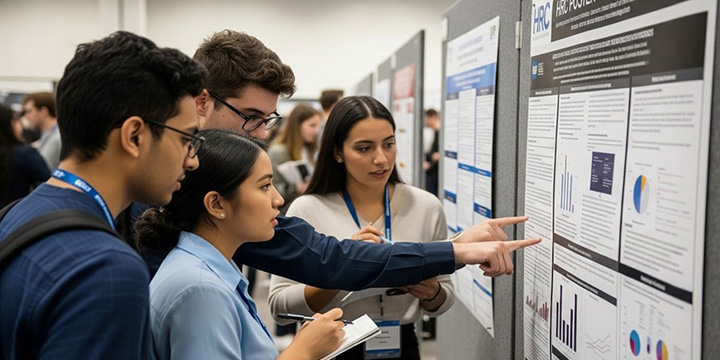
HRC PGR poster competition 2026
Win a prize with your research!
The Humanities Research Centre (HRC) runs a poster competition, which gives PGR students (PhD, MRes, MPhil) in the arts and humanities the opportunity to test their skills in communicating their research beyond their own discipline. Plus, you’ll be in with the chance to win Amazon gift vouchers!
Why enter?
- Producing a poster can be a very useful way of clarifying your research project, not only to others, but also to yourself.
- It will also give you practical experience in communicating your research in an accessible and eye-catching format to different audiences. Think beyond the traditional 'scientific' poster we see at conferences, and instead consider how you can use your creative skills to engage wider audiences, including beyond academia.
- The competition is a great way to learn more about our interdisciplinary research community, make contact with people working in cognate areas, whilst discovering more about the huge and exciting range of postgraduate arts and humanities research projects being carried out at Heslington Hall, University of York.
Who is eligible to enter?
Any current PGR (PhD, MRes, MPhil) student from the Departments of:
- Archaeology
- English
- History
- History of Art, Philosophy
- Language and Linguistic Science
As well as the:
- School of Arts and Creative Technologies
- York School of Architecture
- Centre for Medieval Studies
- Centre for Women’s Studies
The only students not eligible are the winners from last year's poster competition.
Judging and exhibition
The competition will be judged by a panel chaired by the HRC Director, Rachel Cowgill, and we will display the printed posters at a celebratory event around lunchtime (12 noon) on 13 May 2026.
All participants will receive detailed feedback after the event. We want to make sure this is a constructive, fun event and that everyone takes something away from participating. Lunch and refreshments will be provided.
Entry requirements
- Please submit an A2 size PDF poster to hrc-admin@york.ac.uk by 29 April 2026.
You are not able to submit the exact same poster from one year to the next. However, if you participated last year and received feedback from the panel, we very much welcome you to take the feedback on board, adapt your poster accordingly and submit a new version that takes that feedback into consideration.
If you’d like some inspiration, previous winning entries can be found on the HRC web pages.
Poster design resources
For inspiration, check out our previous HRC poster competition winners.
The Electronic Textuality and Theory Group's blog at Western University gives tips on designing posters for the arts and humanities.
The American Historical Association also gives some tips on why and how to design an effective humanities poster, as well as a post from the winner of their 2015 poster competition on why they found presenting a poster at a conference useful.
Try these tips from blogger Colin Purrington. The blog mainly focuses on academic posters for specialist conferences, but many of their tips are also applicable to posters designed for non-specialist audiences.
View previous winning poster designs
Finalists for our 2025 poster competition
We look forward to receiving your entries!