

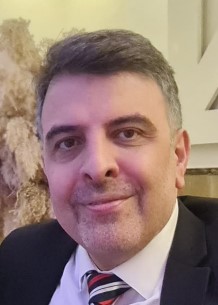
Dr. Behrouz Arabi
Lecturer in Sustainable Operations Management
Visit Dr. Behrouz Arabi's profile on the York Research Database to:
- See a full list of publications
- Browse activities and projects
- Explore connections, collaborators, related work and more
Profile
Biography
I am a Lecturer in Sustainable Operations Management in the School for Business and Society at the University of York. I hold a PhD in Performance Management, and an MSc in Applied Mathematics, specialising in Operations Research. My academic career spans the UK, Portugal, Malaysia and Iran, combining research, teaching and collaboration across disciplines. I previously held research fellowships at the Universities of York and Birmingham, working on the H3 project, and postdoctoral appointments at the Universities of Porto and Malaya. Across these roles, my work has focused on developing analytical approaches to understanding and improving sustainability in agrifood production, cold chains, circular-economy systems and the energy sector.
Alongside my academic career, I have held senior advisory and leadership roles in Iran’s energy sector, with responsibilities covering electricity-market regulation, performance monitoring and infrastructure investment. This professional experience complements my research in operations and supply chain management, connecting quantitative analysis with the practical challenges faced by organisations and policymakers. I have led interdisciplinary research teams, contributed to UKRI-funded projects and worked with government bodies, regulators and industry partners. My wider engagement includes facilitating stakeholder workshops, producing policy and market-review reports, and co-developing food data infrastructure to improve access to evidence. These experiences inform my research and teaching, bringing together analytical methods, sustainability and evidence-informed decision-making.
Research
Overview
My research focuses on sustainable operations and supply chain management, particularly performance measurement, eco-efficiency and sustainability improvement. I develop and apply frontier-based models, including data envelopment analysis (DEA), alongside multi-criteria decision-making and scenario modelling to assess performance and identify feasible pathways towards more sustainable production. My work spans agrifood systems, cold chains, the circular economy, manufacturing and energy. A central concern is developing analytical approaches that account for uncertainty, differences between technologies and undesirable outputs, such as emissions, while helping organisations and policymakers understand the trade-offs involved in improving economic and environmental performance.
My recent research includes assessing agrifood sustainability in the UK and Europe, developing models for sustainable refrigeration technology selection, and evaluating circular-economy performance using stochastic and network DEA. Through my work on the H3 project, I have developed scenario-design approaches for agrifood sustainability and co-developed a food data catalogue and web-based data hub to improve access to evidence for research and policy. I complement quantitative modelling with stakeholder workshops, interviews and policy analysis, connecting methodological development with the priorities of practitioners and policymakers. This work has informed policy and market-review reports on agrifood sustainability and investment in zero-emission cold chains, reflecting my commitment to research that supports practical, evidence-informed decision-making.
Teaching
Other teaching
My teaching focuses on sustainable operations and supply chain management, connecting management theory with practical questions about sustainability, efficiency and resilience. At the University of York, I contribute to undergraduate and postgraduate teaching in Supply Chain Management, Sustainable Operations and Supply Chain Management, and Research Methods. My wider teaching experience includes business analytics and operations research at universities in Malaysia and Iran. I draw on my research and professional experience in food systems, cold chains, the circular economy and energy to bring real-world challenges into the classroom and help students understand how evidence can inform operational decisions.
I take a student-centred and inclusive approach, combining real-world case studies, collaborative problem-solving and digital tools to support students from diverse academic and professional backgrounds. In my logistics teaching, for example, students compare freight transport options, examine trade-offs between cost, emissions and journey time, and justify their recommendations. I also encourage students to evaluate evidence critically and use digital technologies, including generative AI, responsibly. Alongside classroom teaching, I support students with research design, data analysis and academic writing, providing constructive feedback to guide their development. Across these activities, my aim is to strengthen students’ confidence, analytical reasoning and professional judgement, enabling them to apply their learning to complex sustainability challenges.
Publications
Selected publications
Published Journal Articles
Arabi B., Toloo M., Farnoudkia H., Xu B., (2026). Introducing stochastic Data Envelopment Analysis models for performance evaluation of circular economy in European countries: realistic pathways towards sustainability, OR Spectrum.
Pourrahimian, P., Seyedzadeh, S., Arabi, B., Kahani, D., & Lotfian, S. (2026). Digital enablers of the circular economy: a systematic review of applications, barriers, and future directions. Journal of Manufacturing and Materials Processing.
Arabi B., Toloo M., Yang Z., Zhang Pt., Xu B., (2024), Sustainable refrigeration technology selection: an innovative DEA-TOPSIS hybrid model, Environmental Science & Policy.
Sousa, R., Camanho, A., Silva, C., da Silveira, G. J.C., Arabi, B., (2023) Best practices, performance advantage and trade-offs: Insights from frontier analysis, Journal of Productivity Analysis.
Arabi B., Munisamy, S., Emrouznejad A., Toloo, M., & Ghazizadeh MS. (2016) Eco-efficiency considering the issue of Heterogeneity among Power Plants, Energy.
Arabi B., Munisamy, S., Emrouznejad A., & Khoshroo, A., (2016). Eco-efficiency measurement and material balance principle: an application in power plants Malmquist-Luenberger index, Annals of Operations Research.
Arabi B., Munisamy, S., & Emrouznejad, A. (2015). A new slacks-based measure of Malmquist–Luenberger index in the presence of undesirable outputs. Omega,
Arabi B., Munisamy, S., & Emrouznejad, A., & Shadman, F. (2014). Power industry restructuring and eco-efficiency changes: A new slacks-based model in Malmquist–Luenberger index measurement. Energy Policy.
Munisamy, S. and Arabi B., (2015). Eco-efficiency change in power plants: using a slacks-based measure for the meta-frontier Malmquist–Luenberger productivity index. Journal of Cleaner Production.
Khoshroo, A., Mulwa, R., Emrouznejad, A., & Arabi B. (2013). A non-parametric Data Envelopment Analysis approach for improving energy efficiency of grape production. Energy.
Ramli, N. A., Munisamy, S., & Arabi B. (2013). Scale directional distance function and its application to the measurement of eco-efficiency in the manufacturing sector. Annals of Operations Research.
Published Books
Arabi B., Sonal Choudhary (2025), "Undesirable factors in sustainability improvement using DEA", Chapter 8, Taylor & Francis.
Emrouznejad A., Banker R., Munisamy S., Arabi B., (2014), Recent developments in Data Envelopment Analysis and its applications.
Arabi B., H. Vaziri Sabeghi, (2003), Outsourcing and Job Creation in Tehran Regional Electricity Company, Tehran Regional Electricity Company Press
Policy Reports
Arabi B., Toloo M., Choudhary S., (2025), Rebalancing agri-food sustainability in the UK and EU: from insight to policy coherence: workshop report, University of York.
Arabi, B., & Xu, B. (2024). Investment in zero emission cold chain (ZECC) workshop report: market review. Heriot-Watt University.
Selected papers (4 out of 18) presented in refereed conference
Arabi B., Toloo M., Choudhary S., Navigating the Green Frontier: A comparative analysis of agrifood sustainability between the UK and Europe. EURO2025, University of Leeds, June 2025.
Arabi B., Toloo M., Zhang P., Yang Z., Xu B., Sustainable refrigeration system technology selection: a novel DEA-TOPSIS Hybrid Model, DEA45 Conference, University of Surrey, September 2023.
Arabi B., Toloo M., Ruini Qu, Z., Xu B., Introducing stochastic Data Envelopment Analysis models for performance evaluation of circular economy in European countries: realistic pathways towards sustainability, DEA45 Conference, University of Surrey, September 2023.
Arabi B., Hong Y., Li Y., Kadam S., Yu Z., Yang Z, Xu B., Customized assessment and adoption of carbon dioxide hydrate refrigeration system technology, IGEC 2023, University of Glasgow, June 2023.
Sousa R, Camanho A., Silva M., Giovani S, Arabi B., (2020), Best practices, performance advantage and trade-offs: Insights from frontier analysis, 20th Production and Operations Management Society (POMS), Hyatt Regency Minneapolis, USA, Best Paper Award.
School for Business and Society
University of York
Church Lane Building
York Science Park
Heslington
York YO10 5ZFE: behrouz.arabi@york.ac.uk
T: +44 (0)1904 32 6518
R: CL/A/107