
Borthwick Institute for Archives

- Borthwick Institute for Archives
- News
- 2026
- Borthwick Newsletter - November 2026
Borthwick Newsletter - November 2026
Posted on 30 October 2026
November in the Archives - delve into our catalogues with this month’s featured description
Terry's Cricket Club member's cards for 1928 and 1929 season containing lists of club officers and details of fixtures; and ticket and programme for the club's Annual Dinner held at Terry's Restaurant, St Helen's Square, York, on 19 November 1927 [Terry's of York, Archive, TERRY/7/8/4/5]
What's New?
The new semester is well under way at the university and we've been busy with classes and workshops, as well as our usual researcher visits and enquiries. This month we have two new free exhibitions for you to enjoy. 'Fragments of the Medieval World' can be found downstairs in the Yorkshire Room, alongside a display of some of our Archbishops Registers. We'd also like to remind you that if you are planning a visit before Christmas, we will be closing this year on the 17th December and re-opening on the 4th January.
New Accessions
We received four accessions in October, all of them additions to existing archives. These included correspondence, photographs, press cuttings, and concert programmes to be added to the archive of composer and academic Wilfrid Mellers, and a range of reports, magazines, slides, photographs and exhibition materials to be added to the archive of the Yorkshire Wildlife Trust. We also added a small number of items to the archive of architect George Pace, including three diaries detailing his personal and professional life in 1940, 1961 and 1971, as well as lecture notes and articles, press cuttings and photographs of churches he worked on. You can find more of Pace's diaries in the Pace and Sims Archive.
New Catalogues
Number of archival descriptions on Borthcat on 1st November 2026: 165,329
In October we added full catalogues for the parish archives of Acaster Malbis and Brandsby to Borthcat. Brandsby is the elder of the two, with a church recorded in Domesday and parish registers beginning in 1575. The church at Acaster Malbis dates from at least the twelfth century, but its parish registers only survive from 1693.
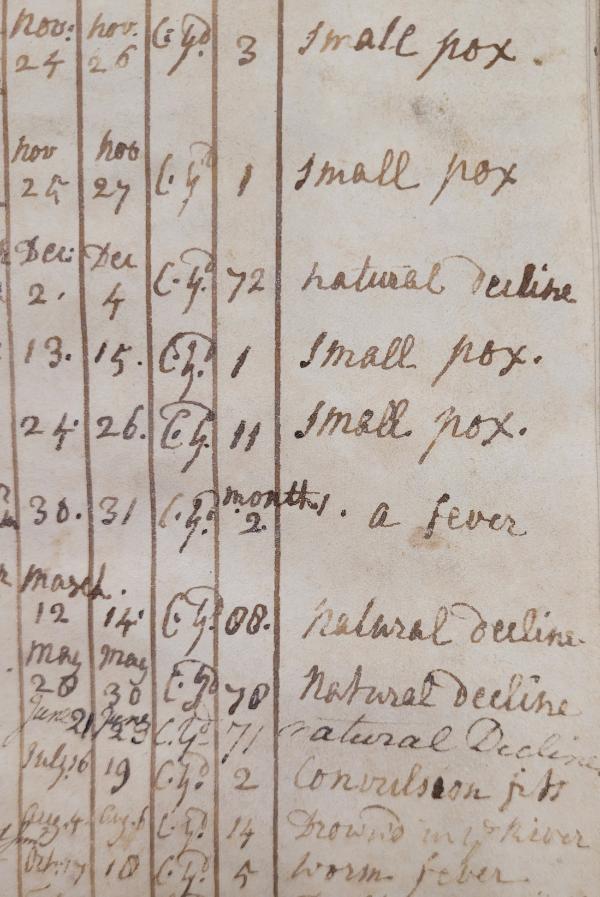
A page from the parish register of Brandsby, with causes of death for 1783.
Both parish archives include 'Dade registers', named after the Reverend William Dade, a Yorkshire clergyman who advocated for making more detailed records of baptisms and burials, in particular recording the names of grandparents in baptismal records. As Dade himself wrote, 'this scheme if properly put in execution will afford much clearer intelligence to the researches of posterity' - something many family historians would agree with! Sadly the scheme did not last but you for some twenty years at Brandsby and (unfortunately) only a few years at Acaster Malbis, you can find names of parents and grandparents with the baptisms, and causes of death with the burials, affording us a glimpse of familial networks and private tragedies in two Yorkshire parishes.
Borthwick Out and About
In October Keeper of Archives Gary Brannan represented us at two different events - despite his broken arm! On 17th October he joined in with the fun at 75 Years of the Goon Show - Live! sharing some of the highlights from our extensive comedy archives, and on 24th October he was in London to discuss 'Destiny of the Daleks' and the Terrance Dicks Archive at the Doctor Who Target Book Club Day. Talking of our extensive comedy archives, our Galton and Simpson Archive was used in the production of new DVD 'The Goons at Rediffusion', which you can purchase from the BFI online shop.
 Andy Hollingworth Archive-600x414.jpg)
Gary at 75 Years of the Goon Show. Copyright Andy Hollingworth, 2026.
University Art Curator Helena Cox gave a talk on the art collection at Pilsen's bi-annual Jiří Trnka International Symposium on the 20th October, while Research Services Archivist Lydia Dean shared some archival insights from the archive of the Yorkshire Wildlife Trust for their 80th birthday celebration on the 22nd. Our fully digitised Retreat Hospital archive was also featured in Who Do You Think You Are Magazine's October guide to finding hospital and asylum records.
Looking ahead to November, Lydia will be drawing on the Yorkshire Wildlife Trust's archive once again at the AGM of the Yorkshire Naturalists' Union on the 7th. Lydia will be speaking with Marie Fooks of the YWT on 'Driving Nature's Recovery – Then, Now and Always'. We'll be welcoming some pupils from a local primary school on the 2nd November to learn more about what we do and the archives we hold, as well as visitors from Sheffield's iSchool later in the month.
We'll be hosting the AGM of the Canterbury and York Society on the 4th November and everyone is very welcome to come along to this year's open lecture which will be given by Dr David Robinson. Dr Robinson will explore the managerial approach of William Melton, Archbishop of York (1317–1340), through the financial and administrative records in Melton's York register. The event begins at 3.30pm at the Borthwick and there will also be an opportunity to view some of our Archbishops Registers in the exhibition cases on the ground floor of the Raymond Burton Library.
And speaking of displays, you can visit our free exhibition, 'Fragments of the Medieval World', in the Yorkshire Room between now and the end of February 2027. The exhibition showcases some of our oldest and rarest records and the efforts made to preserve them. From the lone illuminated pages of the Takamiya Fragments Collection to the medieval music found hidden in the bindings of a later church court book, their story is one of destruction, survival and rediscovery. Don't miss it!
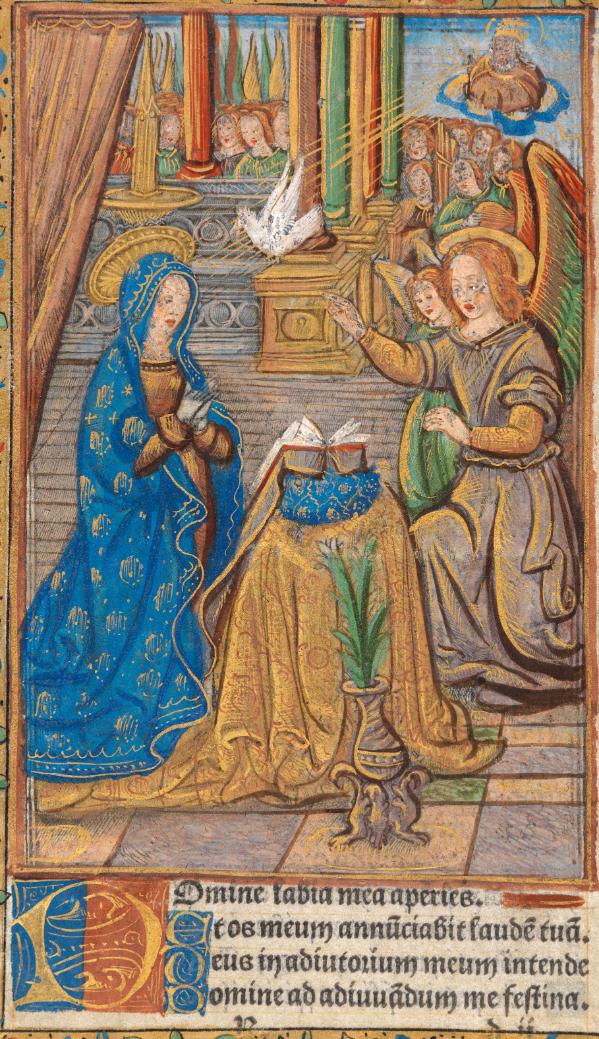
Illumination from a page in the Takamiya Collection
Finally, a selection of material from our Retreat hospital archive has taken a trip to Lewes in Sussex. We've loaned several items, including sketches by the artist Helen Fry (née Coombe), a one-time patient at The Retreat, and a painting of York by her husband Roger Fry, to the Charleston Art Gallery for their Mad Bloomsbury exhibition. The exhibition re-examines forgotten and familiar Bloomsbury histories through the lenses of disability, neurodiversity and lived experience. It opens on the 4th November and runs until April 2027.
Archive of the Month
What is it? Two surviving leaves from a pair of 17th century almanacs, found in a Yorkshire cottage.
Where can I find it? The pages can be found in our Miscellaneous Documents collection, listed under MD/35.
Why is it Archive of the Month?
With the recent changing of the clocks and the end of British Summer Time, it seems appropriate to highlight one of the stranger items in our Miscellaneous Documents collection. In 1969 a resident of Wheldrake discovered two small objects on a ledge in the fireplace of her cottage. They were the size and shape of tennis balls and, when cut open, were found to have a cork centre, surrounded by stuffing under a cover of stitched linen. Whoever had made the balls had used odd bits of paper and string for the stuffing, including, as it turns out, two leaves of a pair of printed almanacs which were subsequently extracted and given to the Borthwick.
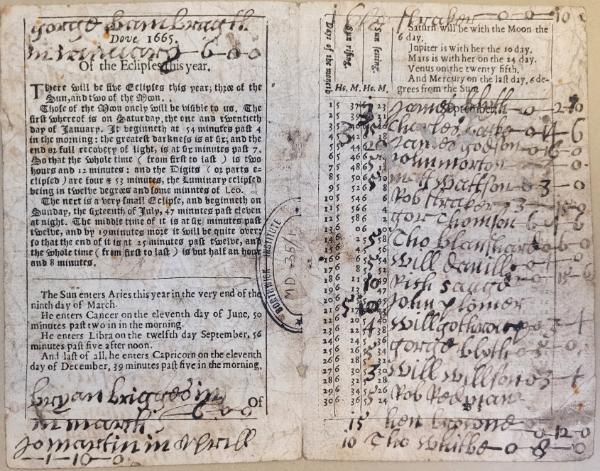
Page from the 1665 almanac
The leaves date from October 1665 and September-October 1679 and contain such useful information as the movement of the sun and moon in relation to the signs of the zodiac, lay and religious festivals, and astrological and weather predictions for the year ahead. 'The Sun enters Aries this year in the very end of the ninth day of March,' we are told on the page for 1665; while in October of that year the owner is warned to expect a mix of cool, wet, windy 'and flabby' weather. In October 1679 the weather predictions are summarised more poetically,
With Mercury in Sextile aspect, Jove,
With Mars then plac'd in Square, doth angry prove
And at that time, we scarce can hope to fail
Of blustering storms, with thunder, and with hail.
Interesting too, are the printed list of expected sunrises and sunsets for these months. There was no British Summer Time in the 17th century. On 1 August 1679 the sun was expected to rise at 4.35 and set at 7.25; on 1 September it was set to rise at 5.35 and set at 6.25. The shortest days, as now, fell in December, when the sun was expected to rise at 8.17 and set at 3.43 for five days in a row.
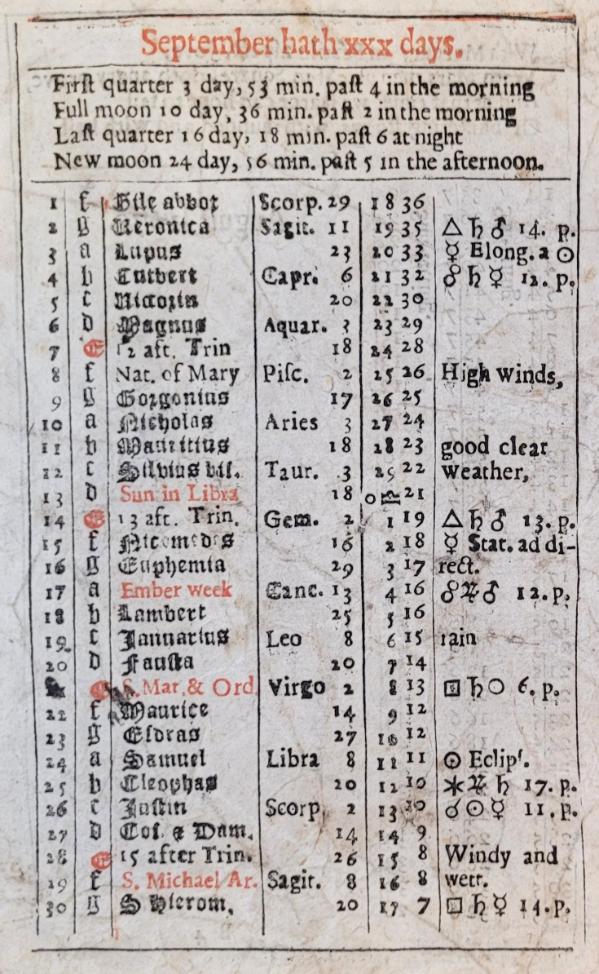
Page from the 1679 almanac
Almanacs of this type were bestsellers in the 17th century, sold for anything from a few pence to a few shillings and designed to be carried in the pocket for easy consultation. At least one of the leaves, if not both, came from the Jonathan Dove series of almanacs which were produced from 1627-1709 and which, like its rivals, began to include less astrology and more science as the century wore on. Almanacs often included blank spaces for the owner to include their own notes and this is the only clue we have as to the owner. On both leaves, in a similar hand, we find lists of names and payments 'reseaved' but, frustratingly, nothing to indicate who was collecting these payments and why.
We are left with only these two mystery leaves, containing only eight pages of the lost almanacs, but they are a reminder that archives can turn up in the most unexpected of places - and that what was once considered to be rubbish can be something quite different a few hundred years later!
We'll be back in December with more news and events from the archives.
Borthwick Institute for Archives
University of York,
Heslington,
York,
YO10 5DD,
UK
Tel:
01904 321166
|
borthwick-institute@york.ac.uk

Legal statements | Privacy | Cookies | Accessibility
© University of York | Modify | Direct Edit