
Borthwick Institute for Archives

- Borthwick Institute for Archives
- News
- 2026
- Borthwick Newsletter - July 2026
Borthwick Newsletter - July 2026
Posted on 30 June 2026
July in the Archives - delve into our catalogues with this month’s featured description.
Fan mail to answer. Includes ‘stock’ and sample answers for various required responses. 1990 - July 1992. [Frankie Howerd Archive, FHOW/Box43]
What's New?
The Borthwick has been a very popular place in June, with our climate controlled searchroom and study spaces offering a welcome respite from the heatwave for staff and researchers alike. As we move into a wetter July, there are a few changes onsite. Most notably our current Keeper of Archives, Gary Brannan, will be leaving us (albeit temporarily) to fill in as the university's Acting Director of Libraries, Learning Services and Research Collections, following the departure of the current director and pending the appointment of their successor. Fortunately, Access and Digital Engagement Archivist Laura Yeoman will be stepping into his role as Acting Keeper of Archives for the next six months to keep things running smoothly as always.
If you are visiting us over the next month, we would also like to remind you that we have a new front door, as the refurbishment of the library lobby continues. Instead of the usual automatic doors at the front of the Morrell Library, you will need to turn left and follow the path round to the entrance to the Harry Fairhurst wing. If you require lift access to the Borthwick, don't forget to let us know as our public lift remains out of commission until the 17th July, with lift access to the Borthwick available via our staff lift. We appreciate your patience while all of this work is ongoing, the result should be a larger and more welcoming entrance to the library and Borthwick - and a much more reliable lift for our visitors!
New Accessions
We accepted eleven accessions in June, eight of which being additions to existing archives. Among the additions to the University of York Archive were the records of the Sumo Society, based on the famous Japanese martial art, as well as 1970s newsletters, flyers and other student ephemera donated to the university's Student Life Collection. We also added new scripts to the archive of television writer Johnny Speight, and cinema lobby cards, photographs, film and books to the archive of the Goon Show Preservation Society.
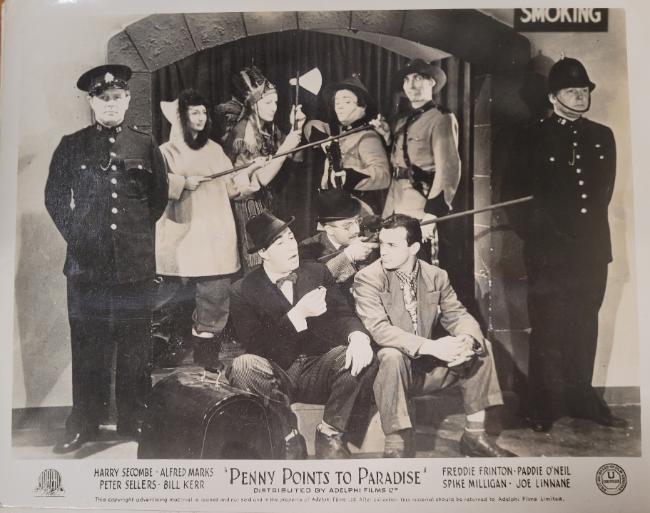
Promotional card for 'Penny Points to Paradise', 1951, starring members of the Goon Show.
Our new accessions include the archive of The Corpus Vitrearum Medii Aevi (CVMA) Great Britain, part of an international research project dedicated to recording and researching medieval stained glass, and the archive of Professor of Art History, Richard Verdi. Professor Verdi taught at the University of York from 1972-1989 before moving to the University of Birmingham where he took up the additional role of Director of the university's Barber Institute of Fine Arts.
New Catalogues
Number of archival descriptions on Borthcat on 1st July 2026: 159,559
In June we added the catalogue for the parish archive of York, St Philip and St James, Clifton to Borthcat. Until the 19th century the area of Clifton to the north of York city centre was part of either the medieval parish of St Olave or St Michael le Belfrey. It was not until 1871 that it officially became a parish in its own right, with its own church completed in 1867 by architect George Fowler Jones. The archive includes parish registers from 1871 and general administrative records for the parish. Of particular interest are the collection of parish magazines from 1879 onwards and the records of the parish's Men's Group and Women's Group, as well as a script for the Clifton School Christmas play, undated but likely performed in the first half of the 20th century..
Borthwick Out and About
June was an extremely busy month here, with the York Festival of Ideas, University Open Days, and other visits and community events. We're pleased to say that many of the Festival of Ideas events were filmed and are being gradually uploaded to their YouTube channel. You can already watch the Doctor Who themed Adventures in Time, Space and Television with Simon Guerrier and our very own Gary Brannan, which draws on our Terrence Dicks and David Whitaker archives, as well as Six Penn'orth of Hope: Gambling and the Rowntree Trusts by Professor Sue Mendus, based on our Joseph Rowntree Reform Trust archive. Gary also chaired Eaters of the Dead with author Kevin Wetmore, exploring how monsters that feed on the dead have been represented in myths, history and popular culture. We'll bring you more of the videos as they are released.
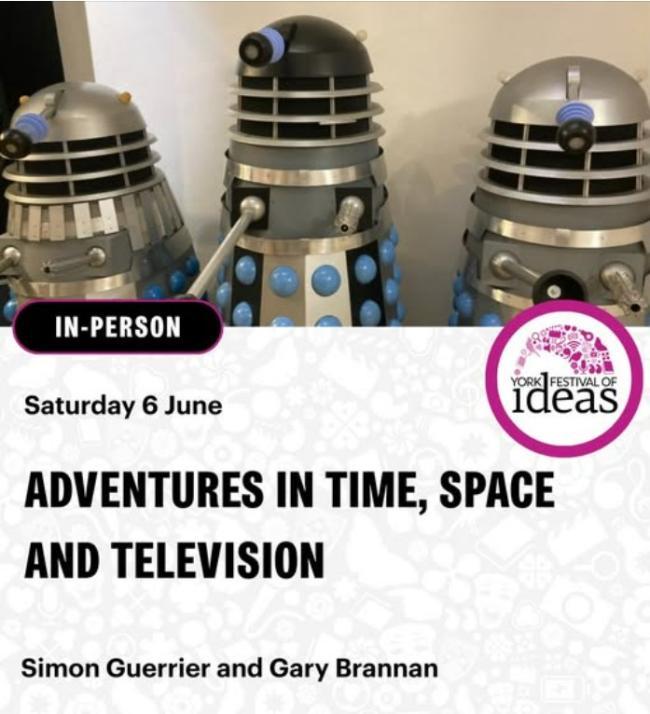
One of the 2026 Festival of Ideas talks now available online.
Our stall at the Derwenthorpe Community Day on 6 June attracted more than 100 visitors who stopped to look over our selection of early New Earswick photographs and talk about the value of community archives. We also had record-breaking numbers at the University Open Days on the 20-21 June, with more than 700 prospective students and their families coming to see our display of original archives over the course of the weekend. We ended the month with yet more visitors - on 25 June we welcomed a group of PGCE history students for a workshop and on 26 June it was the turn of Year Seven students from York High School, who came for a Learning Experience Day, facilitated by York Cares. In both cases the students were given a talk about the archives before getting to view some original material from across the collection.
A letter from our Yorkshire Philosophical Society Archive was recently featured in an article in GeoHistories, shared in full by the York Museum Trust and later covered by the York Press and Country Life magazine. The letter was written by a woman named Anne Wickham and sent to Yorkshire Museum in 1833 to accompany her drawings of an ichthyosaur skull, which are still in the museum's collection. In her letter, she describes a recent visit to Lyme Regis and the 'fine collection' of fossils and drawings she saw there, belonging to fellow enthusiast Elizabeth Philpot and her sisters. Philpot was a friend and collaborator of another very famous resident of Lyme - Mary Anning - and the letter and sketches together highlight the important contributions of women palaeontologists at a time when they were excluded from so many formal institutes of learning.
Finally, Keeper of Archives Gary Brannan wrote about the problems faced by special collections services in higher education for Katina online magazine. His article - Can Special Collections Get a Rebrand? - discusses the dangers of being seen to appeal to a niche and dwindling audience and the strategies employed by the Borthwick in recent years to engage with new audiences and demonstrate the continued relevance of archives in the higher education sector and beyond.
Looking ahead to July we have two new exhibitions for you to enjoy. On 18 June University Art Curator Helena Cox launched 'John Langton Slow Surfacing', a free public exhibition celebrating modern painting in York through the work of Langton, who had close links with both university and city. The exhibition will be in place until 31 October and you can find the gallery on the ground floor of the Hall, straight ahead as you enter the building through the main door. Heslington Hall is open Monday-Friday, 9am-5pm. From 1 July you can also enjoy a new, student curated exhibition on 'Radical Print Culture in the Long 18th Century', which accompanies a one-day symposium by the York Centre for Eighteenth Century Studies. The exhibition uses books from the university's Rare Books collection and the Minster Library and it will be available to view in the Burton Exhibition cases situated at the bottom of the stairs leading up to the Borthwick.
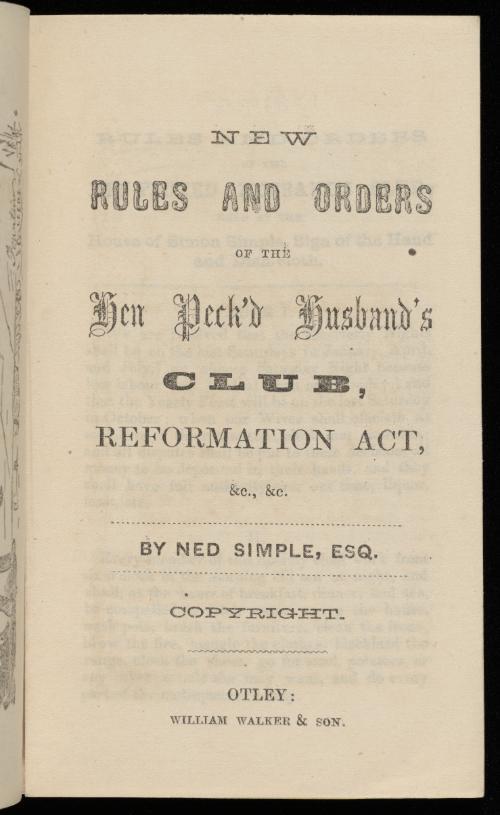
Hen Peck'd Husbands, as featured in the new Radical Print Culture exhibition.
To round out the month, Research Services Archivist Lydia Dean will also be taking part in the 80th birthday celebrations of the Yorkshire Wildlife Trust in July, with a presentation on the organisation's history for staff and volunteers, and Acting Keeper, Laura Yeoman, will be speaking at the International Medieval Congress in Leeds on the archive of the British Sundial Society's Mass Dials Group.
Archive of the Month: Records of Newman Barton, pawnbroker of Thorne
What is it? The business records of a pawnbroker, or money lender, active between 1912 and 1949.
Where can I find it? The archive has been catalogued on Borthcat.
Why is it Archive of the Month?
Of all the occupations that appear in our archives, money lender is among the oldest. For the wealthier classes, such financial transactions were carried out by solicitors and bankers, with often vast sums changing hands and the resulting legal documentation preserved as part of our family and estate archives. Among the poorer classes, loans were rather smaller and more frequently the province of the local pawnbroker, a profession that may well conjure up images of Dickensian novels but which remains alive and well to this day.
The pawnbroker offered secured loans in return for collateral, that is an item or items of value belonging to the recipient of the loan. The pawnbroker would assess the item and offer a sum of money based on its value. If the owner returned to the shop within a certain length of time they could 'buy' their pawned items back for the original cost, plus interest. If they did not, the pawnbroker could sell it and keep all proceeds for themselves. In his 1901 study of poverty in York, Seebohm Rowntree described the pawnbroker as one of several sources of debt for working class families when the costs of the necessaries of life could not be met by their inadequate wages and must instead be borrowed and repaid, sometimes more than once and always with interest.
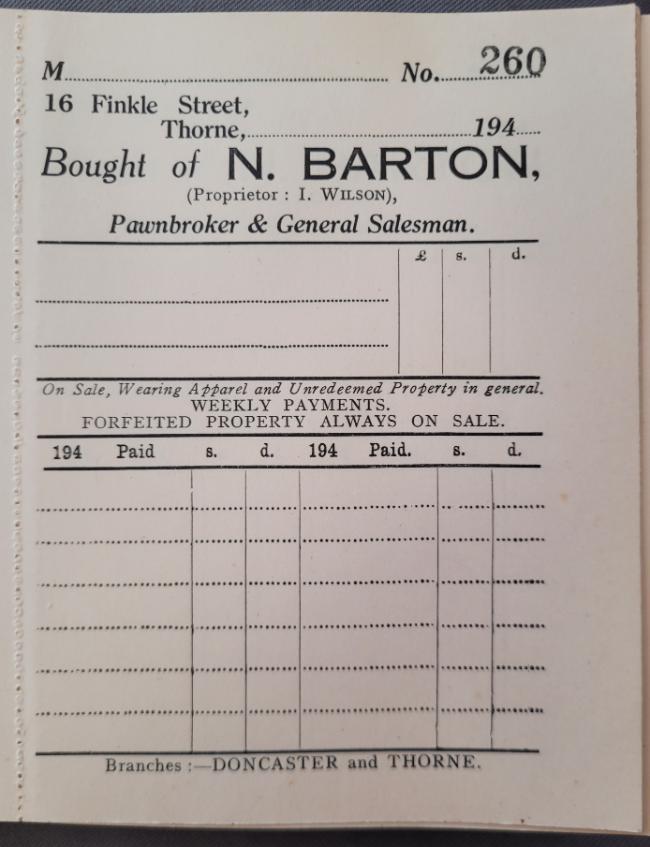
A sample ticket issued by Newman Barton in return for pawned items.
Newman Barton was born in 1864 in Staincross, Yorkshire, and began his career as a pawnbroker's apprentice. By 1901 he had established a pawnbrokerage of his own in Doncaster and over the next twenty years he was successful enough to expand his business, with three shops in the town by 1922, managed by himself and two of his sons. His archive is not extensive, consisting only of payment notes, a receipt book and four volumes of 'records of pawned articles', but the volumes record the names, addresses and type and value of the items being offered as collateral, making them a valuable source of family and local history.
The earliest volume of 'pawned articles' begins in April 1912 with a silver lever watch pawned by Tom Brackenbury of Town End for 12 shillings. A note of 10 and a half pence 'profit charged' is noted beside it. From there we find a litany of jewellery, watches, medals, clothing, blankets and sheets, shoes, and other valuables, pawned for a few pounds at most, but more often for less. By far the most common item of clothing was a suit and the most common jewellery items rings or 'gold alberts' (a pocket watch chain), but there are larger items too. Sewing machines appear frequently, as do bicycles and even bedsteads. In 1923 John Whisker, a piano tuner of Thorne, pawned a violin in its case and later that year a Mr Dumpley pawned a gramophone and records, returning later that same year to add a skirt and boots, a gold ring and a suit - indeed the latter appears to go in and out of pawn multiple times.
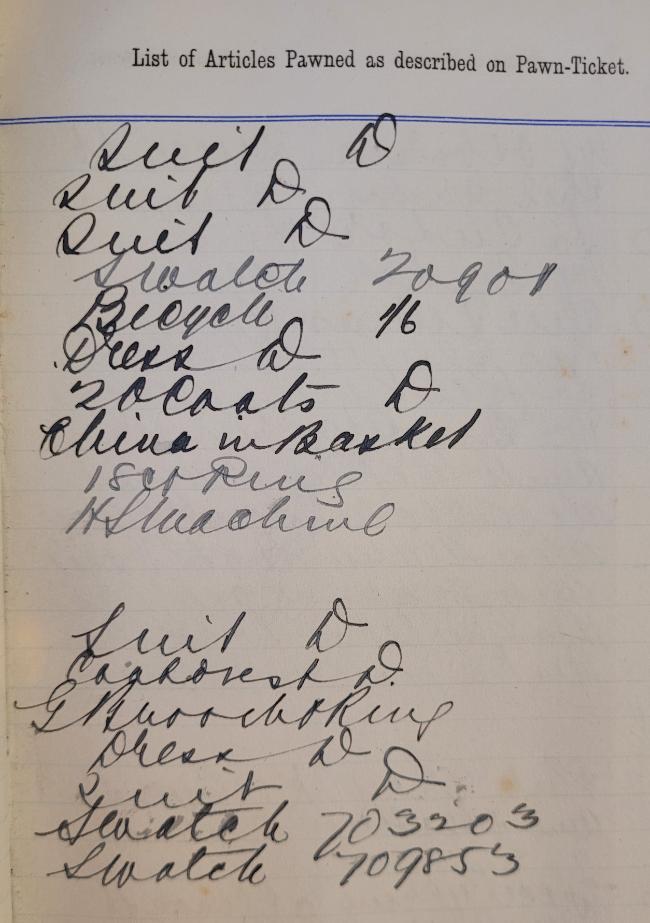
Suits, dresses, china, a bicycle and a sewing machine pawned in the 1910s.
Pawnbrokers' records are not a rare survival, a simple search of The National Archives' national catalogue shows many thousands of results in archives across the UK. But each collection offers a raw, and often moving glimpse of life 'at the sharp end', where money was hard to come by and too often needed, and businesses like Barton's could thrive in the space between the two.
We'll be back in August with more news and events from the archives!
Borthwick Institute for Archives
University of York,
Heslington,
York,
YO10 5DD,
UK
Tel:
01904 321166
|
borthwick-institute@york.ac.uk

Legal statements | Privacy | Cookies | Accessibility
© University of York | Modify | Direct Edit