
Borthwick Institute for Archives

- Borthwick Institute for Archives
- News
- 2026
- Borthwick Newsletter - February 2026
Borthwick Newsletter - February 2026
Posted on 29 January 2026
February in the Archives - delve into our catalogues with this month’s featured description
Poster for the St Valentine's Service, featuring the bands Pink Floyd and Love Sculpture, 15 February 1969 [University of York Archive, digitised at UOY/PP/20/44]
What’s New?
Welcome to the first Borthwick newsletter of 2026! It’s been a rather cold and rainy start to the year here in York, but we’ve had a steady stream of visitors to the searchroom and our usual rush of post-Christmas enquiries, standing at 476 emails, letters, phone calls and online orders at the last count. If you’re planning a visit, please be aware that we will be closed for the week of the 2-6 February for our annual Collections Development Week, allowing us to catch up on crucial behind the scenes work. We’ll be bringing you a full report in the March newsletter and you can of course still drop us an email while we’re closed, although reply times might be slightly delayed.
Finally, if you’re one of our many family history researchers we’re pleased to announce that we will be hosting a weekly drop in session of the York Family History Society for the next six months. The Society will be working from our Microfilm Room every Friday between 10am and 4pm so if you have a query about your York family history research, or aren’t sure how to get started, why not drop by and ask how they can help. The group has access to all of our parish and probate microfilms, as well as Find My Past and Ancestry. If you can’t make it to campus, they also run a session every Monday at the same time at York Central Library.
New Accessions
Since our last newsletter at the start of December we’ve taken in 19 accessions. These include additions to the archives of the University of York, composer Trevor Wishart, writer Terrance Dicks, the Goon Show Preservation Society, Alcoholics Anonymous UK, and comedy writers Laurence Marks and Maurice Gran.
A substantial new addition is the archive of playwright and screenwriter John Antrobus, who sadly died in December at the age of 92. After an early career at ALS (Associated London Scripts), the writers’ cooperative founded by Spike Milligan and Eric Sykes, Antrobus contributed scripts for The Frankie Howerd Show, The Goon Show, and That Was The Week That Was in the 1950s and 1960s. His subsequent work for the big screen included several of the ‘Carry On’ films, the comedy film ‘The Wrong Arm of the Law’ (co-written with Galton and Simpson), and ‘The Bed-Sitting Room’. His archive includes scripts, draft ideas, notes, notebooks and journals for works written alone and in collaboration.
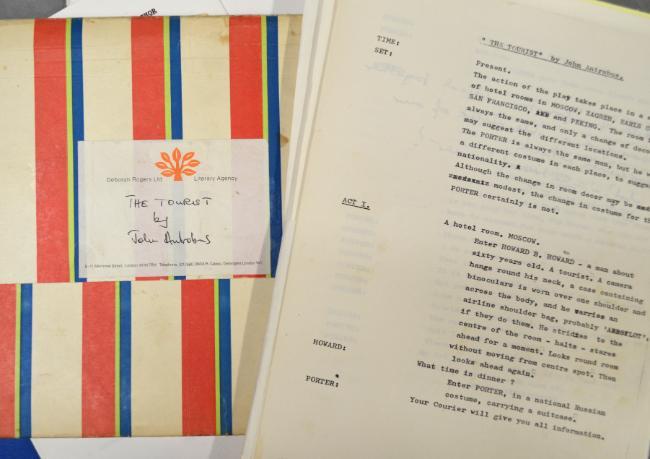
Script 'The Tourist' from the John Antrobus Archive
We have also bolstered our writing and performance collection with the archive of journalist, musician and broadcaster Miles Kington. Kington studied at Oxford alongside Monty Python member Terry Jones (with whom he briefly collaborated) and began his career as jazz critic for The Times newspaper in 1965. It was his seven years at the satirical Punch magazine from 1973-1980, however, that gained him a reputation as one of Britain’s most distinctive humourists. Particularly popular were his ‘Franglais’ columns, which in turn spawned several bestselling books. He went on to write for The Independent newspaper from 1986, appeared frequently on BBC Radio 4 and was a talented musician. His archive includes many boxes of lively and humorous personal and professional correspondence, as well as diaries, notebooks and research notes.
Finally we took in the archive of the United Nations Association International Service (UNAIS). The UK based charity was founded in 1953 and focused on providing opportunities for young people to volunteer in global projects tackling social injustice and climate change. The charity closed in 2025 but its archive, which dates from 1960, tells the story of its work over the decades through minute books, reports, handbooks, photographs and related records.
New Catalogues
Number of archival descriptions on Borthcat on 1st February 2026: 150,735
We’ve recently added the catalogue for the parish archive of Long Marston to Borthcat. If the ‘Marston’ part is already familiar to you, it may be because the Battle of Marston Moor was fought between the Royalists and Parliamentarians on 2 July 1944 just to the west of the village. There are no surviving parish registers for 1644 so we can only guess what effect the battle had on the lives of the people there, but from 1645 there is a complete run of baptisms, marriages and burials, as well as the usual records of parish charities, parish and poor law administration, accounts, and records relating to the architecture and maintenance of the parish church of All Saints, which dates to the 15th century.
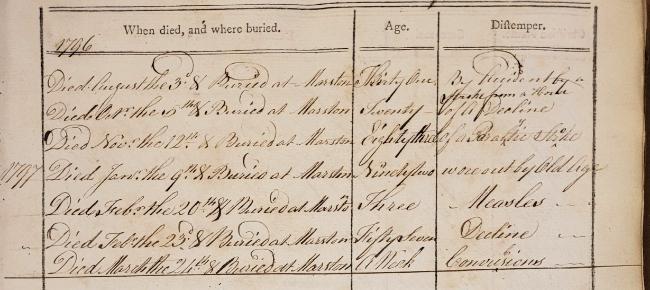
Causes of death in 1796, recorded in the Long Marston burial register
Of particular interest to family historians is the register of burials for 1796-1813 which includes causes of death. Measles, whooping cough, fevers, convulsions, smallpox and dropsy make frequent appearances, as well as more unusual causes such as a strike from a horse, being run over by a cart, and ‘a Violent Cold’. Hearteningly, the same register does also include a list of the 30 parishioners over the age of 70 who were included in the 1871 Census. Ranging from 94 year old Robert Calvert down to the youthful Anne Stephenson and Esther Woodburn at 70, the vicar has noted that the combined ages make an impressive total of 2,329 years - predating the parish by a considerable margin!
Borthwick Out and About
We started the year on a high with appearances on national news. After the BBC published an article over Christmas on a forgotten festive Steptoe and Son script unearthed in the Galton and Simpson Archive, Keeper of Archives Gary Brannan was invited onto BBC Look North, BBC Breakfast and the BBC News at One in early January to talk about the exciting discovery. In December Gary had also represented us as the ‘Missing Presumed Wiped’ event at the British Film Institute.
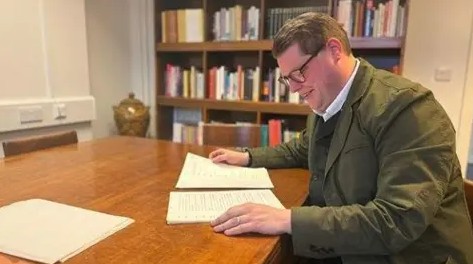
Gary Brannan with the newly discovered script
Later in January University Art Curator Helena Cox gave a talk on the university’s collection to the York Anglo-Scandinavian Society, and Research Services Archivist Lydia Dean and Access and Digital Engagement Archivist Laura Yeoman attended the Millthorpe School Career Fair in York to share some insights into archives as a career.
On the podcast front, we have a new episode of ‘Curator and Keeper’ with the Reverend Canon Maggie McLean, looking at artistic pilgrimage and the links between faith and art, as well as a new episode of ‘Out of the Archive Box’ featuring an interview with comedy writing legend, Brad Ashton. As one of the few remaining writers who worked at Associated London Scripts, Ashton recounts tales of his time working with Spike Milligan, Eric Sykes, Galton and Simpson, Frankie Howerd, Johnny Speight and more.
Looking ahead to February, we’ll be taking a Borthwick display to some of the upcoming Post Offer Visit Days on the 7th, 18th and 25th, where we’ll have the opportunity to chat with prospective students and show them some original records. We’ll also be hosting the Association of University Librarians of Nigerian Universities on the 5th and some schoolchildren learning about Tudor rebellions on the 13th.
Archive of the Month: Dennis Brutus Archive
What is it? A selection of the papers of human rights activist, poet and professor Dennis Brutus who campaigned to have South Africa banned from the Olympics in 1964 on account of its racist Apartheid system.
Where can I find it? You can browse the catalogue on Borthcat.
Why is it Archive of the Month?
The system of Apartheid in South Africa was founded on a belief in the inherent physical and intellectual superiority of the country’s minority white population. Born to parents of mixed Boer and African heritage, Dennis Brutus was categorised as ‘coloured’ under the country’s strict system of racial classification, and, whilst not subjected to the same oppression as Black South Africans, was legally segregated from ‘Whites’, attending a separate school and university.
As a young activist, Brutus was already an outspoken critic of Apartheid, but it was his work against racial discrimination in sport that brought him to national and international prominence. For Brutus, sport laid bare the absurdity of white supremacy. As a university student he saw talented Black athletes outperform their white peers whilst receiving none of the accolades. This colour bar affected sports at all levels: South Africa had all white national sports teams and sent only white athletes to the Olympics and Commonwealth Games, something that went largely unchallenged by the international bodies that organised these events.
Brutus found this unacceptable. In 1958 he founded the South African Sports Association with the aim of promoting ‘true sportsmanship’ and removing ‘all race discrimination in sport’. The Association subsequently led a successful campaign against a proposed tour of South Africa by the West Indian cricket team. In 1962 Brutus set his sights on the Olympics with the foundation of the South African Non-Racial Olympic Committee (SANROC), and it was SANROC which was instrumental in the country being banned from the Games for the first time in 1964. When South Africa attempted reinstatement in 1968 by promising to field multi-racial teams, SANROC and Brutus were able to prove this false and the country remained banned until 1992.
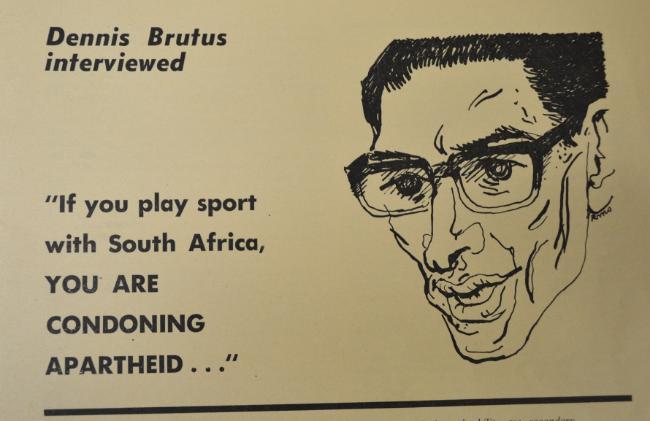
A printed interview in the Dennis Brutus Archive
Throughout this work Brutus was subject to continued government persecution, being, at various times, arrested, banned, imprisoned and even shot. He was eventually forced into exile, spending much of this latter period in the United States where he became a celebrated professor of African literature and a published poet.
Brutus was finally able to return to South Africa in 1990 and died there in 2009. The Dennis Brutus Archive here at the Borthwick is not the only collection of his records to exist, there are also collections at Northwestern University, the University of KwaZulu-Natal and elsewhere, but it is a perfect introduction to his life and work, including as it does a selection of his personal correspondence, his poetry, and, of course, many papers relating to his work against racial discrimination in sport. By demanding athletes be judged on merit, and not on the colour of their skin, Brutus challenged the complacency of the international sporting community, shining an unflattering light on white South African culture and society and undermining the racist beliefs on which Apartheid was built.
We’ll be back in March with more news and events from the archives.
Borthwick Institute for Archives
University of York,
Heslington,
York,
YO10 5DD,
UK
Tel:
01904 321166
|
borthwick-institute@york.ac.uk

Legal statements | Privacy | Cookies | Accessibility
© University of York | Modify | Direct Edit