
Borthwick Institute for Archives

- Borthwick Institute for Archives
- News
- 2025
- Borthwick Newsletter - September 2025
Borthwick Newsletter - September 2025
Posted on 29 August 2025
September in the Archives - delve into our catalogues with this month’s featured description
York County Hospital Playroom. The First Eighteen Months. September 1969 - February 1971 [York District Hospital Archive, NHS/YDH/1/3/2]
What’s New?
The university campus has begun to come back to life in recent days in anticipation of another academic year. Although the Borthwick remains open and busy all year round, the new influx of staff and students means a return to onsite classes and workshops and a chance to share our collections with an even wider audience.
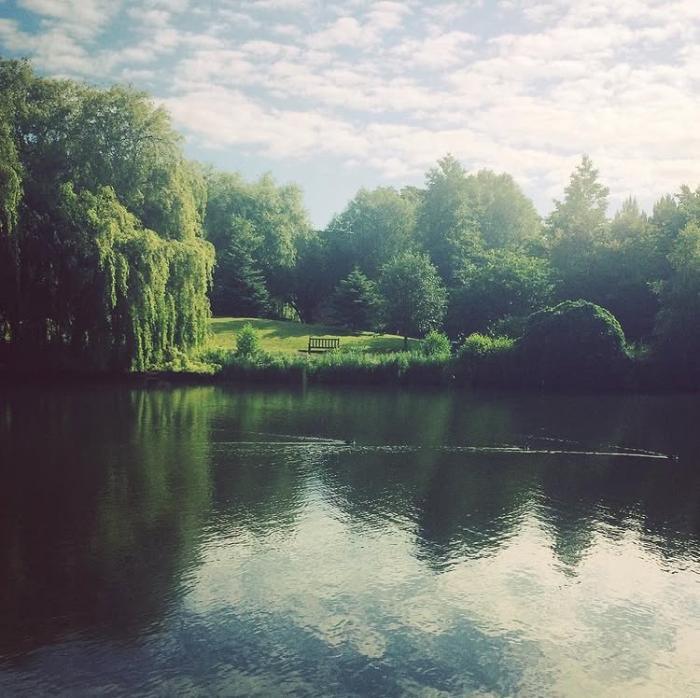
Regular readers of our newsletter will be aware of the valuable help we receive from our numerous volunteers. If you have ever used the many indexes of personal names on our online catalogue Borthcat, chances are you’ve encountered the work of a particularly long-standing group of volunteers from the City of York and District Family History Society. We were deeply saddened to learn recently of the death of one of its members, and one of our former volunteers, Jeanne Baxter. Jeanne enjoyed a long career at York City Library and had an abiding interest in local history. Over many years Jeanne and her fellow Society volunteers indexed thousands of names and personal details from the case books of Clifton Hospital, The Retreat, Bootham Park Hospital and York County Hospital, with Jeanne taking on much of the organisation of the project and personally checking through the index slips to ensure their accuracy. Jeanne’s dedicated work added enormous value to the catalogues and both we, and so many of our researchers, have cause to remember her with gratitude.
New Accessions
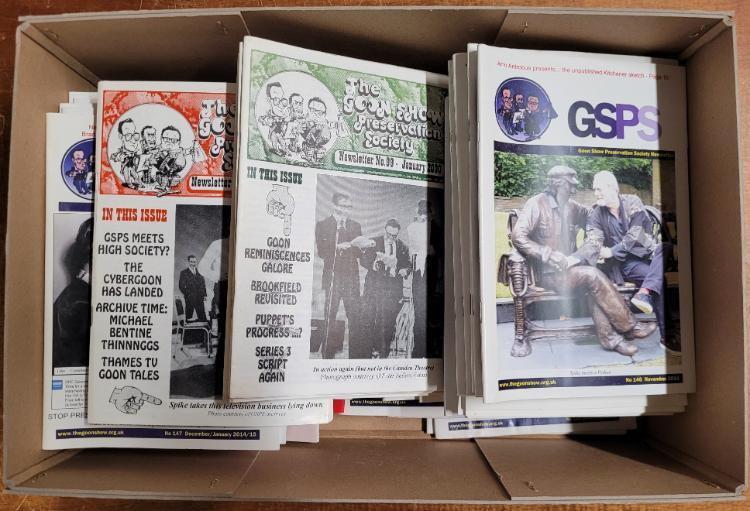
We took in eleven accessions in August. Two of these were additions to the University of York Archive, including recent records relating to landscape management and course handbooks for the History of Art. We also added two new accessions to the archive of the Goon Show Preservation Society, comprising VHS video tapes of shows and performances featuring Goon Show cast members and a 2023 issue of Goon Show News.
We were gifted a published memoir of the anti-apartheid activist and journalist Patrick Duncan, written by his sister Deborah Honoré. The memoir will add valuable context to our existing Patrick Duncan Archive, which was deposited with the university’s pioneering Centre for Southern African Studies in 1976 and came to the Borthwick following the Centre’s closure in 1995.
Sometimes accessions can be very welcome surprises. In 2015 we received 15 boxes of papers from the economist Professor Sir Tony Atkinson relating to a study he had carried out in the 1970s, drawing on the earlier work of Seebohm Rowntree. In 1950 Rowntree and his assistant G.R. Lavers had carried out his third (and final) ‘social survey’ of the city, seeking to assess how far the various welfare measures introduced in the past 14 years had actually succeeded in reducing the poverty recorded in his previous surveys of 1899 and 1936. The results were published in 1951 as ‘Poverty and the Welfare State’ and the conclusions were largely positive ones - with the analysis demonstrating a ‘remarkable decrease in poverty’ between 1936 and 1950.
In the 1970s Atkinson and his colleagues set out to assess to what extent this trend had continued by tracing the children of the families in the 1950 survey and asking them about their earnings, education, housing situation and other factors. The 2015 deposit, and a further addition in 2017, included nearly 400 of these valuable ‘household surveys’, as well as quantities of analysis and related papers, but there were many surveys still missing - or so we thought. We are happy to report that 23 further boxes of missing surveys and other project papers have now been located in Oxford and in August these were transferred to the Borthwick, proving you never quite know what’s still out there, waiting to be found!
New Catalogues
Number of archival descriptions on Borthcat on 1st September 2025: 144,307
In August we added the full catalogue for the archive of Skipwith parish. Although the surviving archive only dates back to the 1650s, the parish church of St Helen has a far longer history. Its tower is thought to date to the tenth century and contains an Anglo-Scandinavian ‘Ragnarok stone’, a carved stone believed to depict a scene from Norse mythology. Although the parish archive cannot lay claim to anything quite so old, or dramatic, you can find many records relating to the restoration and maintenance of the church in the collection, as well as the usual parish registers, records of parish administration and poor relief, and parish school records - and an early parish census.
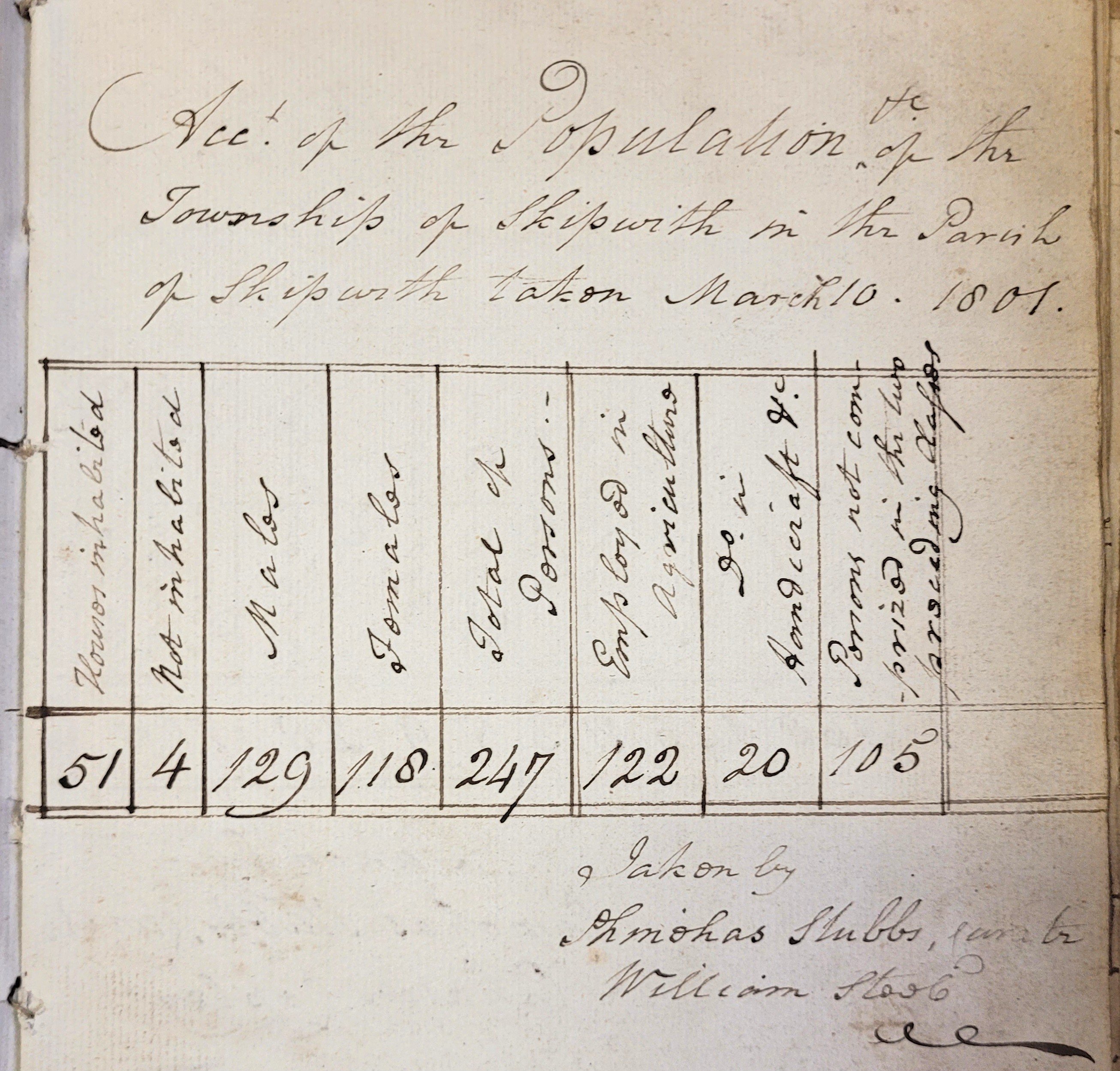
On 10th March 1801 parish officials made an ‘Account of the Population’ of the townships of Skipwith and North Driffield, including the total number of men and women, how many were employed in agriculture, handicrafts or other, and the names of householders. The survey was taken as part of the Census Act of 1800. Further ‘accounts of the population’ were taken in 1811, 1821 and 1831, before the introduction of the 1840 Population Act heralded the first ‘modern’ census the following year and the recording, finally, of the name of every individual.
If you prefer something a little more recent, you can now also browse the contents of the Goon Show Preservation Society Archive via a temporary box list. Cataloguing archives can be a lengthy process and box lists offer a way to make sure staff and researchers can easily access new archives in the meantime. The Society was founded in 1972 to preserve the history of, and celebrate, the groundbreaking British comedy series The Goon Show which launched the careers of Spike Milligan, Peter Sellars and Harry Secombe. Known for its absurdist and subversive sketches and songs, The Goon Show influenced a generation of young artists, including (but not limited to) The Beatles and Monty Python. The Society’s archive includes original and copy scripts, recordings and press cuttings, as well as a wealth of analysis of the Goons and their output and their influence, via newsletters, essays and publications.
Lastly, work has recently begun on the listing of the archive of John Sunderland. If you have ever visited the famous Jorvik Viking Centre in York you will already be familiar with his work, as Mr Sunderland was the designer of the original museum which opened in 1984. It was, incredibly, only his first museum design but it was an immediate success, with nearly a million visitors in the first year alone. Mr Sunderland has generously gifted us 160 of his journals and diaries, detailing his work as a designer of museum and visitor attractions worldwide and you can read more about the archive on Borthcat.
Borthwick Out and About
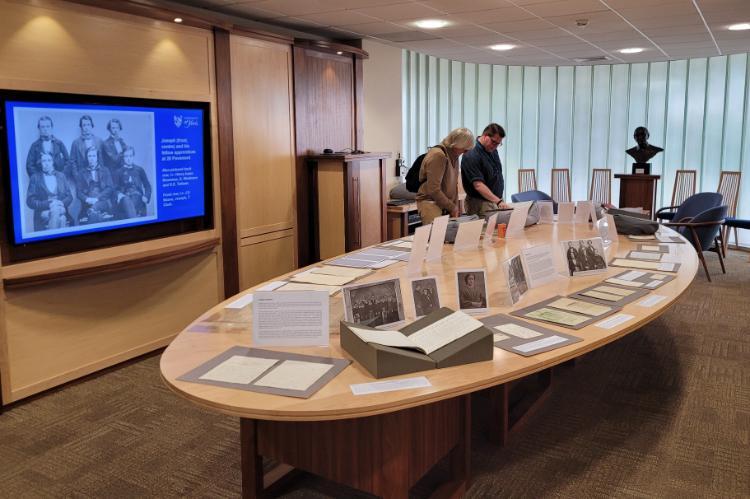
We began August with a pop up exhibition on the life and legacy of Joseph Rowntree. The event was hosted by Collections Information Archivist Sally-Anne Shearn in collaboration with the Rowntree Society as part of their programme of Joseph Rowntree Centenary events. The selected records were intended to show lesser known aspects of Joseph’s childhood at 28 Pavement, his apprenticeship in the family grocery business and his growing interest in social and political reform, as well as his homelife and his work with the Rowntree company and Trusts. It was great to meet so many people and to have the opportunity to chat all things Rowntree.
Our Access and Engagement Archivist Laura Yeoman was similarly busy discussing our collections at the York Army Museum’s Military Memorabilia Day on the 9th August. If you wanted to attend but weren’t able to, or if you’d just like to know more about our military records, you can find a detailed guide on our website.
On the 16th our Keeper of Archives Gary Brannan could be heard on the airwaves of York Hospital Radio. Gary had been invited to talk about our growing comedy collection, including the recent acquisition of the Galton and Simpson Archive. There was also a new article about the Galton and Simpson Archive in the York Press, with photographs of some of the highlights of the collection.
Looking ahead to September, we’ll be represented at the university’s Open Days on the 5th and 6th, where you can find us in the Borthwick Searchroom with a display of records chosen to highlight the breadth of our collections and (hopefully) to attract some new students. We’ll also be having a sale of Borthwick Papers and other publications in Fresher’s Week on the 19th. The sale will be open to everyone and we’ll have more details for you soon!
On the 17th Laura will be speaking to the Quaker Family History Society about the history of The Retreat psychiatric hospital. Incidentally the Retreat’s archive has been fully digitised to around 1919 and can be viewed for free online. And finally, if you’re a student at York St John University keep an eye out for an advert for the forthcoming placement at the Borthwick. You can read what one of last year’s cohort, Rachel Cox, enjoyed about her time here in a new blog ‘Remarkable Insights into Past Lives’.
Archive of the Month: Records of Lady Elizabeth Hastings' Charities
What is it? The surviving archive of the charitable trust established by Lady Elizabeth Hastings in 1739.
Where can I find it? The complete catalogue is available on Borthcat.
Why is it Archive of the Month?
Lady Elizabeth Hastings, or Lady Betty as she was popularly known, was a remarkable woman. In an age where it was rare for women to remain unmarried and to hold wealth in their own right, Lady Betty did both. Moreover she was determined to put her money to good use, channeling funds into causes for which she had a personal affinity and establishing a trust to continue this charitable work even after her death.
Lady Betty was born in 1682, the daughter of Theophilus Hastings, the 7th Earl of Huntingdon, and his wife Elizabeth, co-heiress of Sir John Lewis of Ledston Hall in Yorkshire. At the age of only 23 she inherited Ledston Hall and a substantial income, making her a wealthy and extremely eligible marriage prospect.
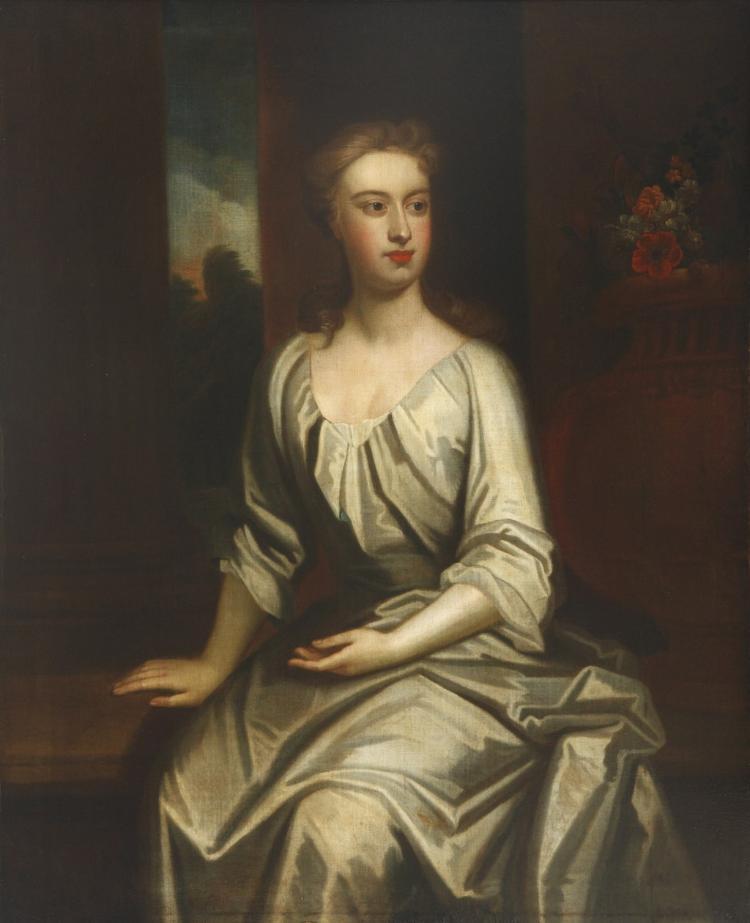
However Lady Betty refused all offers of marriage, although she maintained a wide circle of friends and was known to be a witty and popular hostess. Instead she devoted much of her income to philanthropy, in particular in the fields of religion, health and education. In particular Lady Betty believed that education should be open to boys and girls of all classes and to that end she donated to many charitable schools for the poor, as well as founding a boarding school for girls at Ledsham and supporting the girls’ school at Chelsea founded by Mary Astell, sometimes called Britain’s first feminist.
In 1738, at the age of 56, Lady Betty was diagnosed with breast cancer. She underwent a mastectomy (which at that time would have been performed without anaesthetic) but the prognosis was poor and so she set about ensuring that her good works could, and would continue by establishing a trust in her name. For the trust to be legal she needed to live another 12 months from its creation, so she did - dying a year and a week later on 21 December 1739.
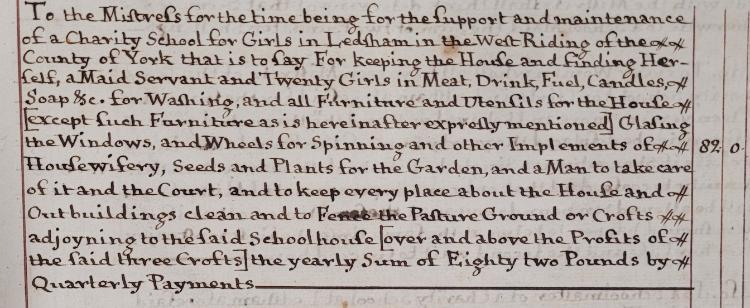
Today the Lady Elizabeth Hastings’ Charities continue to award educational and ecclesiastical grants in the North of England. The charity’s archive was first deposited at the Borthwick in 1984 and includes minutes, accounts, deeds, estate papers and even some school records from the earliest days of the trust through to the 1990s; a fascinating record of one woman’s enduring legacy.
We’ll be back in October with more news and events from the archive!
Borthwick Institute for Archives
University of York,
Heslington,
York,
YO10 5DD,
UK
Tel:
01904 321166
|
borthwick-institute@york.ac.uk

Legal statements | Privacy | Cookies | Accessibility
© University of York | Modify | Direct Edit