
Borthwick Institute for Archives

- Borthwick Institute for Archives
- News
- 2025
- Borthwick Newsletter - October 2025
Borthwick Newsletter - October 2025
Posted on 29 September 2025
October in the Archives - delve into our catalogues with this month’s featured description
2 issues of The Balkan News, 1 October 1918 and 21 October 1918, published at Salonica [Salonika] for British troops fighting on the Macedonian front [Alfred Peacock Archive, PEA/4/6/2].
What’s New?
The weather has turned decidedly autumnal as another academic year begins here on campus. At the Borthwick we took advantage of the last few ‘quiet’ weeks to finish off a number of cataloguing projects, edit two new podcasts, and hold a book sale! If you’re reading this before the 3rd October you still have time to pick up a Borthwick Publications bargain by emailing us or popping into the searchroom on Friday 3rd October, 10am - 3pm.
New Accessions
We took in an impressive 21 accessions in September. Eight of these were additions to the University of York Archive, including records relating to the Centre for Eighteenth Century Studies and the Centre for Health Economics, as well as papers of Stuart Sutcliffe, late Director of the Institute of Advanced Architectural Studies, and some of the research papers of Roy Carr-Hill who worked extensively in the fields of inequality, poverty and health economics. Our existing archive of closed branches of the North Yorkshire East Federation of Women's Institutes received a boost with 14 more boxes of material, and we added parish magazines, baptism and marriage registers to the parish archives of St Edward Dringhouses in York, and to Westow and Acklam.
Our remaining accessions share a theme of performance, beginning with the audio tapes of recordings made by composer Trevor Wishart and John Grant for the Jorvik Viking Centre in 1983. These recordings created the ‘soundscape’ used at the museum until 2010 and you can read more about the work of the museum’s designer, John Sunderland, in October’s Archive of the Month below.
We also added a DVD of ‘The Falkland’s Play’ to the Ian Curteis Archive, based on Curteis’ play of the same name and telling the story of the events leading up to the 1982 Falklands War, and we received an exciting new addition to the Galton and Simpson Archive.
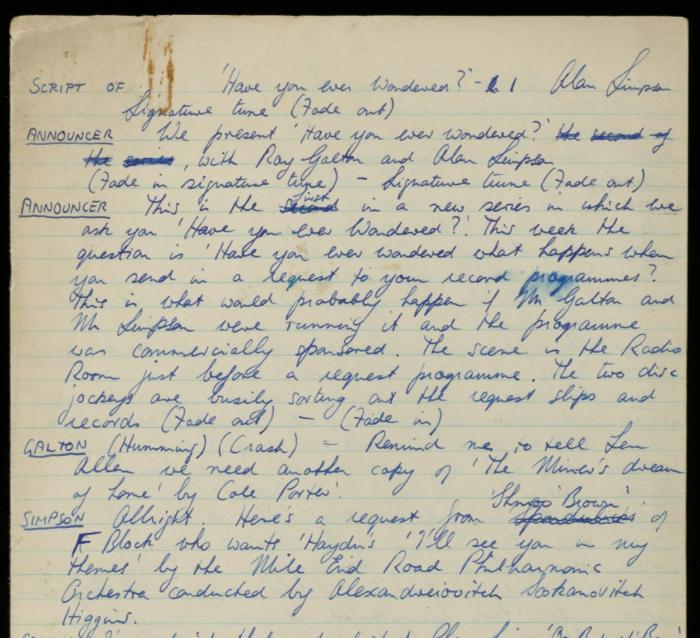
Whilst they would go on to create some of the famous comedy of the 1950s and 60s, Ray Galton and Alan Simpson’s first meeting was a decidedly unglamorous one. As teenagers they were both admitted to Milford Sanitorium in the late 1940s suffering from tuberculosis, and it was there they became friends and wrote their first show together for the hospital radio station. Some of the scripts from this first collaboration survive in the archive already but we now know they had a copy each thanks to Ray Galton’s unexpectedly turning up in a recent house move. Galton’s scripts for episodes 1 and 2 of ‘Have You Ever Wondered?’, as well as a partial script for episode 4, will now be added to the rest of the archive and available for research.
New Catalogues
Number of archival descriptions on Borthcat on 1st October 2025: 145,736
September was a bumper month for Borthcat with the addition of four new catalogues and more than one thousand new archival descriptions. Beginning with the smallest, the archive of the Drax Pensions Charity is closely linked to the Records of Drax Charity Trust and School, founded in 1669 to create a school and almshouses for the poor in Drax. The latter received their fuel and living allowance each year, as well as a new suit of clothes at Christmas. In 1915 this part of Reade’s bequest was converted into a separate charity, the Drax Pensions Charity, but its mission remained the same, to provide relief for three men and three women ‘of good character’ in the parish, a mission it carried out until its closure in 2009.
Another local addition is the parish archive of Acklam and Leavening. The existence of a church at Acklam was noted in the Domesday Book and the parish was, for a short time, the site of the Chancellor of York’s country residence. Apart from a single 1630 deed however, the surviving parish records begin in 1716 with the register of baptisms, marriages and burials. The fate of the earlier registers is, as with many parish archives, something of a mystery, but if you’re looking to do some family history research, don’t despair. Copies of the earlier registers were made as part of the Bishop’s Transcripts and you can see a list of the surviving years for the 17th and early 18th century on Genuki.
From the local to the international, the archive of historian Alfred Peacock will be of particular interest to family historians and military history enthusiasts alike. Peacock completed a doctorate at the University of York in 1973 and went on to write a biography of the ‘Railway King’ George Hudson, but his abiding interest was in the history of the First World War and his archive is a treasure trove of the original documents, research notes, articles and press cuttings on the subject, which he collected from the 1970s until his death in 2004. Many of these were the basis for articles in ‘Gun Fire’, the journal of the northern branch of the Western Front Association which he edited and published (and which is available in the main university library).
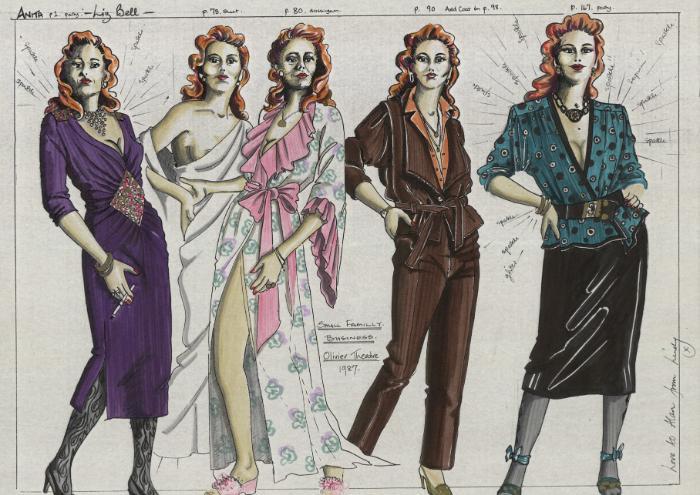
Finally, we are pleased to announce that you can now browse the full box list for the archive of renowned Yorkshire playwright Sir Alan Ayckbourn. The Ayckbourn Archive follows the life and career of Sir Alan from the 1940s to the present day and includes a wealth of scripts, production notes and designs, promotional materials, correspondence and photographs. At 230 boxes it’s a substantial resource for anyone keen to explore Ayckbourn’s extensive body of work or in the history of theatre in the North-East more generally. You can browse the box list at the link or read more about the history of the archive in the Borthwick Blog.
News from Conservation
The summer has been a rollercoaster in Conservation, with periods of busy-ness interspersed with patches of calm. We installed a new environmental monitoring system in July, which sends the data wirelessly. It is taking some time to get embedded, but it will save hours upon hours of manual collection time and analysis. There is also work being undertaken to repurpose certain spaces within the building. This is a longer term project which staff are investing a lot of thought and time into, and which we will hopefully be able to share with you more fully as plans progress.
We hosted a conservation volunteer placement in July for 4 participants, and managed to cram lots of information and techniques into our time together. We packaged glass slides, rolled plans and oversized ledgers, as well as making dust jackets for smaller volumes and surface cleaning architectural plans. Catherine also supported a bookbinding workshop for a RIKE networking event, which was a really positive way to share time with new people.
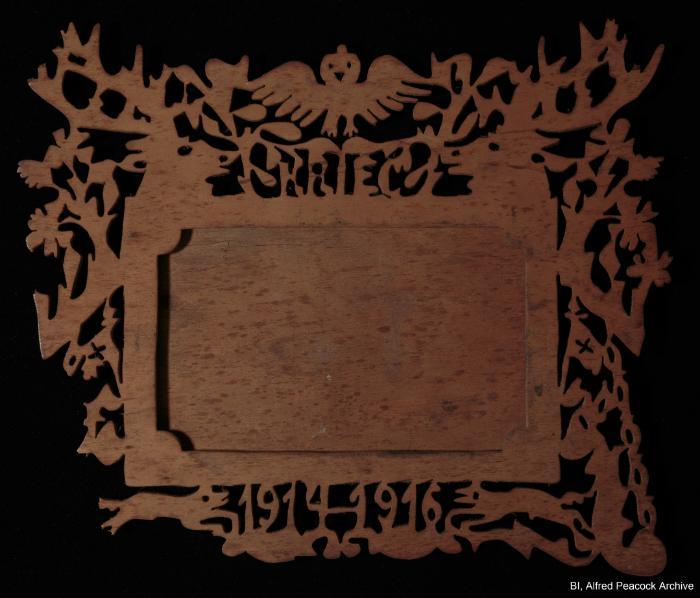
The summer is a key review point in our year, and this was reflected in the general increase in paperwork undertaken. We refresh our annual plan in August, as well as reviewing our risk assessments, and both of these tasks produce further actions such as updating method statements, booking new service contracts, vacuuming filters, arranging hazardous waste disposal, and so on. On a practical front we’ve had some unusual items for bespoke packaging through the workshop too. Our colleague Sally has been working with the Alfred Peacock archive, and so we have been finding ways to safely package a fragile silk ribbon, a broken intricately carved wooden frame, some dried flowers and a broken glass slide, the two parts finally united after many years apart.
September has finally brought our Archive Insight Week student exhibition down into the Burton foyer, which displays some of the elements of the Rowntree archive. The students put this together in just one day during their time with us in June, and hopefully now that the new academic year has started they - and you! - will be able to visit their completed exhibition. Now that the new semester is here we are also excited to be meeting new classes and volunteers, and sharing good handling practice with everyone who will be using the archives!
Borthwick Out and About
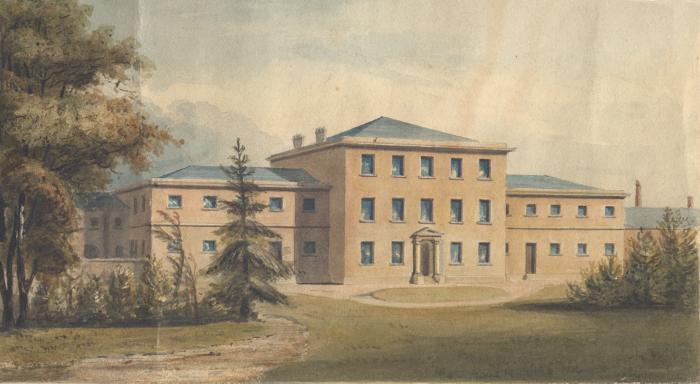
September had something of a hospital theme. On the 10th Dr Robert Adams spoke to the York Press about his newly published history of Bootham Park hospital in York, written using resources and patient records in the hospital archive here at the Borthwick, while on the 17th Access and Digital Engagement Archivist Laura Yeoman spoke to the Quaker Family History Society about the archive of The Retreat psychiatric hospital.
Looking ahead, we have several new podcasts for you to enjoy in October. The latest episode of our new Borthwick Paper podcast series is now available. 'Changing Conceptions of Childhood, 1870-1914: The York Mount School' is written and read by Ruby Hogan and it explores the history of the famous Quaker girls’ school which counts Dame Judi Dench and Noni Jabavu among its alumni.
Speaking of inspirational women, Chris Corbett, Community Engagement Officer at Teesside Archives, was a guest on the Trailblazers by Periplum podcast recently, discussing the life and achievements of Teesside community activist Maureen Richardson. Maureen’s fascinating story came to light after a chance meeting between Chris and our Collections Information Archivist Sally-Anne Shearn, who had come across Maureen’s work in the archive of the Joseph Rowntree Reform Trust.
And from the 2nd October you can also catch a new episode of our Out of the Archive Box podcast. This time Hannah Priest and our own Laura Yeoman will be discussing Hannah Beswick, a wealthy Victorian woman whose fear of being accidentally buried alive led her to become the so-called ‘Manchester Mummy’. Hannah is the author of a book on the subject, published in February this year by the Manchester University Press.
Away from the recording studio, Keeper of Archives Gary Brannan will be speaking at the Religious Archives Group Conference on the 2nd October on the subject of ‘York Archbishops Registers Revealed: 10 Years On’. The searchroom will be open on Friday 3rd October for the final day of our Borthwick Book Sale and on the 4th Laura Yeoman will be talking to the Metcalfe Family History Society about the York Cause Papers.
Finally, on the 10th October the archive of The Retreat psychiatric hospital will take centre stage in ‘Stories of Mental Health From York: Past, Present and Future’, an art and archive exhibition to mark World Mental Health Day 2025. The exhibition will be held in the former hospital's Recreational Room and is open to all. You can find out more about it online.
Archive of the Month: John Sunderland Archive
What is it? The journals and diaries of the museum, exhibition and graphic designer responsible for York’s famous Jorvik Centre and much more besides.
Where can I find it? The archive is at the Borthwick and in the process of being catalogued.
Why is it Archive of the Month?
Wakefield-born John Sunderland was the magic behind the revolution in museum and exhibition design that took place in York in the 1980s.
As a young graphic designer for Yorkshire Television, in the late 1970s, he created the Saturday evening television icon ‘Dusty Bin’ for the hit game show 3-2-1, and went on to work as director and art-director for the film projects of comedian Kenny Everett (1944-1995).
In the early 1980s, John’s career took a remarkable turn, having been commissioned by York Archaeological Trust to develop a museum based around the five-year rescue-archaeology dig of Viking remains at Coppergate, York. He became the Project Designer of the original Jorvik Viking Centre in York in 1981, working with the York-based composer Trevor Wishart to create an immersive and multisensory, experiential approach to the interpretation of York's Viking history.
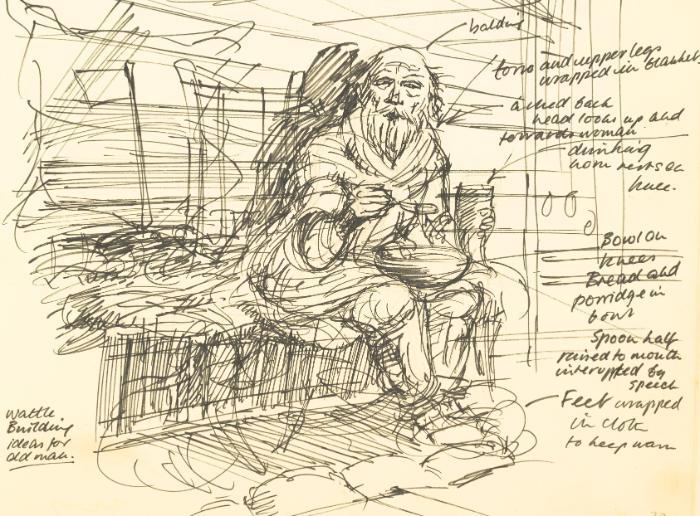
The centre was an immediate commercial success, attracting 980,000 ‘time tunnel’ visitors during the first year, and his design continues to be heralded as a pioneering populist archaeological exhibition, leaving an immediate and lasting impact on the way Britain's and the world's cultural heritage could be presented.
John went on to design and build 25 commercially successful international museums and cultural heritage centres, including ‘The Canterbury Tales’ (1985-1987), a permanent visitor attraction in a converted medieval church in the historic centre of Canterbury; an outdoor adventure play-scape for the Rhondda Heritage Centre (1986-1987); ‘The Oxford Story’ (1986-1988), a tourist attraction and orientation centre for the University of Oxford; concept, layout and story outline for ‘The Whisky Heritage Center’ (1987-1988).
His archive consists of some 160 often beautifully illustrated journals, diaries and daybooks. They not only provide insight into John’s creative process, but describe a chronological journey through the life and career of one of Britain’s most imaginative and innovative cultural creators.
We’ll be back in November with more news and events from the archives!
Borthwick Institute for Archives
University of York,
Heslington,
York,
YO10 5DD,
UK
Tel:
01904 321166
|
borthwick-institute@york.ac.uk

Legal statements | Privacy | Cookies | Accessibility
© University of York | Modify | Direct Edit