
Borthwick Institute for Archives

- Borthwick Institute for Archives
- News
- 2025
- Borthwick Newsletter - December 2025
Borthwick Newsletter - December 2025
Posted on 28 November 2025
December in the Archives - delve into our catalogues with this month’s featured description
Coronation Service with a menu for the Coronation Ball, December 1911; and an order of ceremony for the coronation [Lady Violet Deramore Archive, VDER/5/1/2]
What’s New?
The Christmas holidays are fast approaching and we’ve had a lot of frosty mornings - and even some snow - here in York. Christmas came a little early for Doctor Who fans with our recent announcement that we had successfully acquired the archive of a legend of the Whoniverse, Terrance Dicks. You can read more about this in New Accessions and we’ll be bringing you a lot more news from that archive as we continue to work through the contents. If you’re planning a visit to the Borthwick to view this or any other archive, please note that we will close to the public at 4.30pm on the 18th December and re-open at 9.30am on the 5th January.
New Accessions
We took in four new accessions in November. We added records of the Centre for Women’s Studies and posters for the student Comedy Society to the University of York Archive, and more photographs, promotional materials and programmes to the Joseph Rowntree Theatre Trust Archive. We also took in a small but mighty addition to the archive of the Goon Show Preservation Society - a hard drive containing more than 9000 files comprising copies of TV and film appearances by Goon Show cast members, as well as video of Society meetings and early cartoons.
Our newest and most exciting accession is of course the Terrance Dicks Archive, which arrived here in August but has remained shrouded in secrecy until now. For anyone who grew up in the 1970s, 80s and 90s, and had even a passing interest in the long-running BBC scifi show Doctor Who, the name Terrance Dicks will be a familiar one. Terrance’s association with the show began in 1968, when he was appointed Assistant Script Editor, and lasted until his death in 2019. He became head Script Editor in 1969 and co-wrote his first Doctor Who television story, The War Games, that same year. He went on to write such classic stories as Robot, The Brain of Morbius, The Horror of Fang Rock and State of Decay, but he is perhaps even better known for his prolific output of Doctor Who novels. Terrance wrote the novelisations for 67 Doctor Who television stories, published by Target Books and easily recognisable for their familiar branding and art work, as well as a number of New Adventures novels following the cancellation of the show in 1989.
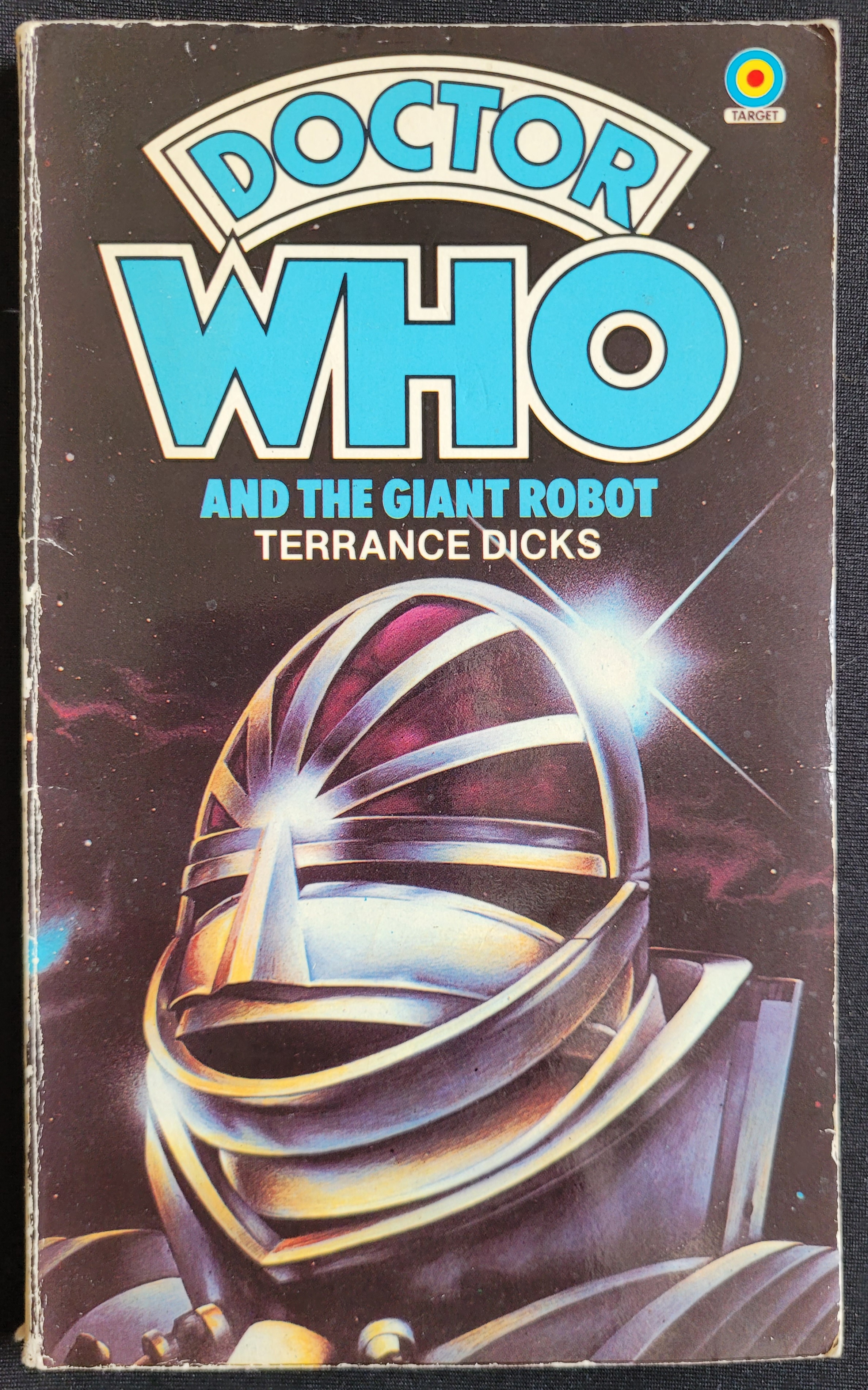
Both the television serial and the novelisation of Robot were written by Terrance Dicks.
His archive contains a wealth of scripts (rehearsal, camera and transmission) for Doctor Who episodes, some written by Terrance and some used by him as a guide for his novelisations. There are also drafts of his many Doctor Who books, showing their development and the additions he sometimes made to the televised version. For example, if you picked up his novelisation of Fourth Doctor story The Pyramids of Mars, you might be surprised to discover it includes a prologue setting out the ‘legend of the Osirians’, and an epilogue in which companion Sarah Jane Smith looks up the events of the story decades later.
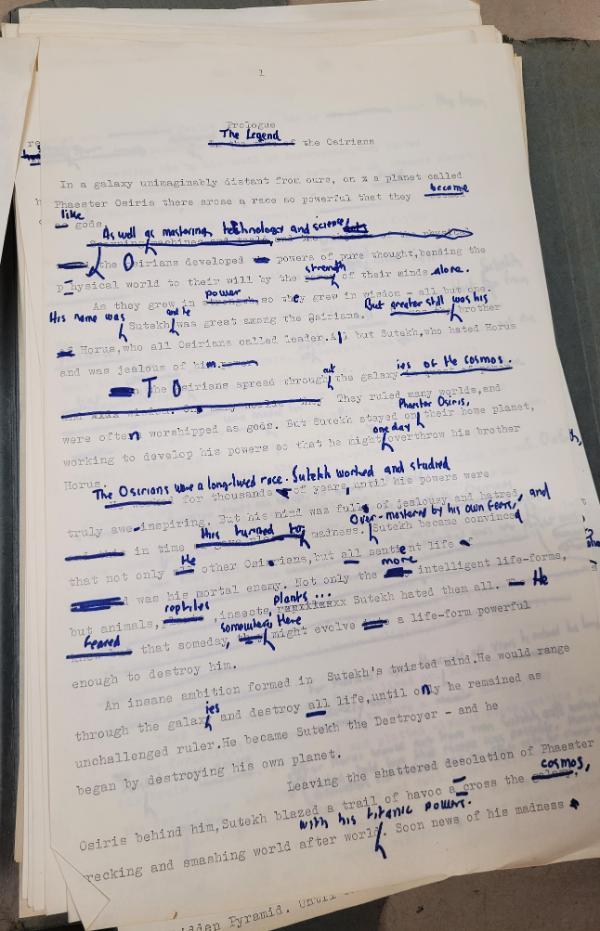
A heavily annotated page from the manuscript of the Pyramids of Mars novelisation.
There are also interviews, copies of official and fan magazines, correspondence, diaries and ephemera relating to his work for the show and its wider fandom, as well as draft books and scripts for the work he did outside of Doctor Who (including some early crossovers with our Galton and Simpson archive). Work on the archive is ongoing but we are enormously grateful to Terrance’s family and to the author Simon Guerrier for making this exciting addition possible!
New Catalogues
Number of archival descriptions on Borthcat on 1st December 2025: 147,126
In November we added the full catalogue for the parish archive of Norton on Derwent, dating back to 1558, the year that Elizabeth I acceded to the throne. The archive is quite a large one at 25 boxes and contains all of the records you might expect from a parish archive, and some unusual survivals you might not. Among the unexpected highlights is a payment of £5 made to a William Ball Wright in 1903 for ‘deciphering, reviving, restoring and transcribing’ 138 pages of the parish registers (clearly a daunting task); programmes for parish entertainments in the 1880s; and a 1941 leaflet reminding parishioners to immunize their children against diphtheria. A bundle of religious tracts and pamphlets exhorts wives and mothers to ‘raise the tone’ of English women at the turn of the 20th century, whilst others grapple with Christian conduct and the ‘race question’ in wartime.
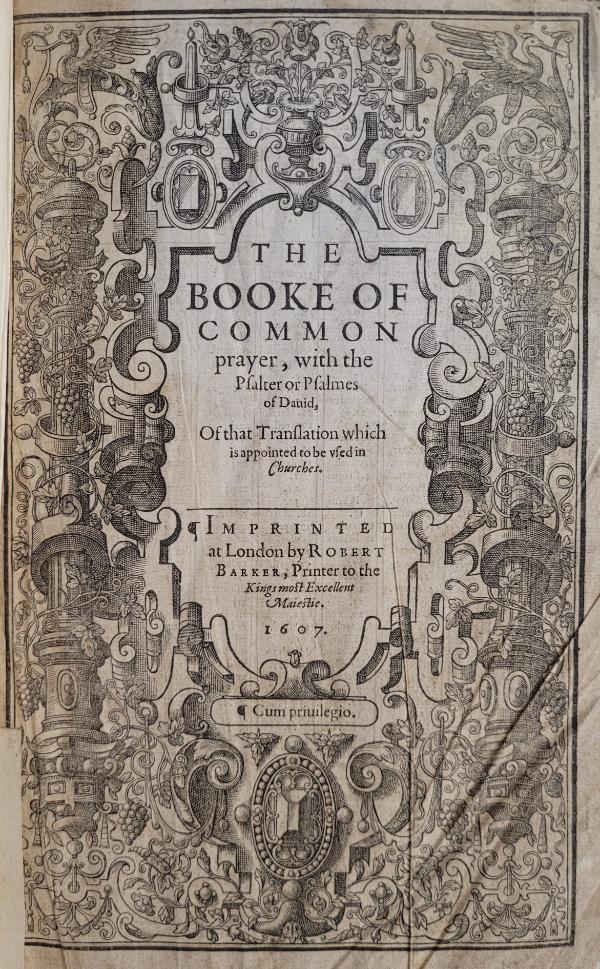
Frontispiece from the 1607 'Breeches Bible' and Prayer Book.
Perhaps the most surprising addition is the copy of a ‘Breeches Bible’ from 1607, so-called because the translation of Genesis 3:7 describes Adam and Eve as sewing ‘figge tree leaves together’ to make themselves ‘breeches’ instead of ‘aprons’, the term used in the 1611 King James Bible. Although this Bible was superseded, at least in Britain, by the King James version, it is still regarded as one of the most important translations of the Bible and was the version used by William Shakespeare and taken to America aboard The Mayflower in 1620.
News from Conservation
Projects have been rumbling along in the Conservation workshop over the autumn. We have had 2 new volunteers over October and November, who have achieved a huge amount of work in reboxing and repackaging various formats, such as architectural plans, Rare Books, Art Collection ceramics and glass plate negatives. Work has been undertaken to prepare some Kit Rob material to go on loan to the Yorkshire Museum next month, which has involved a pre-loan condition assessment, packaging for transportation and the preparation of display supports. A new exhibition will also be installed into the exhibition cases on the ground floor of the Burton in December, so keep an eye out for that!
A particular high point for the conservators this autumn has been spending an afternoon with Barbara Hepworth’s Antiphon, which is located in the foyer of the Sir Jack Lyons Concert Hall. The sculpture and surrounding plinth needed dusting, so we had a pleasant time giving this and the other 2 busts in the foyer a thorough dust and vacuum.
Borthwick Out and About
We began November with a stand at the Yorkshire Archaeological and Historical Society Fair in central York. On campus, we had the opportunity to welcome many new visitors to the archive for tours and introductory talks, including members of the university’s own Linguistic Society, and visitors from Leeds Beckett University and from the University of Bangalore.
Two new blogs were published in the last month. University Art Curator Helena Cox wrote about campus sculptures on her blog and our library colleague Simon Batchelor contributed a guest blog on gurning and the art of face pulling, drawing on one of the Rare Books in our Cooper Abbs Collection.
Looking ahead to the last few weeks of the year, on the 2nd December we will be hosting a workshop led by community-audio project Applied Stories and staff from The National Archives in which participants will get to create sound collages to mark the 80th anniversary of the end of the Second World War, using specially curated records and recordings. On the 5th we will be taking part in a panel session for the Mentally Fit York project looking at how archives can shape future mental health policies. You can reserve a place for the session here.
Archive of the Month: John Mackintosh & Sons Ltd
What is it? The archive of the Halifax based confectionery company that merged with Rowntree’s of York in 1969 to form Rowntree-Mackintosh.
Where can I find it? The archive is fully catalogued on Borthcat.
Why is it Archive of the Month?
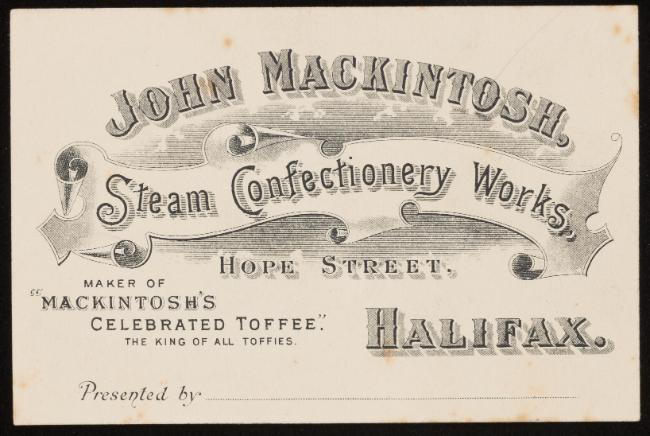
December seems an appropriate month to highlight the archive of John Mackintosh & Sons of Halifax, a name you may know from the tins, or more recently tubs, of Quality Street, one of the most popular British chocolate assortments (and a Christmas staple). The company’s story began some 135 years ago when newly married couple John and Violet Mackintosh opened a pastry shop in the Yorkshire town of Halifax. Violet had experience as a confectioner’s assistant and she is credited with the development of their first ‘Celebrated Toffee’ recipe, using a blend of English butterscotch and American caramel to create the softer, chewy sweet we associate with the word ‘toffee’ today. The creation proved so popular that the business quickly expanded, with Halifax becoming known as the Toffee Town and John Mackintosh as the Toffee King.
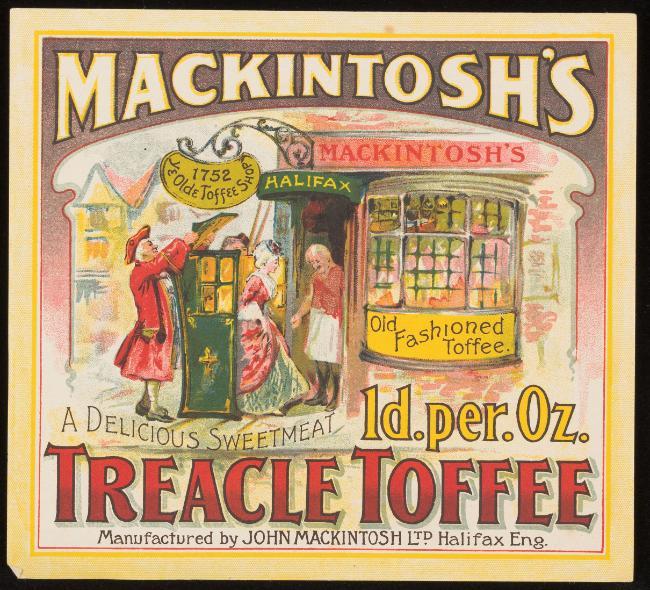
More toffee products followed and in 1936 Mackintosh’s launched Quality Street, their first toffee based chocolate assortment, named after the play by Peter Pan author J.M. Barrie. Quality Street came in tins, bags and mini ‘pocket packs’ and was an instant hit, but did you know that Mackintosh invented other enduring chocolate products? If you have ever enjoyed a Toffee Crisp or Caramac, or shared a packet of Rolos or Munchies, you can thank Mackintosh. You might even have listened to Mackintosh-inspired music. In 1968 George Harrison of The Beatles used a box of Mackintosh ‘Good News’ chocolates as inspiration for the song Savoy Truffle, recorded for the band’s White Album.
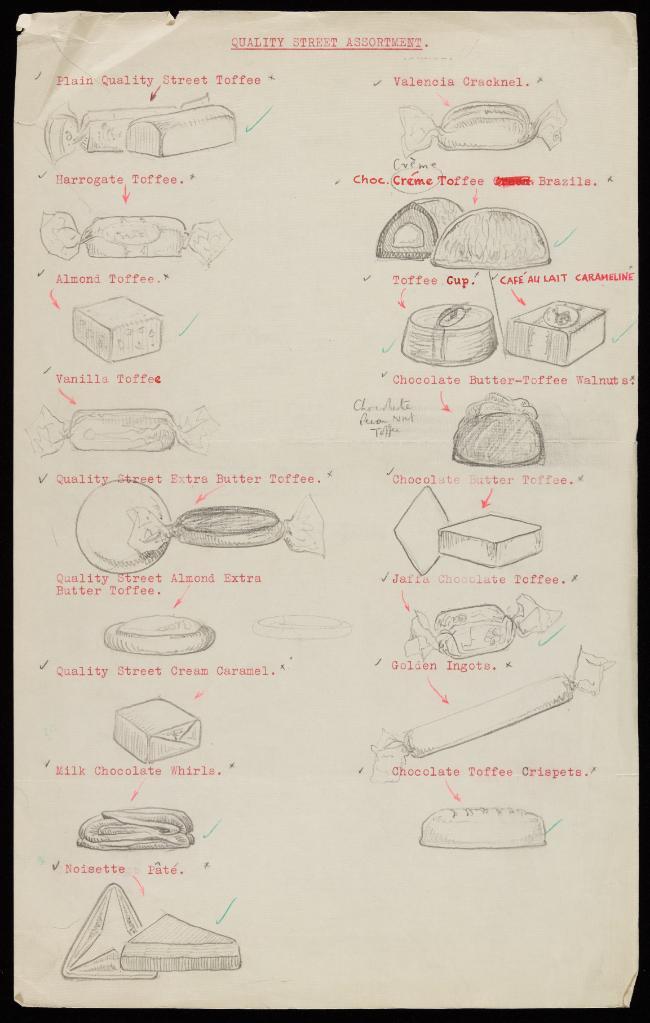
The original contents of a tin of Quality Street.
The merger of Mackintosh and Rowntree in 1969 meant that we were fortunate enough to receive both archives following the takeover of Rowntree-Mackintosh by Nestle some twenty years later. The bulk of the surviving Mackintosh material dates from the 1890s to the 1980s (with some earlier property records), and range from the minutes of the governing board to handwritten recipe books, original artwork for advertisements and records of staff clubs and societies. It even includes a recording of a programme broadcast on Radio Luxembourg in 1938 in which listeners could send in a music request and a memory and receive a box of Mackintosh toffee in return!
The size and scale of our Rowntree archives can have a tendency to dwarf our other business holdings, but the archive of John Mackintosh & Sons deserves to be just as well known. From humble beginnings in West Yorkshire, Mackintosh reinvented the English toffee and created a range of sweet treats we still know and love today. So if you find yourself tucking into a tub of Quality Street this December, raise a Toffee Penny to Violet and John - or just come and see the archive for yourself (no toffee bribes required).
We’ll be back in 2026 with more news and events from the archives.
Borthwick Institute for Archives
University of York,
Heslington,
York,
YO10 5DD,
UK
Tel:
01904 321166
|
borthwick-institute@york.ac.uk

Legal statements | Privacy | Cookies | Accessibility
© University of York | Modify | Direct Edit