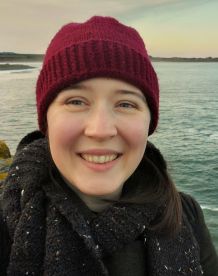
Dr Corrie Hyland
Technical Specialist in Compound Specific Isotope Analysis
Visit Dr Corrie Hyland's profile on the York Research Database to:
- See a full list of publications
- Browse activities and projects
- Explore connections, collaborators, related work and more

Profile
Biography
I am the Technical Specialist in Compound Specific Isotope Analysis for BioArCh at the University of York. Amino acid compound specific stable isotope analysis (CSIA-AA) allows archaeological scientists to examine the stable carbon and nitrogen isotope values of the individual amino acids that make up bone collagen. This technique provides a deeper level of knowledge to expand upon traditional bulk collagen stable isotope analysis to further explore the diets of people, human-animal interactions and environments in the past. My previous experiences conducting CSIA-AA for the Baikal Archaeology Project (DPhil) and the Seeing the Dead project (Postdoctoral Research Associate) have sparked my interest in the wider application of these techniques to archaeological research.
Career
Postdoctoral Research Associate (Stable Isotope Analysis), University of York 2025 – 2026
AHRC Project: Seeing the Dead
DPhil Archaeological Science, University of Oxford, School of Archaeology, 2020 – Present
Thesis title: Extricating the importance of freshwater resource use within prehistoric diets: an evaluation of compound-specific stable isotope analysis
Laboratory Technician, Dr. Amy Styring, School of Archaeology, University of Oxford, 2023
Research Assistant, Dr. Paul Szpak, 2017 – 2020, Trent University
Archaeological Field Technician, AECOM, Summer 2018
Barrie, Ontario, Canada
B.Sc. (Honours), Trent University, Anthropology
Thesis title: Historic impacts of Thule whaling subsistence on artic fox dietary ecology: examined through Stable Carbon and Nitrogen Isotope Analysis
Research
Overview
I use scientific techniques such as stable isotope analysis and radiocarbon dating to reconstruct past individuals' life histories and cultural contexts. By examining human diet and mobility patterns against environmental and societal changes, I develop nuanced interpretations informed by funerary archaeology, paleopathology, and human-animal interactions. A particular passion of mine is extending my research to explore the prehistoric ecology of animal species significant to ancient human cultures. Moving forward in my career, I aim to investigate the intersection between diet and mobility patterns with past health and disease indicators.
Publications:
Hyland, Corrie, Karolina Cameron-Werens, Christophe Snoeck, Aleksander Shchetnikov, Pavel Tarasov, Andrzej Weber, and Rick J. Schulting. 2026. Complex distribution of ancient carbon between tributaries of the Upper Lena seen in radiocarbon dates of modern fish. Radiocarbon. 68(3): 490–520. doi:10.1017/RDC.2026.10219
Eckelmann, Rebekka, Laura Arppe, Alexey Tarasov, Łukas Pospieszny, Lukáš Ackerman, Voker Heyd, Dmitry Gerasimov, Vyacheslv Moiseyev, Vanessa Fairbanks, Corrie Hyland, and Kristiina Mannermaa. 2025. Mobility and community at Mesolithic Lake Onega, Karelia, north-west Russia: insights from strontium isotope analysis. Archaeological and Anthropological Sciences. doi: /10.1007/s12520-024-02129-8
Hyland, Corrie, Michael Scott, Jennifer Routledge, and Paul Szpak. 2021. Stable Carbon and Nitrogen Isotope Variability of Bone Collagen to Determine the Number of Isotopically Distinct Specimens. Journal of Archaeological Method and Theory. doi:10.1007/s10816-021-09533-7
Hyland, Corrie, Jean-François Millaire and Paul Szpak. 2021. Migration and Maize in the Virú Valley: Understanding Life Histories through Multi-tissue Carbon, Nitrogen, Sulfur and Strontium Isotope Analyses. American Journal of Physical Anthropology 176(1):21–35. doi:10.1002/ajpa.24271
McCormack, Jeremy, Paul Szpak, Nicolas Bourgon, Michael Richards, Corrie Hyland, Pauline Méjean, Jean-Jacques Hublin and Klervia Jaouen. 2021. Zinc isotopes from archaeological bones provide reliable trophic level information for marine mammals. Communications Biology 4(683). doi:10.1038/s42003-021-02212-z
Hyland, Corrie. 2018 A Critical Evaluation of DNA Analysis for Palaeopathological Research. Journal of Undergraduate Studies Trent University 6(1): 60-67.
Projects
Seeing the Dead is a UKRI-funded project investigating the Roman Yorkshire funerary custom (3rd and 4th centuries CE) of pouring liquid gypsum over bodies and coffins before burial. This cooperative and multidisciplinary research benefits from the collaboration between museum project partners and specialist researchers to understand the cultural, ritual and practical implications of such an elaborate burial practice. The findings will further broaden the accessibility of these materials through publications, digital capture, didactic videos and exhibitions.
Research group(s)
Collaborators
Trent Environmental Archaeology Laboratory, and collaborators in my current research groups. See project websites for further details.
External activities
Memberships
- Society for American Archaeology
- Canadian Association for Biological Anthropology / l’Association canadienne d’anthropologie biologique
Editorial duties
- Reviewer for Archaeometry, International Journal of Osteoarchaeology
- Abstract reviewer for 14C & Diet and CLARa conferences 2026
Invited talks and conferences
Hyland, Corrie, Maureen Carroll, Michelle Alexander 2026. Lives Encased in Gypsum: Isotopic Insights into Identity, Mobility, and Diet in Roman Yorkshire. UK Archaeological Science Conference, Bristol, UK.
Hyland, Corrie, Amy Styring, Rick Schulting, Andrzej Weber 2024. Amino acid-specific approaches to freshwater reservoir corrections. UK Archaeological Science Conference, York, UK.
Hyland Corrie, Rick Schulting, Amy Styring, Andrzej Weber 2023 Do these radiocarbon dates look fishy to you? Working with the Baikal Archaeology Project to improve their freshwater reservoir effect corrections with new stable isotope approaches. Peterborough Charter of the Ontario Archaeology Society, Online Seminar based in Peterborough, Canada.
Hyland, Corrie, Amy Styring, Rick Schulting, Andrzej Weber 2023 Can amino acid δ13C succeed where bulk δ13C fails? Testing “freshwater diet” signals against known 14C reservoir offsets. Pitt-Rivers Archaeological Science Seminars. University of Cambridge, Cambridge, UK.
Hyland, Corrie, Rick Schulting, Amy Styring, Andrzej Weber 2023. Radiocarbon Dates and Freshwater Resource Use within Prehistoric Diets. Symposium 53–Northeast Asian Prehistoric Hunter-Gather Lifeways: Multidisciplinary, Individual Life History Approach. Society for American Archaeology 88th Annual Meeting. Portland, Oregon, USA.
Hyland, Corrie, Amy Styring, Rick Schulting, Andrzej Weber 2022 Permafrost melt as the driver of archaeological and modern freshwater reservoir effect. 24th Radiocarbon and 10th 14C & Archaeology Conference. Zurich, Switzerland.
Hyland, Corrie, JF Millaire, P Szpak 2021 Poster: Interpreting Life Events using Multi-Tissue Stable Isotope Analysis, Virú Valley Peru. 9th International Symposium on Biomolecular Archaeology. Online Conference based in Toulouse, France.
Hyland, Corrie, JF Millaire, P Szpak 2020 A Warrior, a pregnancy and a highlander on the north coast: Interpreting life events using multi-tissue stable isotope analysis, Virú Valley Peru. 48th Annual Meeting of the Canadian Association for Physical Anthropology/L’Association Canadienne d’Anthropologie Physique, Online Conference based in Canada.
Hyland, Corrie, JF Millaire, P Szpak 2019 Isotopic Analysis of Ritual Killing Events, Virú Valley. North East Andean Archaeology and Anthropology Conference, Brown University, Providence, Rhode Island, USA.