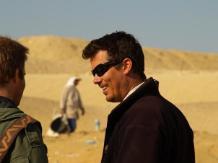
Dr James Taylor
Profile
I am a lecturer in Field Archaeology and Digital Methods at the Department of Archaeology, University of York; I am also director of the MA in Field Archaeology and co-director of the Wolfson Digital Archaeology and Heritage Lab. I am responsible for delivering a range of masters level and undergraduate teaching, including contributing to the core teaching on the Digital Archaeology and Digital Heritage MSc programmes (directed by Dr Colleen Morgan and Dr Peter Schauer), I currently act as the Departmental Ethics Representative.
I have active research interests in Neolithic Archaeology, the Prehistory of Greece and the Eastern Mediterranean, North Africa and the Near East, Theory and Method in Archaeology and Digital Methods in Archaeology (especially Applied GIS, Critical GIS and the impact of the 'Digital Turn' on archaeological practice) - see also my ResearchGate Profile. I am Co-Director of the Toumba Serron Research Project, an archaeological investigation centred on a Neolithic village in Greek Macedonia.
From 2012 to 2019 I was Co-Field Director of the Çatalhöyük Research Project, an important long term research project studying settlement on a Neolithic Tell site in Southern Anatolia. In this role I helped to coordinate and direct the excavation and general site logistics, management of excavators, development and implementation of excavation methods and post-excavation work.
Prior to this I worked as a professional archaeologist since 1998 and spent several years in the UK commercial sector, working first for Birmingham Archaeology (then B.U.F.A.U., 1999-2000) and then Pre-Construct Archaeology (London, 2000-2004). From 2004 I worked freelance for various large research projects; this gave me the opportunity to work extensively in Italy, Iceland, Turkey, Egypt and the Middle East.
Office Hours:
If you are a student and would like to book office hours, you can do so by following this link.
Expertise and Policy
James Taylor is an archaeologist specialising in digital archaeology, archaeological fieldwork and cultural-heritage data. His work examines how excavation records, GIS, 3D models, photographs and digital archives can be created, connected, preserved and reused more effectively. He can provide expert advice on archaeological data standards, post-excavation practice, digital heritage, research ethics, public engagement and the effects of new technology on professional archaeology and archaeological knowledge creation. His regional expertise includes Neolithic societies in Greece, Turkey and the wider Eastern Mediterranean, particularly Çatalhöyük and Toumba Serron. His research connects academic archaeology with professional practice, heritage organisations, local communities and creative practitioners.
Publications & Conferences
Publications
Journal articles
May, K., Taylor, J.S. and Aitchison, K. (2025) ‘Bridging the post-excavation gaps: structured guidance and training for post-excavation in archaeology’, Open Archaeology, 11(1), article 20250049. https://doi.org/10.1515/opar-2025-0049
Perry, S., Simandiraki-Grimshaw, A., Morgan, C., Taylor, J.S., Fadioui, A., Foket, L., Hacıgüzeller, P., Sampatakou, D.V., Derudas, P., Wright, H. and Clough, A. (2025) ‘Towards new futures for archaeological data production: challenging archaeonormativity through storytelling’, Journal of Field Archaeology, pp. 1–20. https://doi.org/10.1080/00934690.2025.2504235
May, K. and Taylor, J.S. (2024) ‘Resurrecting, re-interpreting and re-using stratigraphy: an afterlife for archaeological data’, Antiquity, 98(399), pp. 805–820. https://doi.org/10.15184/aqy.2024.60
Taylor, J.S. (2024) ‘Digital infrastructures and their impact on data acquisition’, Current Swedish Archaeology, 31, pp. 53–58. http://dx.doi.org/10.37718/CSA.2023.05
Taylor, J.S. (2024) ‘The Çatalhöyük Research Project as a high-definition research environment for the study of “urbanization”’, Journal of Urban Archaeology, 10(5), pp. 77–97. https://doi.org/10.1484/J.JUA.5.142499
Twiss, K.C., Bogaard, A., Haddow, S., Veropolidou, R., Taylor, J.S., Pearson, J., Tsoraki, C., Milella, M., Kay, K., Busacca, G., Mazzucato, C., Knüsel, C.J. and Pochron, S. (2024) ‘“But some were more equal than others”: exploring inequality at Neolithic Çatalhöyük’, PLoS ONE, 19(9), article e0307067. https://doi.org/10.1371/journal.pone.0307067
May, K., Taylor, J.S. and Binding, C. (2023) ‘Stratigraphic analysis and the matrix: connecting and reusing digital records and archives of archaeological investigations’, Internet Archaeology, 61. https://doi.org/10.11141/ia.61.2
Hacıgüzeller, P., Taylor, J.S. and Perry, S. (2021) ‘On the emerging supremacy of structured digital data in archaeology: a preliminary assessment of information, knowledge and wisdom left behind’, Open Archaeology, 7(1), pp. 1709–1730. https://doi.org/10.1515/opar-2020-0220
Morgan, C., Petrie, H., Wright, H. and Taylor, J.S. (2021) ‘Drawing and knowledge construction in archaeology: the Aide Mémoire Project’, Journal of Field Archaeology, 46(8), pp. 614–628. https://doi.org/10.1080/00934690.2021.1985304
Sadarangani, F., Taylor, J.S., Boraik, M., Eissa, R., El-Laithy, A.M., Mahmoud, H.M.M. and Shihab, E.M. (2021) ‘Excavations in the Khalid Ibn El-Waleed Garden, Luxor: Avenue of the Sphinxes’, Annales du Service des Antiquités de l’Égypte, 88, pp. 81–144.
Taylor, J.S. and Dell’Unto, N. (2021) ‘Skeuomorphism in digital archaeological practice: a barrier to progress, or a vital cog in the wheels of change?’, Open Archaeology, 7(1), pp. 482–498. https://doi.org/10.1515/opar-2020-0145
Taylor, J.S., Issavi, J., Berggren, Å., Lukas, D., Mazzucato, C., Tung, B. and Dell’Unto, N. (2018) ‘“The rise of the machine”: the impact of digital tablet recording in the field at Çatalhöyük’, Internet Archaeology, 47. https://doi.org/10.11141/ia.47.1
Berggren, Å., Dell’Unto, N., Forte, M., Haddow, S., Hodder, I., Issavi, J., Lercari, N., Mazzucato, C., Mickel, A. and Taylor, J.S. (2015) ‘Revisiting reflexive archaeology at Çatalhöyük: integrating digital and 3D technologies at the trowel’s edge’, Antiquity, 89(344), pp. 433–448. https://doi.org/10.15184/aqy.2014.43
Brown, G. and Taylor, J.S. (2010) ‘Medieval embankment and post-medieval development at Bermondsey Wall West’, Surrey Archaeological Collections, 95, pp. 91–138.
Taylor, J.S., Gisladóttir, G.A., Harðardóttir, A. and Lucas, G. (2005) ‘Eyri in Skutulsfjörður’, Archaeologia Islandica, 4, pp. 68–80.
Book chapters and contributions to edited volumes
Taylor, J.S. and Morgan, C. (2026) ‘Pixelated pencils: hybrid methods for teaching archaeological illustration’, in H. Cobb and K. Croucher (eds.) Archaeology to Transform and Disrupt: Active Learning in and Beyond the University Classroom. Abingdon, Oxfordshire: Routledge.
Taylor, J.S. and Wright, H. (2026) ‘The thinking field: ring-fencing creative space in digital archaeological practice’, in P. Zafeiriadis, M. Katsianis and S. Handberg (eds.) Digital Impacts on Archaeological Fieldwork: Advantages and Limitations: Proceedings of the International Workshop Held at the Norwegian Institute at Athens, 4–5 December 2024. Papers and Monographs from the Norwegian Institute at Athens, vol. 16. Athens: Norwegian Institute at Athens, pp. 237–272.
Sadarangani, F., Taylor, J.S. and Jones, D. (2024) ‘Excavation to publication’, in M. Bárta, M. Megahed and Z. Hawass (eds.) Living at the Wall: Studies in Honor of Mark Lehner. Czechia: Charles University, Faculty of Arts.
Taylor, J.S. (2020) ‘Space and time’, in M. Gillings, P. Hacıgüzeller and G. Lock (eds.) Archaeological Spatial Analysis: A Methodological Guide. Wiley-Blackwell.
Perry, S. and Taylor, J.S. (2018) ‘Theorising the digital: a call to action for the archaeological community’, in M. Matsumoto and E. Uleburg (eds.) Oceans of Data: Proceedings of the 44th Conference on Computer Applications and Quantitative Methods in Archaeology. Oxford: Archaeopress.
Mahmoud, H. and Taylor, J.S., with Gabr, A.A., Abd el-Rahman, M.A. and Saad, M. (2015) ‘A preliminary report on the AA Bakery’, in F. Sadarangani and A. Witsell (eds.) Settlement and Cemetery at Giza: Papers from the 2010 AERA–ARCE Field School, pp. 33–54. North Manchester, IN: HF Group and Ancient Egypt Research Associates.
Taylor, J.S., Bogaard, A., Carter, T., Charles, M., Haddow, S., Knüsel, C.J., Mazzucato, C., Mulville, J., Tsoraki, C., Tung, B. and Twiss, K. (2015) ‘“Up in flames”: a visual exploration of a burnt building at Çatalhöyük in GIS’, in I. Hodder and A. Marciniak (eds.) Assembling Çatalhöyük, vol. 1, pp. 128–149. Leeds: Maney.
Forthcoming
Taylor, J.S. and Zorzin, N. (in press) ‘Digital fields and inclusive futures: towards ethical and participatory approaches in digital archaeological data acquisition and management at Toumba Serron’. Publication details forthcoming.
Contributions to Çatalhöyük Excavations: The 2009–2017 Seasons
Contributions to Hodder, I. (ed.) (2023) Çatalhöyük Excavations: The 2009–2017 Seasons. Çatalhöyük Research Project Series, vol. 12. Ankara: British Institute of Archaeology at Ankara:
Farid, S., Hodder, I. and Lukas, D., with contributions by Taylor, J.S., ‘Chapter 2: Excavation, recording and sampling methodologies’.
Farid, S., Hodder, I., Taylor, J.S. and Tung, B., ‘Chapter 3: Chronology and overall phasing of the North and South Areas’.
Taylor, J.S., ‘Chapter 6: Building 7 and associated spaces: the “Shrine 8 Annex Sequence” (Spaces 470, 487 and 492), and spaces to the west, including Buildings 100 and 104’.
Taylor, J.S., ‘Chapter 7: Building 17 and Spaces 628 and 620’.
Taylor, J.S., ‘Chapter 8: Buildings 162, 161, 160 and 43, and the Space 559 open area’.
Taylor, J.S., ‘Chapter 9: Building 76’.
Taylor, J.S., ‘Chapter 10: Building 79’.
Taylor, J.S., ‘Chapter 11: Building 80’.
Taylor, J.S., ‘Chapter 12: Buildings 87 and 85’.
Taylor, J.S., ‘Chapter 13: Building 86 and Spaces 344, 367 and 329’.
Taylor, J.S., ‘Chapter 14: Building 89’.
Taylor, J.S., ‘Chapter 15: Building 96’.
Taylor, J.S., ‘Chapter 16: Buildings 97 and 130’.
Taylor, J.S., ‘Chapter 17: Building 118 and Space 583’.
Taylor, J.S., ‘Chapter 18: Spaces 553 and 581’.
Contributions to Çatalhöyük Excavations: The 2000–2008 Seasons
Contributions to Hodder, I. (ed.) (2014) Çatalhöyük Excavations: The 2000–2008 Seasons. Los Angeles: British Institute at Ankara and Cotsen Institute of Archaeology, UCLA:
Regan, R., with contributions by Taylor, J.S., ‘The sequence of Buildings 75, 65, 56, 69, 44 and 10, and External Spaces 119, 129, 130, 144, 299, 314, 319, 329, 333, 339, 367, 371 and 427’, pp. 35–52.
Regan, R. and Taylor, J.S., ‘Building 68’, pp. 245–246.
Other archaeological fieldwork publications
Taylor, J.S. (2008) ‘Area AA preliminary phasing’, in Lehner, M., Kamel, M. and Tavares, A. (eds.) Giza Plateau Mapping Project: Season 2006 Preliminary Report. Giza Occasional Papers, no. 3. Cairo: Ancient Egypt Research Associates.
I have also authored extensive grey literature for clients in commercial archaeology, including technical stratigraphic summaries, assessment reports and evaluation reports.
Conference Sessions Organised
Taylor, J., Katsianis, M., & Dell’Unto, N. (2025) ‘Moving Beyond Digital Fieldwork Documentation: Integrating and Preserving Archaeological Knowledge’ Session organised at the 52nd Computer Applications and Quantitative Methods in Archaeology (CAA) ‘Digital Horizons: Embracing heritage in an evolving world’ Conference, 5th - 9th May, Athens, Greece.
Taylor, J.S. & Dell’Unto, N. (2023) 'Where do you draw your lines? Mapping transformation
of archaeological practice in the digital age' session organised at 50th Computer Applications and Quantitative Methods in Archaeology (CAA) “50 Years of Synergy” Conference, 3rd -6th April, Amsterdam, Netherlands.
Nobles, G., Jansen, A.C.Q., Taylor, J.S. & Katsianis M. (2023) 'Synergies in 3D Spatial Analysis' session organised at 50th Computer Applications and Quantitative Methods in Archaeology (CAA) “50 Years of Synergy” Conference, 3rd -6th April, Amsterdam, Netherlands.
Jansen, A.C.Q., Nobles, G., Taylor, J. & Gavryushkina, M. (2021) ‘Exploring the possibilities of 3D Spatial Analysis’ Session organised at 43rd Computer Applications and Quantitative Methods in Archaeology (CAA) “Digital Crossroads” Conference, 14th - 18th June, online (originally Limassol, Cyprus).Taylor, J.S. & Perry, S. (2016) ‘digiTAG 2: Archaeological Storytelling and the ‘Digital Turn’’ session organised at the Theoretical Archaeology Group’s annual UK conference in Southampton, 19th-21nd December, 2016
Taylor, J.S., Perry, S., Berggren, Å & Dell’Unto, N. (2016) ‘Theorising the Digital: Digital Theoretical Archaeology Group (digiTAG) and the CAA.’ session organised at the 44th Computer Applications and Quantitative Methods in Archaeology (CAA) “Exploring Oceans of Data” Conference 29th March - 2nd April, Oslo, Norway.
Taylor, J.S. & Dell’Unto, N. (2015) ’Towards a Theory of Practice in Applied Digital Field Methods.’ session organised at 43rd Computer Applications and Quantitative Methods in Archaeology (CAA) “KEEP THE REVOLUTION GOING” Conference, 30th March - 1st April, Siena, Italy.
Research
The Toumba Serron Research Project
The Toumba Serron Research Project is centred around the excavation of the Late Neolithic village site of Toumba (Τούμπα) Serron (c.5300-4500 B.C.), at Toumba village, Central Macedonia, Greece (c.100 km North-East of Thessaloniki). The site may have multiple phases of occupation and the project seeks to understand the material and social life of a Final Neolithic community through excavation and situate this Neolithic community within its broader social and physical landscape, and compare its mode of material engagement with other prehistoric communities nearby.
The site was first identified during a field survey by Michaelis Fotiadis as part of a research project conducted in 1980-1981. Subsequent survey of the site was begun by the Greek Archaeological Service (Ephoreia) in 2019, followed by a first official collaboration between the Greek Ministry of Culture, National Cheng Kung University (Taiwan) and the University of York, in October 2021. The site is situated 300m North of the modern village of Toumba, in the Serres Regional Unit, near the Strymon River which connects the northern Aegean Sea with the Balkan hinterland and the project will form a hub for a range of complementary archaeological and ethnographic research.
The Toumba Serron Research Project in northern Greece served as a key TETRARCHs case study (see below). The excavation provided an active field environment in which to test how archaeological information could be captured and organised for later reuse by researchers, local communities and creative practitioners. The project combined conventional excavation records with born-digital data, digital photography, drone survey, field-based 3D modelling and an integrated digital archive, contributing to the development of a comprehensive and openly accessible 3D GIS. This made Toumba Serron an important testing ground for connecting primary data acquisition with inclusive interpretation and storytelling.
Transforming Data Reuse in Archaeology (TETRARCHS)
TETRARCHS (Transforming Data Reuse in Archaeology, 2022–2025) was an international, interdisciplinary project investigating how archaeological data can be collected, curated and structured from the outset to support meaningful, inclusive and democratic reuse. I co-coordinated the design and testing of workflows connecting archaeological fieldwork, laboratory analysis and archival practice with downstream storytelling, creative practice and public engagement. The project worked across three analytical scales (landscapes, sites and individual objects) and explored technologies including airborne LiDAR, 3D scanning, digital field drawing and photography.
The consortium brought together archaeologists, data scientists, digital-humanities researchers, museum practitioners and creative professionals from institutions across Europe. Its principal academic and heritage partners included University College London, the University of York and Archaeology Data Service, Vilnius University, the Research Centre of the Slovenian Academy of Sciences and Arts, Lund University, the University of Antwerp and Ghent University. TETRARCHs was supported by the UK Arts and Humanities Research Council, the Research Council of Lithuania, Slovenia’s Ministry of Education, Science and Sport, FORTE in Sweden and the Research Foundation–Flanders through the CHANSE ERA-NET Co-fund programme. CHANSE received funding from the European Union’s Horizon 2020 programme under grant agreement 101004509.
Case Studies and Artistic Residencies
Through the Toumba Serron project, we also hosted two of TETRARCHs’ creative residents, Chloé Dierckx and Eloise Moody, whose work demonstrated how archaeological data and field experiences could generate new forms of public storytelling. Chloé’s project, Sunrises, was developed collaboratively with archaeologists and residents of the modern village. She invited local people to consider which of their possessions might be discovered by future archaeologists, incorporating their responses alongside archaeological objects and stories into a hand-drawn, Tarot-inspired deck of cards. The cards created a non-linear narrative connecting Toumba Serron’s Neolithic past with the lives, memories and imagined futures of its present-day community.
Eloise’s work, All of It Happened and Some of It’s True, shifted attention towards the archaeologists themselves and the personal experiences that conventional archaeological documentation cannot easily preserve. Drawing on extensive conversations with archaeologists about time, memory, daydreaming, celebration and consolation, she created a monumental hand-embroidered work on geotextile using silk, linen, cotton and gold leaf. The finished textile was buried within an excavation trench at Toumba Serron at the end of the 2025 season, placing the thoughts and experiences of contemporary archaeologists directly within the site’s evolving material archive.
The wider project established a “virtuous circle of data stewardship” by considering the full range of stakeholder reuse needs at the beginning of data acquisition rather than only at the point of publication or archiving. Its outputs included end-to-end workflows optimised for narrative reuse, a controlled vocabulary for cultural-heritage storytelling, ISO 25022-aligned assessments of archaeological dataset “quality in use”, and recommendations to help trusted digital repositories prepare their holdings for wider creative, educational and democratic reuse.
'The Matrix': connecting and re-using digital records and archives of archaeological investigations
The Matrix was an AHRC funded Leadership Fellow project (2020-2022) led by Keith May (Historic England), in collaboration with The Hypermedia Research Group (Ceri Binding) University of South Wales and Sheffield University. It investigated how digital data from archaeological excavations can be more consistently recorded, analysed, disseminated and archived in a way that is Findable, Accessible, Interoperable and Re-useable (FAIR). In particular, the work addresses the lack of standardised approaches to the digital archiving and reuse of archaeological stratigraphic and phasing data.
The Hypermedia Research Group (Ceri Binding) is responsible for developing an exploratory Phasing Analysis tool taking advantage of previous research collaborations (STAR, SENESCHAL) with Keith May and current semantic approaches. This work examined how stratigraphic relationships, phases, dating evidence and associated records could be represented in structured, machine-readable forms, allowing information to be more easily connected across excavation databases, publications and digital archives.
The Archaeologist’s Guide to Good Practice
The findings of The Matrix were subsequently taken forward through the AHRC-funded Archaeologist’s Guide to Good Practice (AG2GP) project. Developed through consultation with archaeological contractors, researchers, professional organisations and other sector stakeholders, AG2GP translated the project’s research into practical guidance for post-excavation stratigraphic analysis. The resulting online handbook covers the principal stages of the analytical process, from checking stratigraphic relationships and constructing groups and phases to dating, periodisation, land-use analysis and the production of a stratigraphic narrative. It also identifies the principal digital outputs that should be created and archived to improve their findability, interoperability and long-term reuse.
This work has now been developed into the Chartered Institute for Archaeologists’ Stratigraphic Toolkit. Hosted by CIfA as a professional resource, the toolkit embeds the AG2GP guidance within a sustainable framework for archaeological good practice and provides practitioners with shared terminology, workflows, diagrams, recommended outputs and supporting resources for the consistent analysis and archiving of stratigraphic data.
Aide Memoire
I was a co-investigator on the Aide Memoire Project which investigates the intersections of analogue and digital methods of recording archaeology, specifically seeking to form a holistic understanding of drawing as a method of recording in archaeology within the context of the 'Digital Turn' in field methods.
CAA Special Interest Group: 3D Spatial Analysis
#CAASIG3DSA
The ability to gather spatial data of three-dimensional objects, excavations, and landscapes is changing archaeology’s underlying methodological approaches to recording. As these technologies gain wider adoption the discipline will look to the Digital Specialists for methods to analyse such data. While approaches have begun to develop they have been piecemeal, the CAA’s SIG format seeks to bring together specialists in the field to consider and discuss the methodological and theoretical procedures and problems associated with this topic.
The Çatalhöyük Research Project
The Çatalhöyük Research Project (1993-2017), was an important long term research project studying settlement on a Neolithic Tell site in Southern Anatolia. Çatalhöyük has been the subject of investigation for more than 50 years. Researchers from around the world have travelled to the site over the past half-century to study its vast landscape of buildings, remarkable ways of life, and its many exquisite works of art and craft. Since 1993, the Çatalhöyük Research Project has recruited an international group of specialists to pioneer new archaeological, conservation and curatorial methods on and off site. Simultaneously, it aimed to advance our understanding of human life in the past.
PhD: Making Time for Space at Çatalhöyük: GIS as a tool for exploring the spatiotemporality of complex stratigraphic sequences.
Supervisors: Julian Richards & Steve Roskams
Using data from the well known Neolithic site of Çatalhöyük, Turkey, my research examined the process of intra-site spatio-temporal analysis of complex stratigraphy. In particular I focused upon the visualisation and analysis of the temporal element, using GIS and related technologies to examine the way in which we structure, model, use and query temporal aspects of our excavation data. It also examined the close relationship between spatial and temporal data.