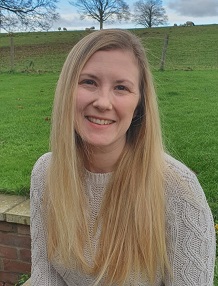
Anna Crossland
Associate Lecturer
Profile
Biography
- BSc (Hons) in Psychology, University of Sheffield, UK, 2001-2004
- MRes in Psychology, University of York, UK, 2017-2018
- MA in Social Research, University of York, UK, 2020-2021
- PhD in Psychology, University of York, UK, 2021-2026
Career
I taught psychology A-level for 12 years in North Yorkshire, before going back to university for postgraduate study. I also co-authored a textbook for A-level psychology and several revision tools. After completing my postgraduate study I became an Associate Lecturer in the Department of Psychology.
Departmental roles
- Student voice lead
- Placements co-ordinator
Prior to become an Associate Lecturer I worked as a Research Associate in 3 different labs, and as an Outreach officer, Graduate Teaching Assistant and Administration Assistant. I have also run sessions and helped to organise outreach events such as Psych! York and University summer schools.
University roles
I have delivered adult learning for the Institute for Lifelong Learning at the University of York, developed and presented courses to sixth form students and run a team of undergraduate students developing support and resources to support potential students.
Research
Overview
Interoception during the perinatal period
Projects
My PhD project focussed on interoception in the perinatal period. Interoception is the awareness and perception of visceral feelings, which may be different in pregnancy. The project focused on understanding these differences between how pregnant and no-pregnant women perceive and interpret their visceral signals. This involved developing and validating a self-report measurement of interoception, and testing whether current measures of interoception are valid during pregnancy. We also tested whether the interoceptive experience during pregnancy has any relationship with body satisfaction and wellbeing in the perinatal period.
Grants
- My PhD was funded by the ESRC on the AQM pathway
Collaborators
- Dr Catherine Preston
- Dr Liz Kirk (Anglia Ruskin University)
Teaching
Undergraduate
- SPID2, L+D2 lectures (maternity cover 2025-26)
- L+D2 Psychology of the Lifespan module 2026 onwards
- GTA sessions with year 1 and 2 students, and summative marking on all UG strands
- Developing and teaching ‘Introduction to Psychology’ and 'Health Psychology' (credited courses) and teaching a short course on mental health, for the Centre for Lifelong Learning.
Postgraduate
-
Clinical Research Methods (Developmental Disorders and Clinical Practice MSc)
-
GTA on the Postgraduate Research Methods (Education)
Other teaching
- A-level psychology (2005-2017)
Publications
Selected publications
Crossland, A. E., Munns, L., Preston, C. E. J. (2025). Analysing the factor structure of the MAIA scale for pregnant women: Development of the MAIA-Preg.
Munns, L., Spark, N., Crossland, A. Preston, C. (2024) Systematic Review on the Effects of Yoga for Postnatal Mental Health and Well-being.
Hansford, K., Crossland, A., Baker, D., Preston, C. E. J., McKenzie, K. (2024). Understanding barriers and facilitators to non-pharmaceutical chronic pain research engagement.
Munns, L. B., Crossland, A. E., McPherson, M., Panagiotopoulou, E., & Preston, C. E. J. (2024). Developing a new measure of retrospective body dissatisfaction: links to postnatal bonding and psychological well-being.
Stafford, L., Munns, L, Crossland, A., Kirk, E and Preston, C. (2024) Bonding with Bump: interoceptive sensibility moderates the relationship between pregnancy body satisfaction and antenatal attachment.
Crossland, A. E., Munns, L., Kirk, E., & Preston, C. E. J. (2023). Comparing body image dissatisfaction between pregnant women and non-pregnant women: a systematic review and meta-analysis.
Crossland, A., Kirk, E., & Preston, C. (2022). Interoceptive sensibility and body satisfaction in pregnant and non-pregnant women with and without children.