
Health Sciences

- Department of Health Sciences
- Research
- Mental Health and Addiction
- Projects
- James Lind Alliance (JLA) Priority Setting Partnership (PSP): Physical and Mental Health in Prisons
James Lind Alliance Priority Setting Partnership: Physical and Mental Health in Prisons

What is a James Lind Alliance project?
The James Lind Alliance (JLA) is a non-profit making initiative, established in 2004. It brings patients, carers and clinicians together in Priority Setting Partnerships (PSPs). These PSPs identify and prioritise the evidence uncertainties, or ‘unanswered questions’, that they agree are the most important for research in their topic area.
Traditionally PSPs have focused on uncertainties about the effects of treatments, but some PSPs have chosen to broaden their scope beyond that. The aim of a PSP is to help ensure that those who fund health research are aware of what really matters to patients, carers and clinicians. We are currently conducting a PSP project relating to Physical and Mental Health in Prisons.
If you have any questions or if you are interested in being involved in the project, please email: jla-prison-health-project@york.ac.uk.
Why are we focusing on Physical and Mental Health in Prisons?
Mental and physical health problems frequently occur at the same time; this is particularly widespread among individuals in secure settings like prisons, surpassing rates seen in the general public and generating substantial challenges for healthcare delivery. Those with treatment-resistant mental illness, personality disorders, or substance misuse problems are especially likely to experience multiple overlapping health issues. Subgroups such as people with intellectual disabilities or neurocognitive disorders also face additional burdens.
Co-occurring common mental (eg, depression and anxiety) and physical disorders (eg, diabetes and obesity) are associated with a higher symptom burden, greater functional impairment, poorer quality of life, increased mortality, slower medication effectiveness, and a higher risk of suicide. Because of these complexities, healthcare needs in secure settings are greater and require comprehensive, integrated strategies.
When co-occurring conditions are not managed effectively, individuals use more health services over time, costs rise, and long-term outcomes worsen. The combined impact of multiple conditions presents ongoing uncertainty for delivery of intervention services.
Current research and practice often fail to address the real-world questions most important to those affected, such as effective integration of mental and physical health care, prevention of social isolation, promoting independence and continuity of support after release.
What are we hoping to achieve?
The aim of the Physical and Mental Health in Prisons PSP is to identify the unanswered questions about common physical and mental health problems which co-occur in prisons. Expertise from lived experience, clinician and professional perspectives will prioritise the most important for research questions to address.
The objectives of the PSP are to:
- work with people with lived experience, clinicians and professionals to identify uncertainties about co-occurring physical and common mental health conditions and the experience of this within prison environments.
- to agree by consensus a prioritised list of those uncertainties, for research
- to publicise the results of the PSP and process
- to take the results to research commissioning bodies to be considered for funding.
What will happen during the project?
We will follow the JLA guidebook for this project. There are seven main parts to a JLA PSP project:
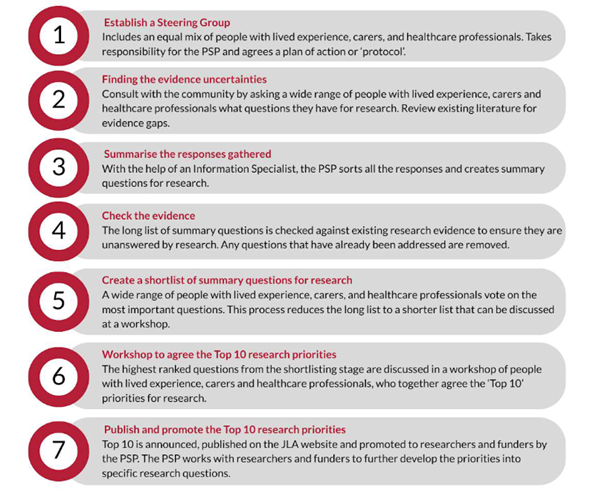
JLA Guidebook, 2025
When will the project take place?
This project started in February 2026 and is expected to finish during Spring 2027.
Community Consultation Survey 1
What is this survey about?
This survey has been developed by researchers at the University of York.
We would like to know what questions you think we should answer for people who have a physical and mental health condition in prison.
Why are we doing this?
People in prison are more likely than people in the community to have both physical and mental health problems.
We are trying to find out what research could help support people with physical and mental health conditions in prison.
Who are we looking for?
We would like to hear from you if:
(A) You have been in prison and had physical and mental health conditions while you were there,
OR
(B) You have a family member or someone you care for who is (or has been) in prison with physical and mental health conditions while in prison,
OR
(C) You work with people in prison who have physical and mental health conditions.
More information
- You can find more details about this survey in the project information sheet (MS Word
 , 321kb).
 - We also have an easy read version (MS Word , 1,254kb) of this information available.