

SOPHIE COULOMBEAU's READING WITH THE BURNEYS WINS 2025 LIBRARY HISTORY ESSAY AWARD
Posted on 5 March 2026
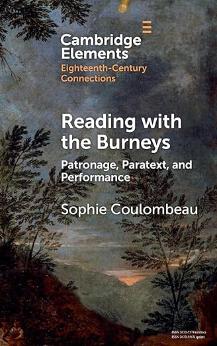
Congratulations to Sophie Coulombeau, whose 2024 Cambridge Element Reading With The Burneys: Patronage, Paratext, and Performance has been named the winner of the 2025 Library History Essay Award, an annual prize funded by CILIP, the Library and Information Association. The judges said: "The Element presents original and new research into the young Charles Burney's interactions with eighteenth-century circulating library culture, notably in Aberdeen (Angus's Circulating Library)." They praised the "outstanding analysis that moves book and reading history forward in interesting ways", remarking that "the approach is novel - truly interdisciplinary... joining [studies of] book history, reading communities, paratext,and the subletting of circulating library books". They added that the author is "an excellent story-teller and literary detective."
The Library History Essay Award is an annual prize for the best article or chapter on library history published in, or pertaining to, the British Isles, within the previous calendar year. Introduced in 1996, the award is organized and sponsored by the Library and Information History Group, one of the oldest special interest groups within CILIP, the Library and Information Association, which aims to support the publication of research into library history in the British Isles. Submissions should contain original historical research and be based on original source materials if possible. Evidence of methodological and historiographical innovation is particularly welcome. The prize is £350.
Reading With The Burneys, which was published in open access format by Cambridge University Press in 2024, offers a multidimensional study of reading practice and sibling rivalry in late eighteenth-century Britain. The case study is the Aberdeen student and disgraced thief Charles Burney's treatment of Evelina (1778), the debut novel of his sister Frances Burney. Coulombeau uses Charles's manuscript poetry, letters, and marginalia, alongside illustrative prints and circulating library archives, to tell the story of how he attempted to control Evelina's reception in an effort to bolster his own socio-literary status. Uniting approaches drawn from literary studies, biography, bibliography, and the history of the book, the Element enriches scholarly understanding of the reception of Frances Burney's fiction, with broader implications for studies of gender, class, kinship and reading in this period. It has been reviewed as "impressive and compelling" (Textual Cultures), "a fascinating micro-history in the print ecology of the long Romanticism" (Women's Writing), and "a case study of reading as a process of transformation...[which]