
Centre for Renaissance and Early Modern Studies

Beyond the Fallen Language: Grammatheologies of John Dee and Thomas Browne
Wednesday 21 October 2026, 1.00PM
Speaker(s): Jakub Wolak, University of Warsaw
In his 1967 Of Grammatology, Jacques Derrida advocates for an investigation of signs and writing as contrasted to language. Derrida emphasizes that writing is not identical with language, which is understood firstly in the context of speaking and spoken word. Noteworthily, when treating of grammatology as positive science, Derrida focuses on the early modern preoccupation with signs: Egyptian hieroglyphs, Chinese characters, cryptography and universal languages. However, his interest in this period is only limited, and he tends to dismiss early modern thinkers as proponents of logocentrism and the metaphysics of presence.
The aim of my paper is to view early modern grammatology from a different angle, namely a theological one, and hence to speak of ‘grammatheology’. My guiding intuition is that the growing fascination with signs had its roots in the perceived divide between language and being or words and things, owed to the heritage of late Mediaeval nominalist metaphysics. Hence, some of the early moderns viewed signs, either those inherited from the ancients (such as hieroglyphs) or those to be invented and perfected in the future (such as cryptographies and universal language) as remedies for the breach between language and being, a breach which some, such as Comenius, interpreted theologically, as resulting from Original Sin and described in the story of the confusion of tongues.
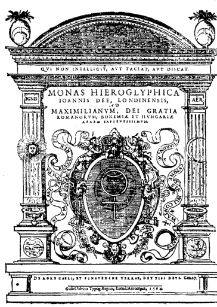
I will devote particular attention to the appropriation of Platonic heritage by the early moderns. Late ancient Neoplatonists such as Plotinus and Jamblichus developed complex philosophical theories of symbols, and their writings wielded considerable influence in the Renaissance, mediated mostly by translations and commentaries of Marsilio Ficino. I will focus on two case studies, that of John Dee’s Monas hieroglyphica (1564) and of Thomas Browne’s Garden of Cyrus (1658): the first being an example of what one may term grammatheological constructivism (and optimism), the other of grammatheological apophaticism (and pessimism). The Monas is marked by a belief that all of the universe can be explained with the use of one potent symbol, the eponymous Monad, uniting geometry, astronomy and alchemy. On the contrary, The Garden’s use of the symbol, that is the omnipresent quincunx, is, as I shall present, deeply ironical and intralingual, testifying to the author’s awareness of the limits of signification.
Book online attendance via Zoom
Please note seminars start 15 minutes after the advertised start time!
JAKUB WOLAK is Assistant Professor at the Institute of Philosophy and Sociology of the Polish Academy of Sciences. His research interests include classical political philosophy and early modern Polish republicanism, as well as Plato and Platonism in the Antiquity and the Renaissance. He has recently published an edition of Jan Dymitr Solikowski’s Facies perturbatae et afflictae Reipublicae (together with Ariadna Masłowska-Nowak and Katarzyna Różycka-Tomaszuk; Warszawa 2025) and a book long essay on the subject (Idea rzeczypospolitej objawiona Janowi Dymitrowi Solikowskiemu na sejmie parczewskim, Warszawa 2025), as well as articles in „Interpretation: A Journal of Political Philosophy”, „Central European Cultures” and other journals. He has translated D.H. Lawrence’s Sketches of Etruscan Places into Polish (Warszawa 2023). He also works as editorial secretary at „Archiwum Historii Filozofii i Myśli Społecznej” („Archive of the History of Philosophy and Social Thought”) and as an editor at „Kronos Philosophical Journal”.
Location: H/G15, Heslington Hall and Zoom
Email: crems-enquiries@york.ac.uk