
Centre for Renaissance and Early Modern Studies

Wild science, Pindaric form and the poetry of everything
Wednesday 7 October 2026, 1.00PM
Speaker(s): Kevin Killeen, University of York
Much of the energy of early modern scientific thought comes from its obsessions with the prolific, both in terms of the encyclopaedic variety of created things, their inexhaustible intricacy, and, then again, with the profligacy of rampant growth spontaneous, irrepressible, verdant here, metallic there, and always more of the world to describe, plunder or love (depending on temperament). And in seeking an appropriate poetic form to render this, the later seventeenth century (re)discovered the Pindaric Ode, as a correspondingly demented form.
Looking at two long quasi-scientific poems, Thomas Heyrick’s The Submarine Voyage (1691) and Mary Chudleigh’s Song of the Three Children, Paraphrased (1703), the paper will address what writings thought that poetry could do that prose could not.
Heyrick’s depressed dolphin-narrator finds himself vertiginous on the sea’s edge, beset by an overwhelming melancholy, as he encounters a kaleidoscopic excess of the aquatic world - the bluest of blue humanities. Chudleigh’s panoptical vision describes a creation physics, at once biblical and Cartesian, its scientific vertigo finding its poetic equivalent in the same Pindaric verse form.
Book online attendance via Zoom
Please note seminars start 15 minutes after the advertised start time!
KEVIN KILLEEN is Professor of English and Related Literature at the University of York. His most recent book, The Unknowable in Early Modern Thought: Natural Philosophy and the Poetics of the Ineffable (Stanford University Press, 2023), is a study of the apophatic and the theopoetics of early modern thought, and considers how science, theology and literature were intermeshed in the era. It was the Winner of the 2024 Roland H. Bainton Book Prize, sponsored by the Sixteenth Century Society & Conference (SCSC), as well as the winner of the John T. Shawcross Prize, awarded by the Milton Society of America.
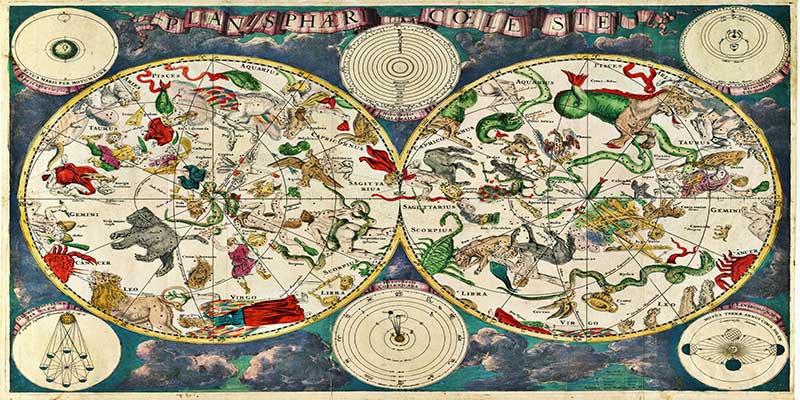
Image: A celestial map from the 17th century, by the Dutch cartographer Frederik de Wit
Location: H/G15, Heslington Hall and Zoom
Email: crems-enquiries@york.ac.uk