
Centre for Renaissance and Early Modern Studies

- Centre for Renaissance and Early Modern Studies
- Seminars and events
- Events Archive
- 2025-2026
- CECS x CREMS "The Ship Commerce: Atlantic and Archival Crossings
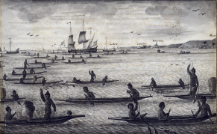
CECS x CREMS "The Ship Commerce: Atlantic and Archival Crossings in the Eighteenth-century Slave Trade"
Wednesday 10 December 2025, 5.00PM to 9pm
Speaker(s): Philippa Hellawell and Liberty Paterson, The National Archives
This seminar is co-hosted with the Centre for Eighteenth Century Studies, and followed by the CREMSMAS party! Drinks and nibbles provided.
This paper considers the histories that can be told by tracing the Atlantic crossings of eighteenth century British slave ships through the collections of The National Archives and beyond. Taking ships listed in Lloyd’s Register as a starting point, with the ship Commerce as an initial example, it shows how disparate records in the Treasury, Admiralty, Board of Trade, Colonial Office, and, on some occasions, the Chancery can be joined up to build a picture of a ship’s passage. By taking the ship as the unit of analysis, we can connect and consolidate archival fragments to add greater dimension to our understanding of the Middle Passage and better connect histories of the trade in enslaved people in West Africa with systems of plantation slavery in the Caribbean.
While the digital resource Slave Voyages has demonstrated the utility of the ‘voyage’ as an important lens to understand the scale of the trafficking of enslaved Africans, tracing ships across oceans and archives can enable us to go beyond a quantitative approach to the trade and instead bring the ship to life through pairing together the various records of state and commerce. Through the ship, we can see the everyday logistics of oceanic travel, shipping industries and slave markets and cast a spotlight on acts of shipboard resistance alongside the methods of enslavers to suppress them. Ultimately, by looking at the passages of a range of ships, this paper will test the limits of the archive, considering both what we can and cannot learn about experiences of enslavement from the archive alone.
Dr. Philippa Hellawell is Head of Collections Research and a specialist in pre-modern maritime and colonial records at The National Archives. Previously the Eighteenth Century Records Specialist, she has spent the last few years researching the records of the Royal African Company and its successor, the Company of Merchants Trading to Africa. She is currently the Project Lead for PASSAGE (Partnership for Atlantic Slavery Scholarship, Archiving, and Global Exchange) – funded by the Lloyd’s Register Foundation - which combines a programme of archival research on eighteenth-century slave ships with an international research mobility programme that supports the research of scholars from West Africa and the Caribbean. Prior to her appointment at The National Archives, she worked as a Teaching Fellow at the University of York and King’s College London and held research fellowships at Royal Museums Greenwich, The Huntington, and the Lewis Walpole Library.
Dr. Liberty Paterson is a Collections Researcher for PASSAGE at The National Archives. She completed her PhD at Birkbeck, University of London, which was an AHRC-funded partnership project with the National Portrait Gallery, London (NPG). The study aims to both remember the impact of wealth derived from the enslavement of African people on the development of the NPG (1856-1906), and understand the role of art in specific processes of forgetting related to the history of slavery that occurred at the Gallery. Liberty co-curated Slavery & the Bank (2022–24) at the Bank of England Museum and curated collection galleries for the 2023 redisplay of the NPG. Prior to her PhD, she spent a decade working in museums and the art market.
Location: Yarbrugh Romm, HG/15 & Zoom
Email: crems-enquiries@york.ac.uk