
Department of Biology

Sharps
Sharps Safety Policy
Sharps Safety Policy / References
Sharps Safety Policy
Purpose
This policy states the minimum requirements for the safe use, handling and disposal of sharps within the Department of Biology. Its purpose is to minimise the risk of injury and exposure to hazardous substances, chemical / biological due to sharps tools and glassware, by promoting safe working practices, appropriate training and effective incident reporting.
Scope
This policy applies to all staff, postgraduate and undergraduate students, visiting researchers, contractors and any other authorised persons who use or may be exposed to sharps while undertaking activities in laboratories, workshops or other departmental facilities.
For the purposes of this policy, sharps include, but are not limited to needles and syringes, suture needles / kits, scalpels, razor blades, glass pipettes, capillary tubes, broken glassware, slides, coverslips, and any other object capable of causing a penetrating, cutting injury, self-inoculation. This policy also applies to animal and insect bites or scratches where skin injury has occurred
Policy Statement
The Department of Biology is committed to preventing sharps injuries by eliminating or reducing the use of sharps wherever reasonably practicable.
Where the use of sharps cannot be avoided, work must be supported by suitable risk assessment and appropriate control measures.
All users of sharps must receive appropriate instruction, training and supervision before undertaking work.
Sharps must be handled safely, disposed of correctly.
All incidents and near misses reported promptly in accordance with University procedures (SOLAR reporting).
References
Departmental Risk Assessment Procedures.
Control of Substances Hazardous to Health Regulations 2002.
Health and Safety (Sharp Instruments in Healthcare) Regulations 2013.
HSE Sharps
The Animals (Scientific Procedures) Act, 1986 (as amended)
Updated 15 July 2026
Controls
Prevention and Control of Sharps Injuries
Most sharps injuries can be prevented through good laboratory practice, appropriate training, supervision and effective risk assessment. Most sharps injuries result from human error, including lapses in concentration, poor planning or unsafe working practices.
Work with sharps must be simple and methodical, focusing on the single task involving the sharp. Multi-tasking or trying to handle multiple items at once must be absolutely avoided.
Work with sharps must be well planned and timed to minimise the potential for distractions.
Workstations must be well-organised with minimal clutter or obstacles to prevent loss of control of the sharp. Workstations must have an easy to reach Sharps Bin.
Users must follow their training, risk assessments and SOPS.
Users must give due time and respect to the task, appreciating the increased personal risk and the consequences of a small lapse in concentration.
Users must maintain constant self-awareness of where their hands and fingers are in relation to the sharp, keeping a safe separation distance at all times.
Disposal
Disposal of Sharps in a Sharps Bin
Sharps bins are movable and must be positioned as close as practicable to the point of use.
Do not overfill sharps bins (Use up to the fill line). Never dispose of sharps in general laboratory waste.
Needles, blades, scalpels etc can be disposed of immediately, point-down, into an approved Yellow Sharps Bin.
Contaminated glassware can go into a Yellow Sharps Bin.
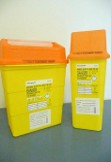
Uncontaminated broken glassware can be placed in the Red Broken Glassware Bin.
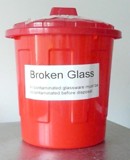
Training
Training should include:
Safe sharp handling techniques
Sharp disposal procedures
First aid arrangements, Occupational Health & Accident reporting
Relevant risk assessments and standard operating procedures
Relevant user training and competency assessment for regulated procedures under the Animals (Scientific Procedures) Act (ASPA).
Refresher training should be provided where procedures change or additional training needs are identified, such as annual refresher for sharps handling.
Needles/Sharps/Glassware
Needles/Sharps/Glassware
Needles
Consider safety engineered, blunt or needlefree systems where reasonably practicable. Use needles only where there is no suitable alternative.
Never leave used needles unattended. Never recap unsheathed needles. Never remove the needle from a used syringe. Transport sheathed unused needles and syringes in an appropriate sealed container.
Dispose of needles immediately, point-down, into a Sharps Bin, do not reuse needles.
Handle needles as little as possible and always keep the point directed away from yourself and your assistants.
Sharps eg. needles, suture kits, scalpels, glass slides used in the BSF
The BSF team provides training and competency records for all procedures requiring sharps, in accordance with the requirements in the Animals (Scientific Procedures) Act, 1986, as amended (ASPA).
Sharp use during regulated procedures must comply with the relevant Project Licence (PPL) and Personal Licence (PIL) authorisations.
Follow an approved risk assessment and SOP / Study Plan.
Agree responsibilities before beginning work where assistance (from the BSF team or other colleague) is required.
Do not start a procedure if you have not been trained or do not feel confident in your abilities in the task. Refresher training and supervision are always available via the BSF team if you feel your competence has lapsed.
Minimise interruptions during procedures / tasks. Take regular breaks. Assess fatigue levels regularly throughout all procedures.
Ensure you (and your assistants) are ergonomically safe. Ensure the workspace and procedure rooms are cleared of clutter.
Ensure live animals are appropriately restrained or anaesthetised. Even if sedated or culled, ensure the animal is securely positioned on a non-slip surface to prevent “slipping” of the sharp.
Ensure the sharp is never directed towards yourself or your assistants.
Glassware
Use plastic alternatives where practicable.
Use suitable hand protection eg. cut resistant gloves when cleaning up broken glass.
Use suitable containers to transport glassware.
Avoid excessive force when handling glass. Take particular care and where practicable use cut resistant gloves, when removing tape, bungs, corks from glassware.
Remove damaged glassware from service immediately.
Scalpels and Other Blades
Avoid using scalpels / razors where safer alternatives exist, such as scissors.
Use the correct tool for the task. Pin the material that is being cut. Use tweezers to prevent injuries.
Use disposable scalpels where practicable. Do not remove the blade. Dispose the scalpel into the sharps bin.
If there is an issue with a disposable sharp tool, do not attempt to repair it by hand. Simply dispose of the tool directly into a sharps bin and restart work with a new one.
First Aid / Near Misses
First Aid / Reporting Near Misses
First Aid Procedure
Following a sharps injury (this includes when bitten/scratched by an animal):
Wash the wound immediately with soap and running water.
Get help ideally from a first aider. Call campus safety, 111 or 999 if serious or the bleeding will not stop.
Encourage gentle bleeding of puncture wounds where appropriate. Do not suck the wound.
Use a sterile swab and apply a waterproof dressing.
Attend A&E if urgent assessment is required.
Reporting of Near Misses / Incidents
Inform your line manager / facilities manager.
Complete the University accident report (SOLAR reporting).
Inform the DSA (Ext. 8524) and Occupational Health Advisor (Ext. 2026 or 2020) if contaminated with chemical / biological agents.
Animal bites and scratches are a primary route of exposure to Laboratory Animal Allergens (LAA). All bites/scratches must be reported and, if necessary, tracked by Occupational Health Advisor for hypersensitivity monitoring.