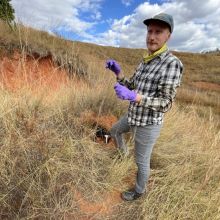
Dr Henry Fell
Postdoctoral Research Associate (Ecological Modelling)
Visit Dr Henry Fell's profile on the York Research Database to:
- See a full list of publications
- Browse activities and projects
- Explore connections, collaborators, related work and more

Profile
Biography
Henry Fell is a disease ecologist with a primary interest in varied means of modelling complex zoonotic disease systems in both a historical and contemporary context.
Henry is currently a member of the RATTUS project at UoY, with a focus on constructing population models of rat populations across Europe over the past 2500 years. Further to model construction he is also working on visualisation methods across the diverse data types included in the project.
He is also a postdoc on a University of Nottingham project, entitled “Soil survival and re-emergence: the continued threat of plague”, which is focused on the prevalence of plague transmission in the highlands of Madagascar.
Career
2022 – Ongoing: Postdoctoral Researcher – NERC (4 Year) - Soil survival and re-emergence: the continued threat of plague. Working in an interdisciplinary team focusing on the re-emergence transmission and distribution of plague (Yersinia pestis) in Madagascar. My work specifically focuses on a broad range of ecological modelling methods with multiple seasons of data collection for field validation.
2017 – 2022: PhD Geography: The University of Nottingham. Thesis Title: Testing the climatic controls on plague (Yersinia pestis) using palaeobiogeographical modelling and experimental microbiology
2016 – 2017: MSc (By Research) Geology: Durham University
2013 – 2016: BSc Geology, Durham University
Research
Overview
Henry Fell is a postdoctoral researcher on the RATTUS project at the University of York, developing mechanistic models and analytical tools to examine rat population dynamics and their implications for historical disease risk. His research focuses on how climate, resources, and demography structure host–pathogen systems, with particular emphasis on plague (Yersinia pestis). Methodologically, his work spans ecological niche theory, ordinary differential equation (ODE) population models, and long-term historical reconstructions and hindcasting. A further strand critically interrogates bias, uncertainty, and colonial legacies in historical disease and environmental data.
Projects
- RATTUS (University of York): Development of ODE-based population models of rat dynamics across Europe over the past ~2,000 years, integrating climate and resource variability, alongside the design of interactive visualisation tools (primarily Shiny applications) to support interdisciplinary hypothesis testing.
- Soil survival and re-emergence: the continued threat of plague (NERC; University of Nottingham): Investigation of environmental persistence and transmission pathways of Y. pestis in Madagascar, combining ecological modelling with field-validated data within an international research programme.
- British Academy Small Research Grant – “Forecasting in the past”: Collaborative research on historical climate–disease relationships, with emphasis on uncertainty, bias, and interpretation in long-term disease reconstructions.
Research group(s)
Henry Fell works within the RATTUS consortium, collaborating with ecologists, archaeologists, historians, and data scientists on mechanistic modelling and research infrastructure. He is also part of the Nottingham-led NERC plague programme, contributing to an interdisciplinary network spanning ecology, microbiology, epidemiology, and public health. Through a British Academy collaboration, he engages with historians and climate scientists to integrate quantitative models with critical historical analysis.
Grants
- Postdoctoral researcher on the £1.4 M NERC-funded project Soil survival and re-emergence: the continued threat of plague.
- Collaborator / Co-Investigator on a British Academy Small Research Grant (historic climate–disease modelling).
- Collaborator on an International Science Partnering Fund (ODA) project on plague transmission in Madagascar.
- Recipient of a University of Nottingham PhD studentship.
External activities
Memberships
- British Ecological Society Membership
Media coverage
- Scientific American: How an Overlooked Eruption May Have Sparked the Black Death
- NBC News: A volcanic eruption may have catalyzed the plague's arrival in Europe, study suggests