
Migration Network

- Research Centre for Social Sciences
- Research and impact
- Migration Network
- News
- 2026
- Bringing York Together for Refugee Week: A Celebration of Courage, Community, and Solidarity
Bringing York Together for Refugee Week: A Celebration of Courage, Community and Solidarity
Posted on 28 July 2026
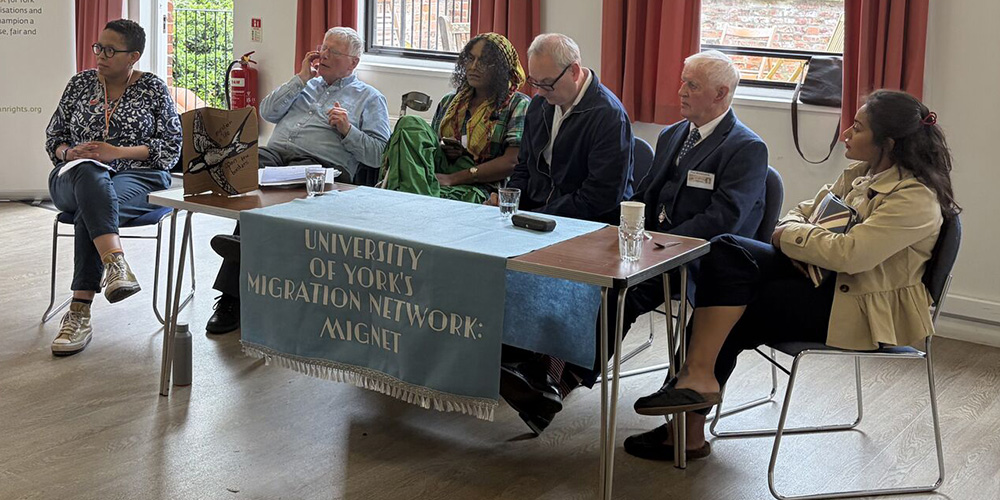
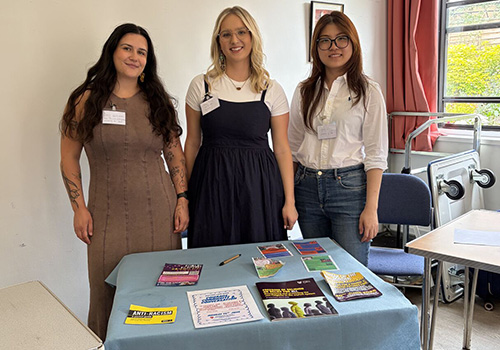
The aim of the fair was simple: to create a welcoming space where organisations could share their work, strengthen relationships with one another, and engage members of the public with the incredible support, advocacy, and community-building taking place in York. It was wonderful to see so many people come together in the spirit of Refugee Week and to welcome civic representatives, including the Lord Mayor, Sheriff, and Sheriff’s Consort.
The fair was attended by a fantastic range of organisations, including City of Sanctuary, Refugee Action York (RAY), Migrant English Support Hub (MESH), City of York Council, including its Family Information Service, York CVS, Time To Be Out, York Human Rights City, York Anti-Raids Group, the Refugee Council, Humanists UK, York Mosque, York Interfaith Group, Friends of the Earth, and Restore York (a Christian housing and support charity).
Together, these organisations reflected the wide-ranging network of support, solidarity, and community action that exists across the city. While some work directly with refugees, people seeking asylum, and migrant communities by providing practical assistance, advice, and specialist services, others contribute indirectly by fostering inclusion, challenging exclusion and discrimination, creating spaces for community and belonging, and building a more welcoming city for all.
In the afternoon, we held a panel discussion centred on this year’s Refugee Week theme, ‘courage’ and explored the many forms of courage demonstrated by refugees, people seeking asylum, and those who stand alongside them. The discussion reflected on the courage required to navigate the asylum process, endure legal scrutiny and cross-examination, maintain hope during prolonged periods of uncertainty and family separation, rebuild lives after experiences of violence and persecution, and speak out against injustice and growing hostility towards migrant communities.
The conversation also recognised that many of the difficulties experienced by people seeking asylum are not inevitable, but are produced and maintained through political and structural decisions. This led to important reflections on York’s status as a City of Sanctuary, an important commitment that must be continuously enacted through meaningful action, accountability, and a willingness to challenge exclusion and inequality.
We continued conversation on the current political context for refugees during Wednesday’s webinar “The most sweeping asylum reforms in modern times?”: Analysing and organising against Labour’s anti-immigration agenda”, organised in partnership with the University of Sheffield. Practitioners, activists and academics, we took stock of what Mahmood described as an “entirely new asylum model for this country”, including making refugee status temporary. The first panel with Martin Lemberg-Pedersen (University of Southern Denmark) and Zoe Bantleman (barrister, former Legal Director of the Immigration Law Practitioners’ Association (ILPA)) discussed Labour’s policy changes and political agenda. It asked whether the reforms are as ‘new’ as claimed or reflect long-standing patterns in UK border policies, situated the reforms in an international context, including the much criticised 'Danish model', and assessed the political and legal implications.
The second panel with Fizza Qureshi (Migrants Rights Network), Melina Mo Martinez (Sheffield City of Sanctuary), Louise Calvey (Asylum Matters) and Eiri Ohtani (Right to Remain), centred community, activist and front-line responses to Labour’s asylum reforms. It reflected on how the policy reforms have been received by asylum and refugee communities, including instilling fear and insecurity, how it affects support services and solidarity practices in a context of criminalisation, underfunding and activist burnout, and how communities can organise against the reforms.
If you have missed the event, you can view the presentation slides here:
- Right to Remain: Solidarity is a verb
- Asylum in the UK and the hostile environment: The fight for a more human and dignified system
- Analysing Labour’s anti-immigration agenda
Lastly, Inspired by this year’s Refugee Week theme of “Courage”, the University of York Migration Network organised a film evening in collaboration with the York Museums Trust in the beautiful surroundings of the Yorkshire Museum on Thursday 18th June. The programme included two documentaries--Escaping Libya's Detention Industry (May 2025) and Armed with Words: Interpreting the War in Afghanistan (2022) and the docudrama No Release (September 2025).
We were fortunate to have Sara de Jong introduce her short film by video link from Finland, which gave the audience a very strong sense of the powerful touring exhibition “We Are Here, Because You Were There: Afghan Interpreters in the UK”, which she created with the photographer Andy Barnham along with some of the voices of her Afghan interpreter interviewees.
Farah Abou El Sel, a former Protective Fellowship holder at the Centre for Applied Human Rights at the University of York introduced her film on Libya’s detention industry by video link all the way from Sydney, Australia.
Simon Parker introduced our MigNet colleague Monish Bhatia’s docudrama ‘No Release’, which dramatically reconstructs the lives of two asylum seekers who on release from prison are confronted with a new form of punishment: constant surveillance through GPS ankle monitors imposed by the UK immigration system. A lively question and answer session followed the film screenings and former Lord Mayor of York, Dave Taylor, commented that while “challenging and gut-wrenching at times, the York Refugee Week Film event at Tempest Anderson Hall was highly educational.”
If you have missed the event, you can still watch the films online:
- We Are Here, Because You Were There: Afghan Interpreters in the UK
- No Release
- Escaping Libya's Detention Industry
Thank you to everyone who attended, contributed, and helped make the event such a success. Refugee Week may last only one week, but the work of creating inclusive communities and standing in solidarity with refugees and people seeking asylum continues every day.