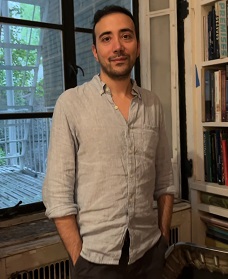
Erhan Tamur
Lecturer in Art Curating
Deputy Head of Admissions
Visit Erhan Tamur's profile on the York Research Database to:
- See a full list of publications
- Browse activities and projects
- Explore connections, collaborators, related work and more

Profile
Biography
BA, Boğaziçi University; MA, Freie Universität Berlin; MA, MPhil, PhD, Columbia University
I am an art historian and curator specializing in the arts of Ancient Western Asia, particularly Mesopotamian and Anatolian art from the third to the first millennium BCE. Before joining the Department in January 2024, I took part in the renovation and reimagining of the permanent galleries of the Department of Ancient West Asian Art at the Metropolitan Museum of Art in New York. Between 2018–2022, I was employed at The Morgan Library and Museum in New York, where I co-curated the international loan exhibition “She Who Wrote: Enheduanna and Women of Mesopotamia (3400-2000 BCE).”
My first monograph, The Discovery That Never Was, is forthcoming with the University of Chicago Press. My work has also been published in Res: Anthropology and Aesthetics, Muqarnas: An Annual on the Visual Cultures of the Islamic World, Sculpture Journal, Forum Kritische Archäologie, and The Journal of the Ottoman and Turkish Studies Foundation, and supported by grants and fellowships from the Center for Advanced Study in the Visual Arts (CASVA) of the National Gallery of Art in Washington D.C., The Mellon Foundation, The Sakıp Sabancı Center for Turkish Studies, the German Academic Exchange Service (DAAD), and The Academic Research Institute in Iraq (TARII).
Research
Overview
Overview
- Ancient Mesopotamian and Anatolian art (particularly Sumerian art, Neo-Assyrian art and architecture, Hittite art, and Syro-Anatolian art in the Iron Age)
- Museum studies & the theory and practice of decolonization
- Archaeology and histories of colonialism
- Art historical and archaeological theory; continental philosophy; time and temporality
- The Ottoman Imperial Museum
Projects
My research is located at the intersection of the arts of West Asia (predominantly Iraq, Syria, Turkey, and Egypt) and the politics of art history, archaeology and museology. My first monograph, The Discovery That Never Was: Art, Politics and Time in Tello (Ancient Girsu) (University of Chicago Press, forthcoming), integrates decolonial and critical perspectives into the study of ancient West Asian art. Taking the site of Tello in Iraq as a case study and challenging the prevailing view that Tello and the Sumerians were “discovered” in 1877 by a French diplomat in an assumed terra incognita, I incorporate numerous systematically neglected sources from the last five thousand years—from Sumerian inscriptions to Hellenistic material, and from Medieval Arabic texts to the nineteenth-century Ottoman archives. In short, I argue that the enlistment of the putatively self-evident notion of “discovery” has served to gloss over millennia-long histories of local engagement with Tello.
My work has also aimed to question and recalibrate art historical theories and methodologies that are often taken to be neutral and universal. For example, in refuting the empirical basis for ethnic classifications of Syro-Anatolian orthostat reliefs (c. 1200–700 BCE), I redefined the concepts of “style” and “ethnicity,” and constructed an alternative categorization deriving from a re-evaluation of both ancient contexts and modern disciplinary histories. In addition, the colonial legacies of the discipline have been a major area of research in my recent publications, with a focus on networks of forging, looting, and smuggling antiquities. I have also worked on the longstanding impact of the concepts of immanence and stylistic influence in the field of art history (especially in the works of Meyer Schapiro and Hans Sedlmayr).
I am currently undertaking several writing projects. The first is on art, memory, and antiquarianism in ancient Mesopotamia, while the second is a book-length study tentatively titled The Merchant of Cyprus: Luigi Palma di Cesnola vs. The Ottoman Government (1865–1876). The third is a history of the Ottoman Imperial Museum through a critical reading of both western and local textual and visual sources.
Since 2018, I have been active in the museum field and worked on the permanent collections of Ancient West Asian art at the Metropolitan Museum of Art and the Morgan Library and Museum in New York. At the latter institution, I co-curated with Sidney Babcock an international loan exhibition titled She Who Wrote: Enheduanna and Women of Mesopotamia, 3400-2000 BC (14 October 2022–19 February 2023).
In terms of fieldwork, I have attended archaeological excavations in Turkey, and been part of the international team for the Mapping Mesopotamian Monuments Project sponsored by Columbia University and directed by Professor Zainab Bahrani. This is an on-site documentation effort in Iraq and Turkey which seeks to counter the looting and destruction of the past, and the related dissociation of people from their diverse cultural histories.
Past Research Projects
- Co-curator, She Who Wrote: Enheduanna and Women of Mesopotamia, 2022–Feb. 2023, The Morgan Library & Museum, New York.
- Archaeologist and Researcher, Mapping Mesopotamian Monuments Project sponsored by Columbia University Presidential Global Initiative and directed by Professor Zainab Bahrani.
- Researcher, “The Parallel Heritages: The Sorbonne and Columbia Collections of Antiquities,” 2019–20.
- Assistant Trench Supervisor, Tarsus/Gözlükule Archaeological Excavations (2009, 2010).
- Researcher, “Halet Çambel–Nail V. Çakırhan Residence in Arnavutköy: Historical and Socio-Cultural Study of an Ottoman Seaside Mansion of the Early Nineteenth Century,” Boğaziçi University, 2008–2009.
Research group(s)
In terms of fieldwork, I have attended archaeological excavations in Turkey, and been part of the international team for the Mapping Mesopotamian Monuments Project sponsored by Columbia University and directed by Professor Zainab Bahrani. This is an on-site documentation effort in Iraq and Turkey which seeks to counter the looting and destruction of the past, and the related dissociation of people from their diverse cultural histories.
Supervision
Supervision
Dr Tamur welcomes enquiries from potential doctoral candidates wishing to undertake advanced research in the fields of Ancient Western Asian art and museum studies.
Publications
Full publications list
Books
- She Who Wrote: Enheduanna and Women of Mesopotamia. New York: The Morgan Library & Museum, 2022 (with Sidney Babcock).
- [Forthcoming] The Discovery That Never Was: Art, Politics and Time in Tello (Ancient Girsu). Chicago: University of Chicago Press.
Reviews:
The New York Times, “In Search of Enheduanna, the Woman Who was History’s First Named Author” (9 Nov 2022); The New Yorker, “The Struggle to Unearth the World’s First Author” (19 Nov 2022); The Wall Street Journal, “Ancient Civilization in the First Person” (24 Nov 2022); Art in America, “Ancient Feminine Power” (19 Dec 2022); Near Eastern Archaeology 85, no. 4 (Dec 2022): 306–308; The New York Review of Books, “Enheduanna’s Brutal Muse” (16 Feb 2023); American Journal of Archaeology 128, no. 2 (April 2024): 279–86.
Peer-Reviewed Journal Articles
- [Forthcoming] - “‘All significant and worthy of preserving:’ Constructing Ancient Mesopotamia in the Ottoman Imperial Museum.” Accepted for publication in Muqarnas: An Annual on the Visual Cultures of the Islamic World 42 (2025)
- [Forthcoming] - “The Demise of the Asiatic Lion: A Tale of Travel, Archaeology, and Colonialism,” ARAM Periodical 26 (2024).
- “The ‘Discoverer’ and the ‘Informant,’” Forum Kritische Archäologie 12 (2023): 134–139.
- “Specters of Influence: Meyer Schapiro and the New Vienna School,” RES: Anthropology and Aesthetics, vol. 75-76 (2021): 207–20.
- “Of Consuls and Steamers: Material Foundations of Colonial Archaeology in Late Ottoman Iraq,” Journal of the Ottoman and Turkish Studies Association, vol. 8, no. 1 (2021): 369–76.
- “Style, Ethnicity, and the Archaeology of the Aramaeans: The Problem of Ethnic Markers in the Art of the Syro-Anatolian Region in the Iron Age,” Forum Kritische Archäologie 6, no. 1 (2017): 1–72.
Peer-Reviewed Book Contributions and Catalogue Essays
- [Forthcoming] “Gentleman Smugglers: Towards a New History of Ancient West Asian Archaeology.” Accepted for publication in the Sculpture Journal.
- [Forthcoming] “‘All significant and worthy of preserving:’ Constructing Ancient Mesopotamia in the Ottoman Imperial Museum.” Accepted for publication in Muqarnas: An Annual on the Visual Cultures of the Islamic World
- [Forthcoming] “The Demise of the Asiatic Lion: A Tale of Travel, Archaeology, and Colonialism.” Accepted for publication in ARAM Periodical
- “All for a Silver Vase? Osman Hamdi Bey’s Indignant Resignation Letter from the Ottoman Imperial Museum,” Keshif: E-Journal for Ottoman-Turkish Micro Editions 3, no. 3 (2025): 78–88.
- “The ‘Discoverer’ and the ‘Informant,’” Forum Kritische Archäologie 12 (2023): 134–139.
- “Specters of Influence: Meyer Schapiro and the New Vienna School,” RES: Anthropology and Aesthetics, vol. 75-76 (2021): 207–20.
- “Of Consuls and Steamers: Material Foundations of Colonial Archaeology in Late Ottoman Iraq,” Journal of the Ottoman and Turkish Studies Association, vol. 8, no. 1 (2021): 369–76.
- “Style, Ethnicity, and the Archaeology of the Aramaeans: The Problem of Ethnic Markers in the Art of the Syro-Anatolian Region in the Iron Age,” Forum Kritische Archäologie 6, no. 1 (2017): 1–72.
Editor-Reviewed Articles
- “In Defense of ‘Incremental Change.’” Forum Kritische Archäologie 12 (2023): 66–68.
- “Goddesses, Mothers, and Rulers.” Expedition 64, no. 2 (2022): 34–43.
- “New Impressions and Future Directions: Columbia University’s Collection of Ancient Western Asian Seals.” EuropeNow 41 (2021) (with Majdolene Dajani)
- “Documenting Disappearing History: The Mapping Mesopotamian Monuments Project,” Mar Shiprim, online publication of The International Association for Assyriology (2020) (with Matthew Peebles)
Encyclopedic Entries
- The Mapping Mesopotamian Monuments Project (2018-ongoing): Hasankeyf (3191 words); Diyarbakır City Walls, Gates & Towers (2521 words); The Great Mosque of Diyarbakır (Ulu Cami) (2306 words); Gisgis Rock Relief (1185 words); Eğil Rock Relief (1461 words)
Reviews
- Review of Ian Verstegen, “The New Vienna School of Art History: Fulfilling the Promise of Analytic Holism” (Edinburgh: Edinburgh University Press, 2023),” Journal of Art Historiography 29 (December 2023): 1–12.
- Review of James F. Osborne, “The Syro-Anatolian City-States: An Iron Age Culture (Oxford: Oxford University Press, 2020),” Ancient Near Eastern Studies 59 (2022): 327–330.
Popular Articles (selected)
- Guest on Immaterial, a podcast from The Metropolitan Museum of Art, New York
- “Kings, Dealers, and Librarians: The Story of a Statue of Shulgi,” The Metropolitan Museum of Art, Departmental Dispatch, 2023 (with Anne Dunn-Vaturi)
- “She Who Wrote: Enheduanna and Women of Mesopotamia, ca. 3400–2000 BC (October 15, 2022 through February 19, 2023),” The Morgan Library and Museum, blog post, 2021.
- From “Near East” to “Western Asia:” A Brief History of Archaeology and Colonialism, The Morgan Library and Museum, blog post, 2020.
Teaching
Undergraduate
- The First Cities: Art and Architecture of Ancient Mesopotamia
- Art and Iconoclasm: The Power of Images
- Babylon/Berlin: Ancient Art & Modern Museology
- Curatorial Practice Now
- Group Exhibition Project
- Objects in Focus (Curating)
Postgraduate
- Who Owns Antiquities? The Politics of Museology and Archaeology
- The Past in the Present: Time and Temporality in Ancient Art and the Modern Museum
External activities
Overview
Talks and Conference Presentations
- Invited speaker, “The Colonial Incision: Archives and Indigeneity,” at the workshop titled “Heritage of Colonialism in Archival Research” organised by the Network for Sustainable Archaeological Practices (NetSAP), online, May 14, 2025.
- Panelist on the occasion of the publication of Finding Antiquity, Making the Modern Middle East, ed. Guillemette Crouzet and Eva Miller (Bloomsbury, 2025). University College London, May 13, 2025.
- Convenor of the eight-paper session “Who Owns Antiquities?” at the Association for Art History (AAH) Conference, University of York, April 9–11, 2025.
- Invited speaker, “The ‘Discoverer’ and the ‘Informant,’” University of East Anglia, World Art Research Seminar, February 6, 2025.
- Invited speaker, “The Archaeology of an ‘Uncharted Territory,’” Research Forum, Department of Archaeology, University of York, October 12, 2024.
- “Didactics and Their Discontents: The Tacit Coloniality of Museological and Archaeological Narratives,” Seventeenth International Conference on the Inclusive Museum, MuseumsQuartier, Vienna, online, September 13–15, 2024.
- “The Demise of the Asiatic Lion: A Tale of Travel, Archaeology, and Colonialism,” The Fifty-Fifth International Conference of the ARAM Society for Syro-Mesopotamian Studies: Orientalism and Western Travellers to the Levant, 1500-1950, The University of Oxford, July 8–10, 2024.
- “Colonialism and Archaeological Networks: The Case of Tello (ancient Girsu),” Digging up the Past: Exporting Antiquities in the Ottoman Empire from the Late 19th to the Early 20th Century, Staatliche Museen zu Berlin, June 6–7, 2024.
- Participant, “(Un)learning Europe through a Decolonial Lens: Epistemologies, Theories, Praxes” workshop, Université libre de Bruxelles, Belgium, online, February 29, 2024.
- Guest Lecturer on “Unsettling Hierarchies” for Prof. Adrienn Kácsor’s seminar at Northwestern University, online, February 2, 2024.
- Guest Lecturer, “Mesopotamian Archaeology and Provenance Research,” Staatliche Museen zu Berlin, online, December 12, 2023.
- Panelist, “Decolonizing European Museums,” 29th International Conference of Europeanists, Reykjavik, Iceland, June 27–29, 2023.
- Lecturer, “Enheduanna and Women of Mesopotamia” (in Turkish), The Morgan Library & Museum, online, February 10, 2023.
- Workshop leader, “Ancient Cylinder Seals,” The Morgan Library & Museum, New York, February 2–3, 2023.
- Panelist, “Archaeology, Nation and Race: Confronting the Past, Decolonizing the Future in Greece and Israel,” The American Society of Overseas Research (ASOR) Annual Meeting, Boston, November 16–18, 2022.
- Guest Lecturer on “Teaching and Curating Ancient Art” for Professor Liat Naeh’s seminar “Art in Antiquity,” University of Toronto, online, August 10, 2022.
- “Site-Worlds,” Center for Advanced Study in the Visual Arts (CASVA), National Gallery of Art, Washington D.C., April 7, 2022.
- “From ‘Near East’ to ‘Western Asia:’ A Brief History of Archaeology and Colonialism,” The American Society of Overseas Research (ASOR) Annual Meeting, online, December 12, 2021.
- “Beyond the ‘Great Men’ of Archaeology: Tello and its Local Histories,” The Morgan Library & Museum, online, November 3, 2021.
- “Enheduanna: Authorship and Gender in Ancient Mesopotamia,” Fashion Institute of Technology, New York, October 6, 2021.
- Panelist, “Diskussionsrunde zum Begriff Vorderasiatische Archäologie,” [Panel on the term Near Eastern Archaeology], Freie Universität Berlin, online, February 18, 2021.
- “Of Consuls and Steamers: Material Foundations of Colonial Archaeology in Late Ottoman Iraq,” Voices of Emerging Scholars I: Politics of Archaeology, Columbia Global Centers, online, January 20, 2021.
- “Cylinder and Stamp Seals in the Columbia University Collections I and II” (with Majdolene Dajani), as part of the project Parallel Heritages: Humanities in Action. The Sorbonne and Columbia Collections of Antiquities, Columbia University, March 6, 2019 and the Sorbonne, Paris, 4–5 November 2019.
- “The Third Dimension: The Essential and the Redundant in Assyrian Reliefs,” Graduate Colloquium of the Department of Art History and Archaeology, Columbia University, November 2, 2017.