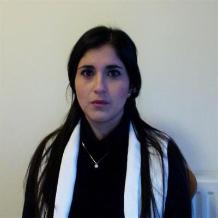
Dr Ana Bilbao Yarto
Senior Lecturer in Modern and Contemporary Art
Visit Dr Ana Bilbao Yarto's profile on the York Research Database to:
- See a full list of publications
- Browse activities and projects
- Explore connections, collaborators, related work and more

Profile
Biography
BA Universidad de las Américas Puebla
MA and PhD University of Essex
Ana is a Senior Lecturer in Modern and Contemporary Art. Her research explores histories of exhibition-making and art institutions, contemporary art from the Global South, and the links between Art, Human and Environmental Rights. She is interested in decolonial thought and extractivism. Prior to joining the University of York, she was editor of Afterall Journal and research fellow at Afterall Research Centre at Central Saint Martins, University of the Arts London.
In 2017, she was Visiting Scholar in the Art History Department at KU Leuven, Belgium. Ana has taught undergraduate and postgraduate modules on the history of exhibition making, curatorial theory and practice, post-impressionism, avant-garde, and contemporary art at the University of Essex. She was a visiting lecturer on the BA and MA in Culture, Criticism and Curation and on the MRes in Exhibition Studies at Central Saint Martins (UAL). Ana has worked in various areas of the cultural sector, including arts education, curating, and art fairs.
Departmental roles
Impact Case Study, Women's Forum representative
Research
Overview
Ana's research is centred on Contemporary Art and Exhibition Histories from the Global South. She is currently working on the intersections of Art, Human, and Environmental Rights through the lens of extractivism and decolonial thought.
She is also interested in the emergence and proliferation of Small Visual Arts Organisations (SVAOs) in various parts of the world from the 1990s to the present. She approaches the transdisciplinary curatorial strategies developed by these small arts spaces as crucial to understanding the broader arts ecology of our time.
More generally speaking, Ana is interested in the history of display from the cabinet of curiosities to the present, and in historical trajectories of modern and contemporary art, particularly Latin America and Southeast Asia.
In 2018, with the support of the British Council Myanmar and Acción Cultural Española, she had the opportunity to undertake research in Yangon, Myanmar (with Anca Rujoiu). She held a research residency in lugar a dudas in Cali, Colombia.
Ana is a co-investigator in the Art Rights Truth (https://artrightstruth.com/) alongside Prof. Paul Gready, co-director of the Centre for Applied Human Rights, and artist and filmmaker Emilie Flower. The Art Rights Truth is a three-year AHRC-funded research project based at the Centre for Applied Human Rights and the Department of History of Art at the University of York. It asks a bold question: Can the arts save human rights?
As the human rights field faces increasing political and cultural pressure, its core values remain vital —but its forms and strategies may need to change. Art Rights Truth argues that collaborations between artists and activists can generate new ways of working, offering powerful alternative languages, images, and practices for engaging with human rights today.
The project has brought together academics, artists, and practitioners from across disciplines. We’ve partnered with leading arts and human rights organisations, like Yorkshire Sculpture Park, Amnesty International and CIVICUS, and commissioned a wide range of collaborative artworks that address human rights issues around the world.
Publications
Selected publications
* Small Visual Arts Organisations in the Global South: Geographies of Display (book under contract with Routledge, forthcoming).
* 'The Current of Change: Carolina Caycedo’s Río Serpiente and the Reimagination of Human Rights.' In Missing Dimensions, Broader Territories, edited by Emilie Flower, Paul Gready, and Brian Phillips, (forthcoming). Palgrave.
* ‘Beyond Legalities: Leonel Vásquez, Immersive Art, and the Embodied Discourse of Human Rights’. In Missing Dimensions, Broader Territories, edited by Emilie Flower, Paul Gready, and Brian Phillips. (forthcoming). Palgrave.
* ‘Is the Road to Hell Paved with Good Intentions?: The Nest Collective’s Return to Sender’. Art Rights Truth. [Blog]. https://artrightstruth.com/blog/blog-post-title-two-7gkn8
• ‘Where Is My Land?: Sand Extraction, Land Reclamation, and Artistic Imagination in Cambodia and Singapore’, Southeast of Now: Directions in Contemporary and Modern Art in Asia, vol 7, issue 1, 2023, pp. 3-30.
• ‘The Museum of European Normality: Colonial Violence, Community Museums, and Practices of Display’, Museum Management and Curatorship, vol 36, issue 6, 2021, pp. 649-668.
• ‘Museo Comunitario del Valle de Xico: A Community’s Trench of Struggle – Genaro Amaro Altamirano in conversation with Ana Bilbao’, Art and its Worlds: Exhibitions, Institutions and Art Becoming Public (Exhibition Histories Series), London: Afterall, 2021, pp. 236-245.
* 'The Closed Exhibition: When Form Needs a Break', Revista da Historia da Arte, 14, 2019, pp.126-143
* “From the Global to the Local (and Back): Curatorial Strategies in Biennials and Small Visual Arts Organisations”, Third Text, vol. 33, issue 2, 2019, pp. 179-194.
* “Mining Colombian Contemporary Art: Histories, Scales and Techniques of Gold Extraction”, Burlington Contemporary, 1, 2019.
* “Micro-Curating: the role of SVAOs (Small Visual Arts Organisations) in the History of Exhibition-Making”, Notebook for Art, Theory and Related Zones, issue 25, 2018, pp. 118-138.
* “Re-Thinking the Social Turn: The Social Function of Art as Functionless and Anti-Social” in Rhetoric, Social Value and the Arts: But How Does it Work (eds. Charlotte Bonham-Carter and Nicola Mann), Palgrave Macmillan: London, 2017, pp. 51-66.
* Bilbao, Ana and Pavel Reichl, “Between Earth and the World: Heidegger on Turrell, Nature and Aesthetic Intelligibility”, kritische berichte, Heft 2, Jahrang 45, 2017, pp. 84-91.
* “SIN (without): The Alienated Spectator,” re-bus 7, 2015, pp.105-112.
Teaching
Undergraduate
UG: Curatorial Practice Now/Art and Its Institutions, Art and Politics: Global Conceptualisms, Journeys, Histories and Methods of Display
Postgraduate
Contemporary Art and Social Justice
External activities
Editorial duties
As editor of Afterall Journal, Ana was interested in the articulation of artistic cross-cultural narratives, as well as in decolonial methodologies in editing, writing and knowledge dissemination.
Issues conceived alongside the journal’s editorial team include:
- Issue 43 ‘Kinship, Communitas, Comunidad’ (with Charles Esche, Anders Kreuger, David Morris and Charles Stankievech)
- Issue 44 ‘Ethno-Aesthetics and Institutions’ (with Charles Esche, Candice Hopkins, Anders Kreuger, David Morris and Charles Stankievech)
- Issue 45 ‘Scenes of Discord: Unlearning History and Healing Wounds’ (with Charles Esche, Anders Kreuger, David Morris, Wanda Nanibush and Charles Stankievech)
- Issue 46 ‘Reconstruction: Performance and Collective Action’ (with Ute Meta Bauer, Charles Esche, Anders Kreuger, David Morris, Anca Rujoiu and Charles Stankievech)
- Issue 47 ‘Situated Practices and Conditioned Positions’ (with Ute Meta Bauer, Charles Esche, Anders Kreuger, David Morris, Anca Rujoiu and Charles Stankievech)
- Issue 48 ‘Looking Back, Looking Forward: 20 Years of Afterall’ (with Ute Meta Bauer, Charles Esche, Anders Kreuger, David Morris, Anca Rujoiu and Charles Stankievech)
- Issue 49 ‘Modes of Experience, Alternative Economies and Extractivism’ (with Bart de Baere, Ute Meta Bauer, Charles Esche, Adeena Mey, David Morris, and Charles Stankievech)