

Professor Glenn Hurst
ASSOCIATE DEAN (INTERNATIONAL) OF THE FACULTY OF SCIENCES
Green Chemistry Education
+44 (0)1904 322842
Email: glenn.hurst@york.ac.uk
Profile
Biography
Professor Glenn Hurst is a Professor of Green Chemistry Education in the Department of Chemistry at the University of York and a leading figure in internationalisation across the Faculty of Sciences. As Associate Dean (International), he plays a central role in shaping the Faculty’s global strategy, strengthening international partnerships, and expanding opportunities for students and staff to engage with global scientific communities. His work focuses on developing sustainable, mutually beneficial collaborations and embedding international perspectives into teaching, research, and student experience.
Professor Hurst joined the University of York in 2014 as an Associate Lecturer after completing an MChem at Durham University and a PhD at Newcastle University. He was promoted to Associate Professor in 2020 and to Professor in 2023.
Alongside his Faculty‑level leadership, he is internationally recognised for advancing systems‑thinking approaches to green chemistry education. His pedagogical research explores how active learning, digital platforms, and real‑world sustainability contexts can transform student engagement and deepen understanding of complex global challenges. His contributions have been widely adopted and celebrated, including recognition through the Royal Society of Chemistry’s Higher Education Teaching Award.
Within the Department of Chemistry, Professor Hurst has held several major leadership roles. He served as Chair of the Board of Studies in Chemistry from 2022 until the completion of his term, guiding programme development, quality assurance, and strategic educational enhancement. He has also chaired the Natural Sciences Teaching Committee and the University Learning and Teaching Forum, championing creativity, interdisciplinarity, and evidence‑informed educational practice across the institution.
Professor Hurst publishes extensively in chemistry education and sustainability, contributes to international discussions on the future of chemistry teaching, and is regularly invited to speak at global conferences. His scholarship spans curriculum design, pedagogical innovation, and public engagement, reflecting his commitment to preparing students to address global sustainability challenges.
Research
Research
Our research embraces a students-as-partners approach to use innovative pedagogical tools and methodologies, conferring a deep understanding of subject matter using holistic systems thinking frameworks. Through this, learners are enabled to visualise the interconnections and relationships among components of complex and dynamic systems together with being able to examine how the system may change over time and how systems-level phenomena emerge from interactions between associated constituents.
By utilising a blend of top-down and bottom-up approaches designed to engage students while providing them with rich contexts, learners can access a more integrated and interdisciplinary understanding. Such approaches have included programme and module design together with facilitating new technology-enhanced learning opportunities through social media and gaming.
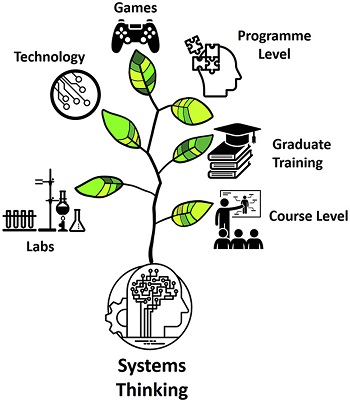
Systems thinking approaches are highly applicable towards addressing the most pressing global challenges such as the United Nations Sustainable Development Goals given the interconnected nature of the goals, requiring interdisciplinary collaboration at an international level and the consideration of entire dynamic systems. Through an integrated systems-level understanding, this can create opportunities to evoke change in accordance with the goals where the impact can be enhanced through demonstrating synergies and potential conflicts between goals as a result of system perturbations.
Systems thinking approaches to education are particularly well suited for integration with green and sustainable chemistry because applying the principles of green chemistry and devising molecular design strategies all depend upon considering the reliance of reactions and processes on one another with local and global systems. Much of our work is focused on employing an overarching systems thinking framework within green and sustainable chemistry education.

For up-to-date publication details please use:
